
The Last Client, Act II – The Dead Woman

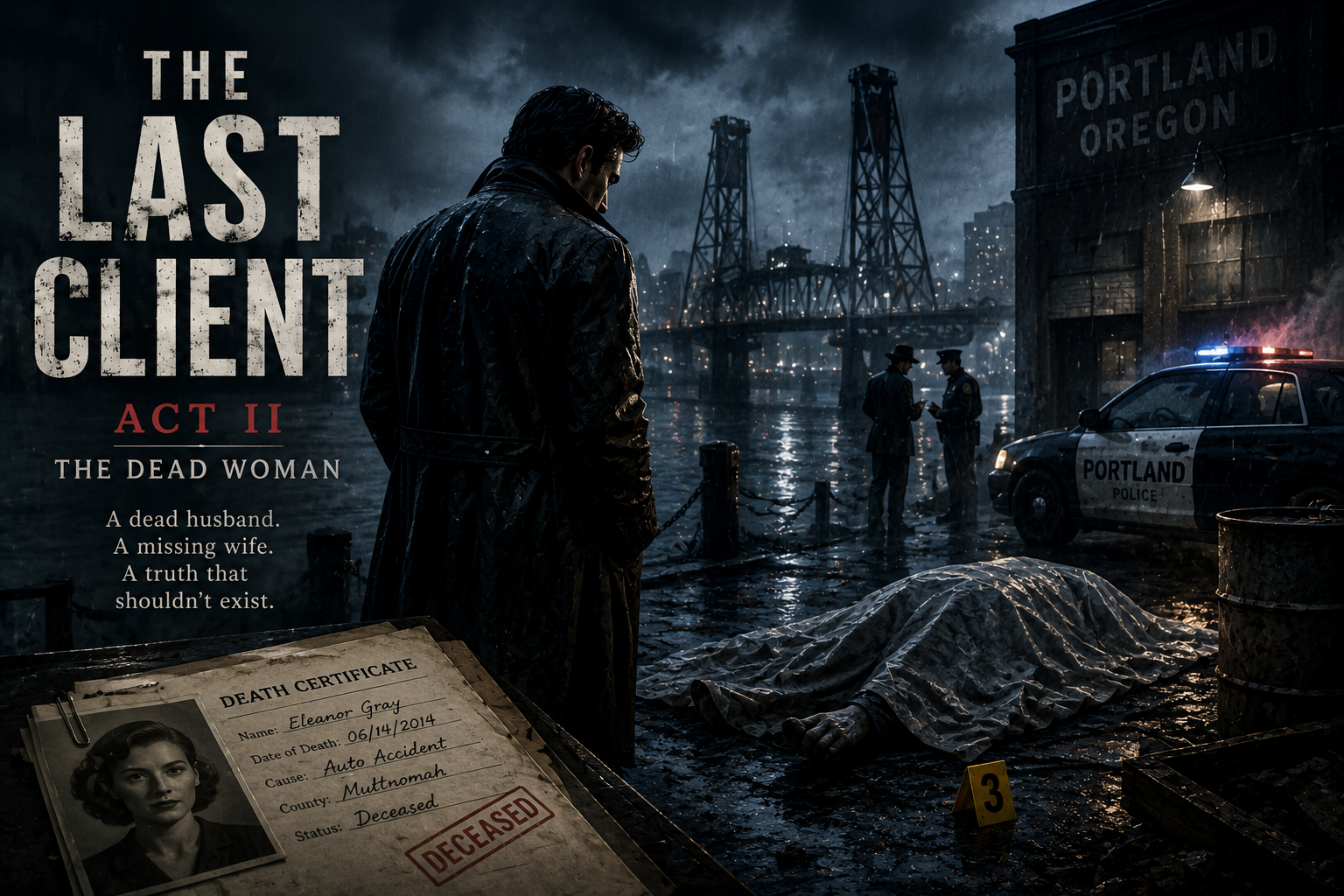
The telephone woke me at six fourteen the next morning.
Nobody calls a private detective at six fourteen in the morning to deliver good news.
I fumbled for the receiver on the nightstand.
“Mercer.”
“Jack?”
The voice belonged to Lieutenant Frank Donnelly.
Portland Police Bureau.
Homicide.
One of the few men left on the force who still spoke to me.
Mostly because he felt sorry for me.
“Frank.”
“You awake?”
“I am now.”
“We found a body.”
I rubbed my eyes.
“Congratulations.”
“It’s your client.”
That got my attention.
I sat up.
“What client?”
“The one you’ve been asking about.”
My apartment suddenly felt much colder.
I hadn’t told Frank about Eleanor Gray.
I hadn’t even started the investigation.
“How do you know who my client is?”
“Because your business card was in his pocket.”
Silence.
Outside, rain tapped against the window.
The familiar Portland soundtrack.
“Where?”
“South waterfront. Near an old warehouse off Macadam.”
“I’ll be there.”
I hung up before he could object.
The body lay beneath a yellow tarp.
Police cars lined the narrow street.
Their flashing lights reflected off puddles and corrugated metal walls.
The Willamette River flowed quietly a block away.
Unimpressed by another human tragedy.
Frank stood beside the medical examiner sipping coffee.
He looked exactly the way every detective looks after too many years.
Tired.
Cynical.
Cold.
“Morning.”
“It was until you called.”
He lifted the tarp.
The dead man stared at the gray sky.
Mid-fifties.
Clean-shaven.
Dark suit.
Expensive shoes.
Single gunshot wound above the left eye.
Professional. Quick. Personal.
I recognized him immediately.
The photograph from Eleanor’s handbag.
Richard Gray.
“Your missing husband?” Frank asked.
“Looks that way.”
“You know him?”
“His wife hired me yesterday.”
Frank raised an eyebrow.
“Hired you to find him?”
“Yes.”
“Guess she doesn’t need the refund.”
I ignored him.
The dead man’s expression was strangely peaceful.
As if whatever had frightened him had finally caught up.
“What do we know?”
Frank shrugged.
“Found by a dock worker around five thirty.”
“No witnesses?”
“No witnesses.”
“No weapon?”
“No weapon.”
“No suspects.”
“Portland’s finest at work.”
“We learned everything from you old-timers.”
I almost smiled.
Almost.
The medical examiner interrupted.
“Time of death approximately between midnight and two.”
Frank looked at me.
“When did you meet the wife?”
“Yesterday evening.”
“Convenient.”
“Are you suggesting she killed him?”
“I’m suggesting spouses are usually near the top of the list.”
That was true.
It was also usually correct.
I looked back at Richard Gray.
A successful investment manager.
Missing for three days.
Dead within hours of somebody hiring a detective.
There was a story there.
I just didn’t know what it was. Yet.
The address Eleanor had written down led me to a small house in Sellwood.
The rain had eased into a mist.
The neighborhood was quiet.
Tree-lined streets.
Old homes.
The kind of place where people owned lawn mowers and worried about property taxes.
The house sat at the end of a narrow block.
White paint. Blue shutters. Empty.
A weathered FOR SALE sign leaned against the porch.
I knocked anyway.
Nobody answered.
I peered through a dusty window.
The rooms were vacant.
No furniture. No curtains. No signs of recent occupation.
The place had clearly been abandoned for months.
I checked the paper again.
Same address.
No mistake.
That bothered me.
It should have bothered me more.
I drove downtown and found a payphone.
The number she had given me rang once.
Then a recording answered.
“The number you have dialed has been disconnected.”
I hung up.
Dialed again.
Same message.
By noon, irritation had replaced curiosity.
By one o’clock, curiosity was becoming concern.
By two, I was sitting inside the Multnomah County Records Office.
A clerk with thick glasses examined my note.
“You sure this is the name?”
“Eleanor Gray.”
She typed.
The keyboard clattered.
Rows of filing cabinets stretched behind her.
“Nothing.”
“Try Gray, Eleanor.”
She did.
Still nothing.
“No driver’s license.”
“No property ownership.”
“No business registration.”
“No marriage license.”
That wasn’t impossible.
But it wasn’t normal.
Everybody leaves footprints.
Taxes. Bills. Addresses. Parking tickets. Something.
Nobody simply exists for fifty years without appearing in a database.
“Try Richard Gray.”
That produced results.
Plenty of them.
Property ownership.
Tax records.
Business filings.
Voter registration.
A perfectly ordinary life.
The kind bureaucrats adore.
“What about spouse information?”
The clerk frowned.
“Current spouse listed as Margaret Gray.”
“Margaret?”
“That’s what it says.”
I felt a knot tighten somewhere in my stomach.
“Not Eleanor?”
“No.”
She turned the screen toward me.
There it was.
Margaret Gray.
Married fourteen years.
Current legal spouse.
I thanked her and left.
Outside, the rain had returned.
Harder now.
Wind pushed sheets of water across the streets.
People hurried beneath umbrellas.
Cars hissed through puddles.
Portland looked exactly the way it should.
Gray. Wet. Secretive.
I found a coffee shop and sat by the window.
Something wasn’t right.
Richard Gray existed.
The dead body proved that.
But Eleanor Gray was unraveling.
Wrong address.
Disconnected number.
No records.
No marriage.
No trace.
The entire woman seemed to be dissolving beneath scrutiny.
I took out the photograph she’d given me.
Richard stood beside the sailboat smiling confidently at the camera.
On the back was a handwritten date.
August 14.
No year.
No location.
Just a date.
For the first time, I noticed something else.
The photograph was old.
Not ancient.
But old enough.
The edges had yellowed.
The surface showed wear.
At least ten years.
Maybe more.
Why would a wife carry an outdated photograph of her husband?
I stared out the window.
Rain flowed down the glass.
People became shadows.
Shadows became ghosts.
A thought occurred to me.
One simple possibility.
Maybe Eleanor Gray had never been Richard Gray’s wife.
Maybe she’d lied from the beginning.
The idea made sense.
Until I reached the County Archives three hours later.
That was where the real trouble began.
The archivist was a thin woman who smelled faintly of dust and old paper.
She listened patiently as I explained what I needed.
Then she disappeared into the stacks.
When she returned, she carried a file.
“Found her.”
I felt a flash of relief.
Finally.
A lead.
The archivist opened the folder.
Inside was a death certificate.
My eyes moved across the page.
Name.
Date of birth.
Address.
Everything ordinary.
Until I reached the date of death.
Ten years ago.
Car accident on Highway 26.
Fatal injuries.
Case closed.
I read it twice.
Then a third time.
The archivist studied me.
“You knew her?”
“No.”
My voice sounded distant.
“At least I don’t think I did.”
Because less than twenty-four hours earlier, Eleanor Gray had been sitting across from me in my office.
I’d heard her voice.
Shaken her hand.
Taken her money.
Watched her disappear into the rain.
And according to the official records of Multnomah County, she’d been dead for a decade.
For a long moment I simply stared at the death certificate.
Outside, thunder rolled somewhere over the city.
The archivist said something.
I didn’t hear it.
Because a new possibility had entered the room.
One that was impossible.
And yet somehow felt more believable than any explanation I’d found all day.
Richard Gray was dead.
But Eleanor Gray wasn’t.
The woman who hired me existed.
I knew she existed.
The question was no longer who killed Richard Gray.
The question was:
Who exactly had walked into my office last night?
Read other posts in this series:
- The Last Client, Act I
- The Last Client, Act II
- The Last Client, Act III
- The Last Client, Post Script
👁️ 136 views