
The Last Client, Act I – A Portland Noir Mystery

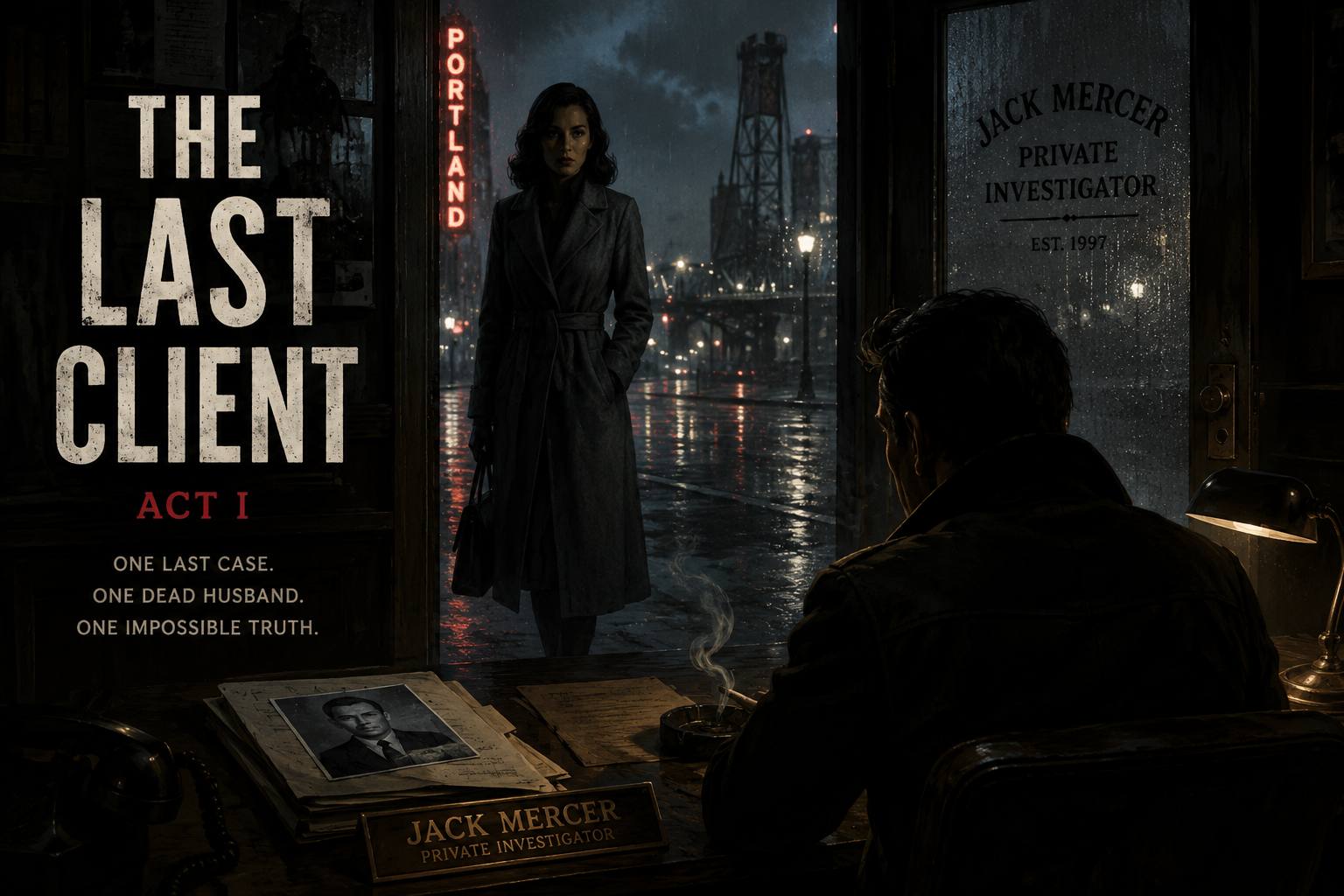
Portland looked best in the rain.
That wasn’t a compliment.
Rain blurred the sharp edges. It softened the cracked sidewalks, the tired storefronts, the rust creeping up the steel bones of the bridges. It turned the city into a watercolor of reflected lights and forgotten promises.
On dry days, Portland showed you exactly what it was.
On wet days, it lied.
I preferred the lies.
From my office window on Southwest Third Avenue, I could just make out the glow of signs through the rain-smeared glass. Beyond them, somewhere in the darkness, the Willamette River slid silently beneath the bridges. Barges moved along the waterfront. Freight trains groaned in the distance. The city still carried traces of its timber-town past, even if most people pretended otherwise.
The rain had been falling since morning.
Not a storm.
Just the steady Oregon drizzle that seemed less like weather and more like a permanent condition.
I sat behind my desk staring at a cardboard box.
Twenty-seven years of detective work fit into three boxes.
That seemed wrong somehow.
A lifetime should occupy more space.
I picked up a file from the top of the stack.
Missing husband. Found in Reno.
Another file. Insurance fraud.
Another. Missing dog. Found under a neighbor’s porch.
The stories that consume years of your life eventually become paper.
Then they become dust.
Tomorrow, the office would be empty. The landlord had already found a replacement. A tax consultant.
Apparently people still wanted help hiding money. Finding truth was a less profitable business.
I glanced at the brass nameplate on the desk.
JACK MERCER
PRIVATE INVESTIGATOR
The lettering had begun to fade.
Just like the man who paid for it.
The old wall clock read five fifty-eight.
Two minutes.
I would lock the door, walk away, and let somebody else worry about Portland’s secrets.
The city had plenty left.
The docks. The unions. The politicians. The businessmen who attended charity dinners while laundering their sins through shell companies.
Every city has ghosts.
Portland simply had more rain to hide them.
I reached for my coat.
A knock stopped me.
Three slow taps.
I ignored them.
Another three taps followed. Patient. Confident.
Whoever stood outside wasn’t selling something.
Salesmen knock nervously. This knock expected an answer.
I sighed.
“Come in.”
The door opened.
A gust of cool air swept into the office.
Then the woman stepped inside.
Rain glistened on her gray coat.
She closed the umbrella with a practiced motion and stood quietly for a moment, letting her eyes adjust to the dim room.
She wasn’t young.
She wasn’t old.
She belonged to that dangerous age where beauty stopped announcing itself and became something quieter.
Something more difficult to ignore.
Dark hair framed a pale face.
Gray eyes.
The kind that seemed to be measuring distances invisible to everyone else.
“I hope I’m not interrupting.”
Her voice was calm. Educated. No trace of panic. Most clients arrived carrying fear. She carried something else.
Resignation.
“You are,” I said.
She noticed the boxes.
“Moving?”
“Retiring.”
“Congratulations.”
“Nobody has ever said that with less enthusiasm.”
A faint smile appeared. Then disappeared.
“I only need a few minutes.”
I should have sent her away.
The office was closed.
My career was over.
Whatever problem she carried belonged to tomorrow.
Instead, I pointed at the chair across from my desk.
She sat.
I sat.
The rain tapped against the window.
Somewhere below, a streetcar bell echoed through downtown.
“What can I do for you?”
She removed a pair of black leather gloves.
“My husband is missing.”
Of course he was.
After nearly three decades, every mystery eventually became either a missing spouse or a dead one.
Sometimes both.
“When did he disappear?”
“Three days ago.”
“Police involved?”
“Yes.”
“And?”
“They believe he left voluntarily.”
I nodded.
That happened often enough.
People vanished all the time.
Most weren’t kidnapped.
Most weren’t murdered.
Most simply reached a point where staying felt worse than leaving.
“What do you believe?”
For the first time she hesitated.
Not long.
Just enough.
“I don’t think he’s missing.” The rain seemed louder suddenly. “I think he’s hiding.”
That was different.
I leaned back.
“Hiding from whom?”
Her gaze drifted toward the window.
The lights outside reflected in the glass.
“Himself, perhaps.”
“That’s not usually how hiding works.”
“No.”
“No enemies?”
“Not that I know of.”
“Debts?”
“No.”
“Trouble at work?”
“I wouldn’t know.”
“You wouldn’t know?”
“We’ve been separated.”
That explained some things.
Not all of them.
“His name?”
“Richard Gray.”
She opened her handbag and removed a photograph.
I took it.
The picture showed a man standing beside a sailboat.
Mid-fifties.
Well dressed.
Expensive smile.
The sort of man who looked successful from a distance.
The sort of man detectives learn to distrust.
“He works in finance?”
She raised an eyebrow.
“How did you know?”
“The watch.”
She glanced at the photograph.
A gold watch peeked from beneath his cuff.
Not flashy.
Expensive.
The kind of thing that whispered wealth instead of shouting it.
“He manages investments.”
“Successful?”
“Very.”
“Faithful?”
The question slipped out before I could stop it. Years of habit. Her expression never changed.
“No.”
At least one honest answer.
That made me trust her more than all the others.
She reached into her handbag again and placed an envelope on my desk.
I opened it.
Five hundred dollars.
Cash.
Fresh bills.
I hadn’t seen that much money in one place for months.
“Retainer.”
“That’s generous.”
“I’d like you to find him.”
I studied her face.
There was no desperation there.
No hope either.
Just determination.
The look of someone completing an unpleasant task.
Not beginning one.
“What happens when I do?”
“You ask him a question.”
“What question?”
She looked directly at me.
The gray eyes seemed older suddenly. Much older.
“Why?”
“Why what?”
“Just why.”
The answer hung in the room.
A puzzle with missing pieces.
I waited for her to explain.
She didn’t.
Instead, she stood.
The interview was apparently over.
“That’s all?”
“That’s all.”
I took out my notebook.
“Address?”
She wrote it down.
Then a telephone number.
The handwriting was neat.
Deliberate.
Old-fashioned.
The kind taught before schools decided penmanship was optional.
I slipped the paper into my pocket.
She pulled on her gloves.
For a moment she seemed about to say something else.
Instead, she turned toward the door.
Her hand rested on the knob.
“Mr. Mercer?”
“Yes?”
“If you find Richard…”
She paused.
“…be careful what truths you uncover.”
Before I could answer, she stepped into the hallway.
The door closed softly behind her.
I sat there listening to the rain.
The office suddenly felt colder.
I don’t know how long I remained at my desk.
Maybe five minutes.
Maybe ten.
Eventually I stood and crossed to the window.
Down below, people hurried through the evening beneath umbrellas.
Headlights reflected on wet pavement.
A freight train in the distance rattled windows.
I searched for the gray coat.
The woman should still have been visible.
There weren’t many pedestrians on a night like this.
But she wasn’t there.
She had vanished.
Not disappeared.
Not mysteriously evaporated.
Just gone.
Swallowed by rain and Portland darkness.
I remember thinking it was odd.
Nothing more.
By tomorrow morning, I would understand how wrong I was.
Because before the sun rose over the Willamette, Richard Gray would be dead.
And the woman who hired me would become the most impossible client of my career.
Read other posts in this series:
- The Last Client, Act I
- The Last Client, Act II
- The Last Client, Act III
- The Last Client, Post Script
👁️ 120 views