
The Language Survived. Its Written World Did Not Remain Whole.

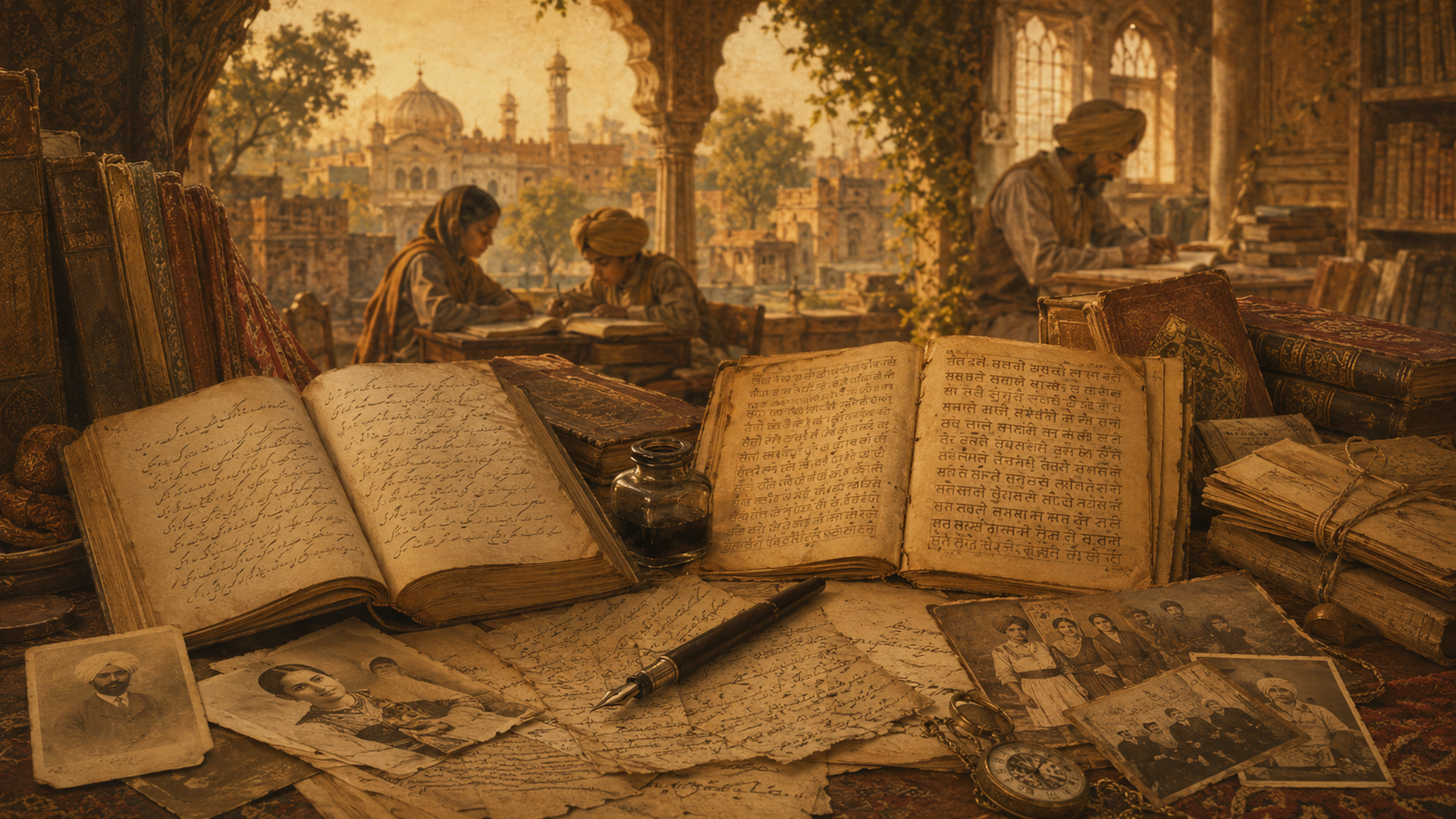
Partition did not kill Punjabi.
The language continued to be spoken in homes, markets, fields, villages, cities and refugee neighbourhoods. It survived in songs, jokes, prayers, arguments, wedding rituals and the stories grandparents told after dinner.
It remained one of the most widely spoken languages of the subcontinent.
Yet survival can be misleading.
A language may continue to be spoken while losing access to its written past. It may remain popular in music while weakening in schools. It may be loved in the home but avoided in professional life. It may carry emotion while another language carries authority.
That is what happened to Punjabi in the decades after Partition.
The spoken language remained alive.
Its literary world became fractured.
Its scripts moved apart. Its readers grew separated. Its historical records became inaccessible to later generations. Its dialects survived unevenly. English, Hindi and Urdu gained prestige in education, administration and professional life.
Punjabi did not disappear.
But the world in which Punjabi had once functioned as memory, literature, scholarship and identity no longer remained whole.
A Shared Literary Culture Was Broken Apart
Before 1947, Punjab’s literary culture did not belong to one religion, one script or one political community.
Hindu, Muslim and Sikh writers participated in overlapping worlds of poetry, journalism, publishing, storytelling and scholarship. Punjabi existed alongside Urdu, Persian, Hindi and English. Writers used different scripts depending on their education, audience, location and subject.
The literary culture of Punjab was never simple.
It was layered.
A person might speak Punjabi at home, read Urdu newspapers, study Persian poetry, use English in official work and encounter religious writing in Gurmukhi, Shahmukhi or Devanagari.
The region’s multilingualism was not necessarily seen as a contradiction.
People moved between languages and scripts because the worlds around them required it.
Partition disrupted this ecosystem.
When Hindu and Sikh communities left western Punjab, Pakistan lost much of its Gurmukhi-reading population. When Muslim communities left eastern Punjab, India lost readers, writers and publishers connected to Urdu and Shahmukhi traditions.
The books did not all vanish.
The poetry did not suddenly cease to exist.
But the communities that had sustained those literary traditions were separated.
A manuscript needs more than paper.
It needs readers.
A newspaper needs more than a printing press.
It needs a public.
A literary culture survives only when writers, editors, publishers, teachers and readers continue to participate in the same conversation.
After Partition, that shared conversation became much harder to sustain.
Two Scripts, Two Reading Worlds
Punjabi continued to be written on both sides of the border.
In India, Gurmukhi became the principal script of Standard Punjabi.
In Pakistan, Shahmukhi remained the primary script used for Punjabi writing.
The spoken language remained close enough for many people to understand one another.
The written language did not.
A person from Amritsar and a person from Lahore could often hold a conversation without translation. They could speak about food, family, music, politics and history. Their pronunciation might differ. Their vocabulary might shift. But the language remained recognizably shared.
Give them each other’s newspapers, however, and the connection could disappear.
The Indian reader might not know Shahmukhi.
The Pakistani reader might not know Gurmukhi.
The same language had entered two different reading systems.
This was more than a technical problem.
Script determines access.
It determines which books a child can open, which archives a researcher can examine, which poems a reader can encounter without translation and which family documents remain intelligible.
A language can be shared in speech while divided in literacy.
That is what happened to Punjabi.
The border separated territory.
The scripts separated readers.
When Family Records Become Silent
The loss of script knowledge was not confined to universities and libraries.
It entered people’s homes.
Refugee families often preserved old letters, notebooks, diaries, land records, photographs with handwritten captions and documents carried from homes they never saw again.
The first generation could read them.
The next generation often could not.
A letter written by a grandfather might survive in a wooden box for seventy years. The paper might remain intact. The ink might still be visible. The family might know that the letter was important.
But nobody in the house might be able to read it.
The document survived.
Its meaning did not.
This is one of the quietest forms of cultural loss.
Nothing is visibly destroyed. There is no fire, no censorship, no deliberate erasure. The record remains physically present.
But the bridge between the record and the reader disappears.
A family may own its history and still be unable to access it.
This happened in different ways on both sides of Punjab.
In India, many descendants of refugees gradually lost the ability to read Urdu or Shahmukhi, even when their grandparents had been fully literate in those scripts.
In Pakistan, everyday familiarity with Gurmukhi declined sharply after the departure of most Sikh and Hindu communities.
The result was a strange historical distance.
Later generations inherited places, memories and stories that were documented in scripts they could no longer read.
When History Could No Longer Be Read
A script preserves more than literature.
It preserves evidence.
Land records, inscriptions, religious documents, newspapers, memoirs, travel accounts, community registers and local histories often survive only in the script in which they were originally written.
When knowledge of that script declines, history becomes harder to recover.
This problem is especially visible in the study of Sikh historical sites in Pakistan.
Researchers working on projects such as Jeevay Sanjha Punjab have used pre-Partition sources, local surveys and oral histories to identify and document hundreds of Sikh shrines and historical locations across Pakistan.
Many of these sites had become neglected, forgotten or poorly recorded.
Some were known locally by altered names.
Others survived as abandoned structures without clear historical identification.
Old Gurmukhi texts sometimes preserved details that later documentation did not.
The issue was not that the history had ceased to exist.
The issue was that fewer people could read the records that contained it.
This is the danger of script loss.
When a script becomes unfamiliar, the past begins to depend on specialists.
What was once ordinary literacy becomes archival expertise.
A letter that a grandmother could read easily may require a researcher two generations later.
A village inscription that local residents once understood may become indecipherable to the people living beside it.
The history remains present.
Its readers disappear.
Translation Preserved Much, But Not Everything
Translation helped reconnect the divided literary worlds of Punjab.
Major works of Punjabi literature crossed the script divide through Gurmukhi editions, Shahmukhi editions, transliteration and translation. The poetry of Bulleh Shah, Waris Shah, Shah Hussain, Baba Farid and others continued to circulate across borders.
Modern technology has made this movement easier.
Readers can now find transliterated poetry online. Scholars collaborate across countries. Digital archives preserve rare newspapers and manuscripts. Social media allows Gurmukhi and Shahmukhi readers to encounter each other’s work.
But translation cannot recover everything.
The famous works usually survive.
The obscure ones often do not.
A celebrated poem may be published in several scripts. A village diary may never be transcribed. A major novel may be translated. A local newspaper may remain buried in an archive. A well-known poet may cross the border. Hundreds of lesser-known writers may not.
Literary memory is selective.
It saves what institutions decide is important.
The rest depends on families, collectors, researchers and chance.
This is why the fracturing of Punjab’s written world mattered so deeply.
The literature did not disappear.
But the network that had carried ordinary writing from one generation to the next was weakened.
The New Language of Success
The decades after Partition transformed the choices Punjabi families made for their children.
Across India and Pakistan, education became closely tied to social mobility. Families that had endured displacement, poverty or insecurity were determined to give the next generation a more stable future.
Language became part of that calculation.
In India, Hindi expanded as the language of education and public life across much of northern India. Standard Punjabi gained institutional strength within Indian Punjab, particularly after the creation of the Punjabi-speaking state in 1966.
English remained the language of higher education, professional advancement and elite opportunity.
In Pakistan, Urdu became the dominant language of national identity, education and administration. English retained its importance in higher education, the civil service, business and the professions.
Parents understood the hierarchy.
They knew which language appeared in competitive examinations.
They knew which language opened doors in universities.
They knew which language employers valued.
They knew which language was associated with power.
The choice was rarely emotional.
It was practical.
Parents did not stop loving Punjabi.
They feared that Punjabi alone would not be enough.
When Language Becomes an Investment
For generations, language had been inherited almost automatically.
Children learned the speech of the household because everyone around them used it. They absorbed songs, expressions, proverbs and stories without formal instruction.
Modern education changed that relationship.
Language became an investment.
Parents began choosing schools based partly on the language of instruction. English-medium education acquired enormous prestige. In India, the phrase “convent school” became associated with discipline, fluency and upward mobility, even when the school had little connection to an actual convent.
In Pakistan, English-medium education similarly became a marker of status and opportunity.
Parents made sacrifices to provide it.
They were responding to reality.
English offered access to higher education, technology, medicine, administration, global business and international mobility.
The decision made sense.
But it produced consequences.
When children spent most of their day learning, reading and socializing in English, Hindi or Urdu, the ancestral language occupied less of their intellectual life.
Punjabi remained the language of family affection.
Another language became the language of achievement.
Over time, the distinction became self-reinforcing.
Loved, But Not Always Valued Equally
Punjabi has never disappeared from public culture.
It is visible everywhere.
It thrives in music, cinema, comedy, social media and popular entertainment. Punjabi songs travel far beyond Punjab. Punjabi expressions enter Hindi films. Punjabi performers reach global audiences. The language carries humour, warmth, rhythm and emotional force.
Yet popularity should not be confused with prestige.
Punjabi is often celebrated as the language of celebration, friendship, romance, village life and family emotion.
It is less often presented as the language of scholarship, science, leadership or advanced education.
Popular culture repeatedly returns to familiar Punjabi characters.
The loud uncle.
The generous host.
The impulsive friend.
The innocent villager.
The emotional mother.
The colourful wedding guest.
These characters are often affectionate and recognizable. They also narrow the cultural imagination.
A language associated mainly with comedy and celebration may be widely loved while still being treated as unsuitable for serious knowledge.
That is the deeper problem.
A language is not secure merely because people sing in it.
It is secure when they can also study mathematics, write history, discuss law, teach science and conduct business in it.
A society reveals the value it assigns to a language through the institutions in which that language is permitted to operate.
Punjabi in Public, Another Language in Power
This contradiction is particularly visible in Pakistan.
Punjabi is the mother tongue of a very large portion of the population. It is spoken widely in everyday life, yet Urdu and English dominate many formal institutions.
Punjabi may fill the marketplace while remaining absent from the classroom.
It may be heard in political speeches while official documents appear in another language.
It may shape private conversation while professional advancement depends on English.
Indian Punjab gave Standard Punjabi a stronger formal role in education and administration.
Yet even there, English and Hindi carry significant prestige. Many urban families increasingly prioritize English-medium education. Some children understand Punjabi but are less confident speaking or reading it.
The pattern differs across regions, but the underlying pressure is similar.
Punjabi remains culturally powerful.
Its institutional position is less secure.
Dialects Face an Even Greater Challenge
If Standard Punjabi struggles for institutional space, regional dialects face an even harder future.
Majhi, Malwai and Doabi remain widely used, strengthened in part by music, cinema and concentrated speaker populations.
Other varieties have less visibility.
Pothohari, Derawali, Multani, Jhangvi, Shahpuri, Dhanni and related forms may survive strongly in certain families or regions, but they are rarely languages of formal education.
Children may hear them from grandparents but read only Standard Punjabi, Urdu, Hindi or English.
The dialect becomes something they understand but do not fully possess.
This shift can occur within two or three generations.
The first generation speaks the dialect naturally.
The second generation speaks it with some mixing.
The third generation understands it but responds in another language.
The fourth generation remembers a handful of expressions.
Language loss rarely arrives as silence.
It arrives as reduced fluency.
Not Everything Has Been Lost
The story is not entirely one of decline.
Languages leave traces.
They survive in recipes, nicknames, blessings, insults, jokes, lullabies and the phrases elders use without thinking.
A family may no longer speak its ancestral dialect fluently, yet still preserve its rhythms in everyday speech.
A wedding song may carry words whose meanings nobody fully understands.
A proverb may outlive the dialect that produced it.
An old recording may preserve a voice long after the speaker is gone.
Across India and Pakistan, scholars and community groups are documenting dialects, digitizing manuscripts, recording oral histories and preserving endangered archives.
Families are beginning to participate as well.
They record grandparents telling stories.
They scan old letters.
They ask elders the names of lost villages.
They trace recipes, customs and expressions back to places abandoned in 1947.
Technology cannot reverse every loss.
But it can preserve what remains.
Preservation Begins at Home
The survival of Punjabi’s many voices will not depend only on universities and governments.
It will depend on families.
Every household contains an archive.
It may not look like one.
It may be a grandmother’s memory of a village near Sargodha. A grandfather’s pronunciation of a word no one else uses. A notebook in Urdu. A letter in Gurmukhi. A wedding song from Multan. A proverb from Rawalpindi. A recipe whose name survives in a dialect the younger generation cannot speak.
These fragments matter.
They are not merely personal curiosities.
They are pieces of Punjab’s history.
Preservation does not always require a major institution.
Sometimes it begins with a phone recording.
Sometimes it begins by asking an elder to repeat a word.
Sometimes it begins by translating a letter before the last person who can read it is gone.
The Future of Punjabi
Punjabi does not need to be frozen in the past.
Languages survive by changing.
They borrow words. They cross borders. They enter new technologies. They adapt to new generations.
The goal is not to preserve every dialect exactly as it sounded in 1947.
That is impossible.
The goal is to ensure that change does not become erasure.
Punjabi must remain more than a language of nostalgia.
It must also become a language of knowledge, creativity, education and the future.
Its two scripts should not remain permanent walls. Digital tools, transliteration and cross-border publishing can help readers move between Gurmukhi and Shahmukhi.
Its dialects should not be treated as incorrect versions of a standard language. They should be recorded, studied and respected as archives of regional memory.
Its literature should not remain trapped in scripts that later generations cannot read.
Its history should not wait silently in boxes and abandoned buildings.
Every Word Carries a Memory
Partition divided Punjab’s land.
Education divided its linguistic pathways.
Script divided its readers.
Prestige divided the language of home from the language of success.
Yet Punjabi survived all of this.
It survived because people continued to speak it even when institutions did not value it equally. It survived because songs travelled where books could not. It survived because grandparents repeated stories. It survived because families carried words across borders and passed them forward, sometimes without realizing what they were preserving.
Not everything has been lost.
But survival should not make us complacent.
A language can remain visible while its deeper inheritance fades.
Every dialect preserves a different memory of Punjab.
Every script opens a different door into its past.
Every word remembered is a small act of preservation.
The language survived.
Now the task is to preserve the worlds it still carries.
Languages and Dialects of Punjab:
- Before 1947, Punjab Did Not Speak One Punjabi, Part I
- Partition Divided Punjab. It Also Divided Its Voices, Part II
- The Language Survived. Its Written World Did Not Remain Whole, Part III
Folklore of Punjab:
- Echoes of the Five Rivers: A Journey Through Punjabi Folklore
- Echoes of the Five Rivers, Part 1: The Soul of Punjab and Its Stories
- Echoes of the Five Rivers, Part 2: Themes, Motifs & the Soul of Punjabi Storytelling
- Echoes of the Five Rivers, Part 3: Folk Beliefs, Rituals & the Living Spirit of Punjab
- Echoes of the Five Rivers, Part 4: Folk Music, Songs & the Voice of the Land
- Echoes of the Five Rivers, Part 5: The Qissas – Love, Rebellion, and the Eternal River
- Echoes of the Five Rivers, Part 6: Saints, Seekers & the Soul of Punjab
- Echoes of the Five Rivers, Part 7: Legends of Valor, Justice & the Everyday Hero
- Echoes of the Five Rivers, Part 8: Folklore & Modernity – The Stories That Refuse to Die
- Echoes of the Five Rivers, Part 9: Reflections, Continuity & the River That Remembers
Rise and Fall of Sikh Empire:
- The Rise and Fall of the Sikh Empire: Part 1 – The Rise and Fall of Banda Bahadur
- The Rise and Fall of the Sikh Empire: Part 2 – Sikh Persecution
- The Rise and Fall of the Sikh Empire: Part 3 – Persian & Afghan Invasions
- The Rise and Fall of the Sikh Empire: Part 4 – The Rise of the Sikh Empire
- The Rise and Fall of the Sikh Empire: Part 5 – The Fall of Sikh Empire
👁️ 68 views
Share this post :
Archives
| M | T | W | T | F | S | S |
|---|---|---|---|---|---|---|
| 1 | 2 | 3 | 4 | |||
| 5 | 6 | 7 | 8 | 9 | 10 | 11 |
| 12 | 13 | 14 | 15 | 16 | 17 | 18 |
| 19 | 20 | 21 | 22 | 23 | 24 | 25 |
| 26 | 27 | 28 | 29 | 30 | 31 | |
Categories
Missives from Planet Nagi
Sign up for our newsletter.
Get insightful stories, updates, and inspiration delivered straight to your inbox. Be the first to know what’s new and never miss a post!