
Partition Divided Punjab. It Also Divided Its Voices

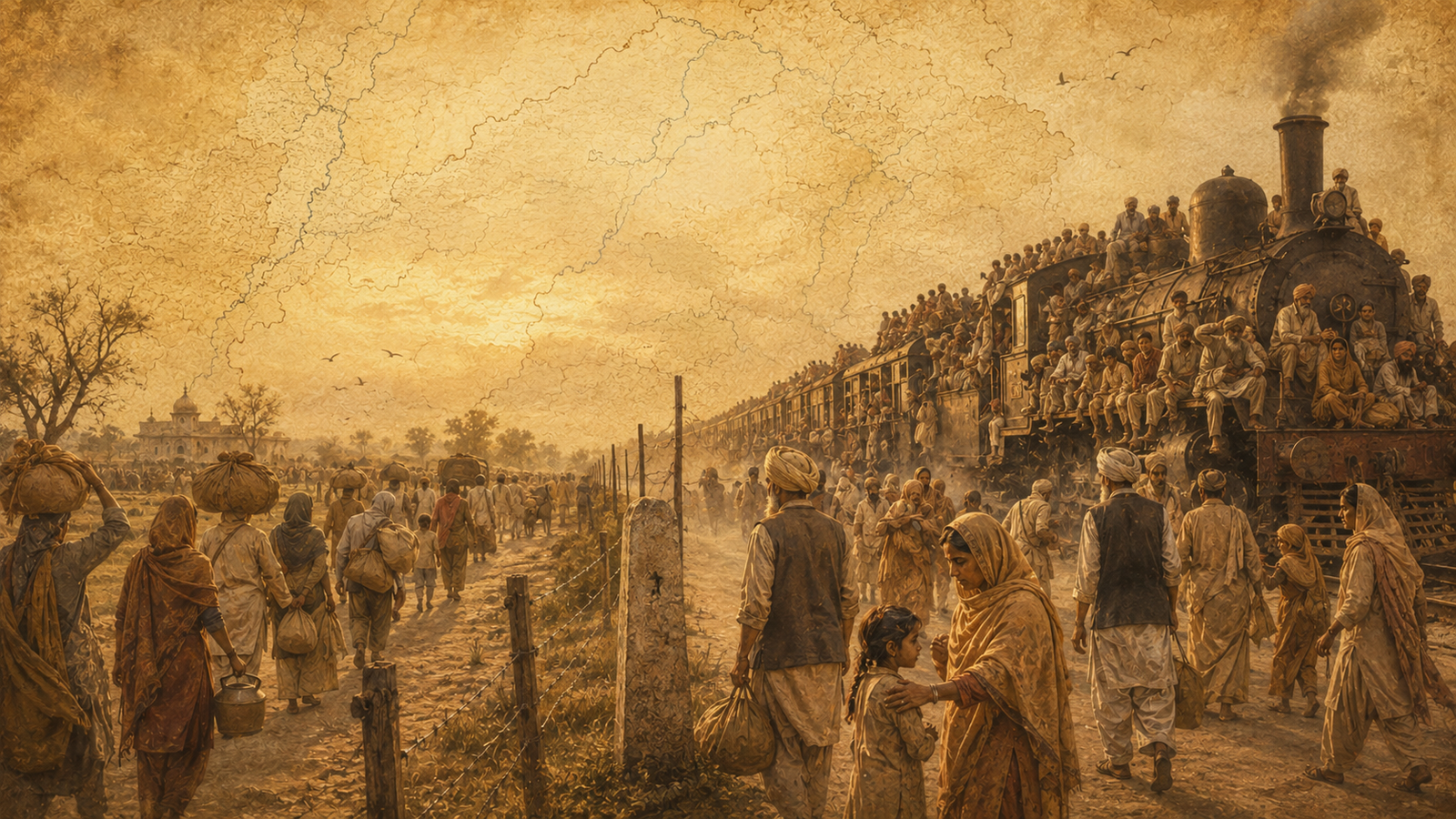
In August 1947, a line was drawn across Punjab.
On one side stood India. On the other stood Pakistan.
The line divided districts, farms, canals, roads and railway tracks. It separated cities from the villages that supplied them, markets from the communities that traded in them, and shrines from the people who had visited them for generations.
It also divided language.
Not because people on one side suddenly began speaking differently from those on the other. Language does not change overnight because a government draws a border. The dialect spoken in a village did not transform when the village became part of a new country.
But the world that sustained that dialect changed completely.
Families migrated. Neighbourhoods emptied. Schools adopted new languages. Scripts acquired political and religious meanings. Children learned to read differently from their parents. Communities that had once lived together were scattered across unfamiliar towns and refugee settlements.
The voices survived the journey.
The social worlds around them often did not.
The Border Cut Through a Linguistic Landscape
Before Partition, the dialects of Punjab existed within a connected geographical landscape.
Majhi flowed across Lahore, Amritsar, Kasur, Gujranwala and Sialkot. Pothohari spread through Rawalpindi, Jhelum, Gujar Khan, Murree and Mirpur. Multani, Derawali, Jhangvi, Shahpuri and other western varieties were rooted in their own regional belts.
These dialects were not contained within neat political boxes. They followed rivers, trade routes, marriage networks and patterns of settlement.
A border changed all of that.
Villages that had spoken similar forms of Punjabi for generations found themselves in different countries. Towns that had traded with one another became separated by customs posts, military checkpoints and political suspicion.
The new border did not silence the dialects immediately. People continued to speak as they always had.
But language depends on more than speech.
It depends on who lives nearby, whom people marry, where children attend school, what books they read, which cities they visit and which institutions recognize their language.
Partition disrupted all of these relationships.
It did not merely divide Punjab into two territories.
It broke apart a linguistic ecosystem that had evolved over centuries.
The Great Movement of People
Millions of people crossed the new border.
Hindus and Sikhs left western Punjab for India. Muslims left eastern Punjab for Pakistan. Many travelled in fear, confusion and grief. They carried what they could, often abandoning homes, land, shops, documents and possessions accumulated across generations.
They also carried language.
Families from Lahore, Rawalpindi, Multan, Jhang, Sargodha, Sheikhupura and countless smaller towns arrived in Indian refugee camps and newly developing neighbourhoods.
They found themselves living beside people from other parts of Punjab.
A family speaking Pothohari might become neighbours with a family from Multan. Someone from Jhang might work beside someone from Lahore. A Derawali household might share a courtyard with a Majhi-speaking family.
Dialects that had once belonged to distant regions now met every day.
Something similar happened in Pakistan. Muslim migrants from Amritsar, Jalandhar, Ludhiana, Ambala and other areas of eastern Punjab brought their own forms of speech with them.
Yet the two migrations did not produce identical linguistic outcomes.
In western Punjab, the majority of Punjabi-speaking Muslims remained within their historical homeland. The population changed dramatically, but the territorial continuity of Punjabi speech remained largely intact.
In India, many refugees from western Punjab settled outside the new Indian state of Punjab. They rebuilt their lives in Delhi, Haryana, Rajasthan, Uttar Pradesh and other parts of the country.
This difference would matter enormously.
A dialect survives most easily when a community remains concentrated, maintains strong social networks and passes the language to children through everyday use.
Migration weakened some of these conditions.
But migration alone did not determine the fate of a language.
One Partition, Two Linguistic Journeys
After 1947, Punjabi entered two different national systems.
India and Pakistan made different choices about education, administration, script and national identity. These decisions gradually reshaped how Punjabi was spoken, written and valued.
The language remained connected across the border. Many Punjabis could still understand one another in conversation.
But the institutions surrounding the language began to diverge.
In India, Punjabi became increasingly associated with Gurmukhi and with the political demand for a Punjabi-speaking state.
In Pakistan, Punjabi continued to be written in Shahmukhi, but Urdu became the principal language of national identity, administration and education.
The difference was not simply one of alphabet.
It was the beginning of two separate institutional histories.
The Language of Home and the Language of School
For many families, the most important linguistic change did not happen in Parliament or in government offices.
It happened in the classroom.
Children often spoke one language at home and learned another at school.
This is where language shift frequently begins.
Parents may continue speaking their ancestral dialect. Grandparents may tell stories, recite proverbs and sing songs in it. But when children learn to read, write, study and succeed in another language, the balance inside the family gradually changes.
The home language becomes associated with intimacy.
The school language becomes associated with knowledge and advancement.
Over time, children begin answering their parents in the language of school. They understand the family dialect but struggle to speak it. Their own children may recognize only a few words.
The language has not disappeared.
Its territory has shrunk.
Standard Punjabi in Indian Punjab
After Partition, India faced the enormous task of rebuilding schools and resettling millions of displaced people.
Governments had to decide which languages children would learn to read and write. Punjab’s many regional dialects did not become separate languages of education.
Schools did not generally teach Jhangvi, Pothohari, Shahpuri, Derawali or Multani as distinct subjects.
Instead, education within Indian Punjab increasingly centred on Standard Punjabi written in Gurmukhi.
This brought important benefits.
It created a common written language. It supported publishing, education, administration and literary production. It gave Punjabi a stronger institutional foundation within India.
The Punjabi Suba movement eventually contributed to the reorganization of the region. In 1966, the state of Punjab was reconstituted largely around Punjabi-speaking areas.
Standard Punjabi gained a formal place in public life.
But standardization always has a cost.
When one form becomes the language of school, government and literature, other forms are pushed into more limited roles.
A child may speak Malwai, Doabi or Puadhi at home but learn Standard Punjabi in the classroom. The distance may be manageable because these varieties are closely related.
For refugee families from Pothohar, Multan, Dera Ghazi Khan or Jhang, the difference could be greater.
Their grandparents’ speech remained Punjabi in a broad cultural sense, but it was no longer the form receiving institutional support.
The school taught the standard.
The family preserved the memory.
Punjabi Refugees Outside Punjab
Many Punjabi refugees did not settle within Indian Punjab.
They rebuilt their lives in Delhi and across northern India. Their children entered schools where Hindi was the dominant regional language, often accompanied by English.
For these families, Punjabi was not simply competing with a standardized form of itself.
It was competing with the language of the state.
A child from a Multani, Pothohari or Derawali-speaking household might speak the ancestral dialect with grandparents, Hindi with friends, and English in higher education or professional settings.
This multilingualism could be an advantage. It allowed families to adapt quickly and participate in new social and economic environments.
But it also changed what was passed forward.
The ancestral dialect often became the language of the eldest generation.
Punjabi or Hindi became the language of everyday public life.
English became the language of ambition.
The shift was rarely forced by a single decision. Most parents did not wake up one morning and decide to abandon their dialect.
They made practical choices.
They wanted their children to succeed in school. They wanted them to find work. They wanted them to belong in their new surroundings.
The language of survival gradually became the language of the future.
Shahmukhi Continued in Pakistan
In Pakistan, Punjabi continued to be written in Shahmukhi, the Perso-Arabic script historically used for Punjabi across much of western Punjab.
This preserved access to a rich literary tradition.
Punjabi poetry, Sufi writings, qissas, songs and modern literature continued to be written and published in Shahmukhi. The works of Bulleh Shah, Waris Shah, Shah Hussain and other poets remained central to Punjab’s cultural memory.
But Punjabi did not become the principal language of education or national administration.
Urdu acquired the role of national language and became dominant in schools, government and public life. English remained influential in higher education, the civil service and professional advancement.
Punjabi continued to be the everyday language of a vast population.
Yet it often lacked the institutional status that its number of speakers might have suggested.
People spoke Punjabi at home, in markets, in humour, music and informal conversation.
They studied in Urdu or English.
This created a familiar contradiction.
Punjabi was everywhere, but not always where authority lived.
The Script Divide
Before Partition, Punjab’s written world was already multilingual and multiscript.
Urdu was widely used in administration, education and literary culture across much of the province. Punjabi appeared in Shahmukhi, Gurmukhi and, in some contexts, other scripts.
After Partition, script became more closely tied to national, religious and regional identity.
In Indian Punjab, Gurmukhi became firmly associated with Standard Punjabi.
In Pakistan, Shahmukhi remained the primary script for Punjabi writing.
The spoken language remained broadly connected.
The written language moved apart.
A Punjabi speaker in Amritsar might understand a Punjabi speaker in Lahore. They could speak about family, music, food and shared history without needing translation.
But they might not be able to read one another’s books.
This was a profound change.
Conversation could still cross the border.
Literacy often could not.
When the Written World Receded
For refugee families in India, the shift in script affected more than formal literature.
Many families had left behind letters, notebooks, diaries, legal documents, newspapers and books written in Urdu or Shahmukhi.
The first generation could read them.
The next generation often could not.
A grandfather’s letter might remain carefully preserved in a box, but his grandchildren might be unable to understand it. A family notebook could survive physically while its meaning disappeared.
This was not simply a change from one alphabet to another.
It was a break in access to memory.
When later generations cannot read the script of their ancestors, they become dependent on translation, transcription or oral explanation.
Once the last person capable of reading the document is gone, a family may still possess the record but lose the story it contains.
The words remain visible.
Their world recedes.
Not Every Dialect Shared the Same Fate
It would be wrong to say that Partition caused all Punjabi dialects to decline in the same way.
Some survived strongly.
Others weakened.
Some evolved into broader linguistic identities.
Some became symbols of regional pride.
The Bannuwal community, for example, consciously preserved its dialect alongside songs, rituals, proverbs and cuisine after migrating from Bannu to India. Community memory helped carry the language across generations.
Among Multani and Derawali refugee families, cultural organizations, gatherings and oral traditions helped maintain a sense of linguistic identity. Yet many younger speakers gradually shifted toward Hindi, Standard Punjabi or English.
Pothohari followed a different path.
Much of its speaker population remained within its historical homeland in Pakistan. It also travelled with diaspora communities. Yet research and community observation suggest that it remained stronger in some villages than in urban areas, where Urdu and English gained influence.
The fate of a dialect depended on many things:
Where its speakers settled.
Whether they remained concentrated.
Whether they married within the community.
Whether children heard the language daily.
Whether schools recognized it.
Whether books, songs and recordings existed.
Whether the language was associated with pride or embarrassment.
Migration mattered.
But community mattered just as much.
What Makes a Language Survive?
Languages do not survive merely because older people love them.
They survive because children use them.
They survive when the language is connected to ordinary life, not only nostalgia. They survive when people can joke, argue, study, write, dream and build relationships through them.
A dialect may remain emotionally important while becoming practically unnecessary.
Families might remember it during weddings, religious gatherings or visits from elders. They may preserve certain expressions, foods and songs. But if children do not need the language for friendship, education or work, its everyday use begins to fade.
This does not mean families have failed.
They are responding to the incentives around them.
A society tells people which languages matter through its schools, examinations, offices, media and job markets.
Parents listen carefully to that message.
The Voices Crossed the Border
Partition is often remembered through trains, refugee columns, abandoned houses and lost cities.
Its linguistic consequences were quieter.
A dialect rarely disappeared in one dramatic moment.
It weakened through thousands of ordinary decisions.
A mother spoke Hindi to help her child succeed at school.
A father used English because he believed it would create opportunity.
A family moved to a city where nobody else spoke the grandparents’ dialect.
A child understood the old language but answered in the new one.
A letter remained unread.
A proverb was remembered incorrectly.
A song lost one verse.
None of these moments appeared in official histories of Partition.
Together, they reshaped the linguistic future of Punjab.
The border divided the land in 1947.
The deeper separation unfolded over decades.
Punjabi continued on both sides. Its dialects remained in villages, families, music and memory. But the institutions surrounding them moved in different directions.
The language remained shared.
The scripts, schools and literary worlds did not.
The voices crossed the border.
Their journeys did not.
Languages and Dialects of Punjab:
- Before 1947, Punjab Did Not Speak One Punjabi, Part I
- Partition Divided Punjab. It Also Divided Its Voices, Part II
- The Language Survived. Its Written World Did Not Remain Whole, Part III
Folklore of Punjab:
- Echoes of the Five Rivers: A Journey Through Punjabi Folklore
- Echoes of the Five Rivers, Part 1: The Soul of Punjab and Its Stories
- Echoes of the Five Rivers, Part 2: Themes, Motifs & the Soul of Punjabi Storytelling
- Echoes of the Five Rivers, Part 3: Folk Beliefs, Rituals & the Living Spirit of Punjab
- Echoes of the Five Rivers, Part 4: Folk Music, Songs & the Voice of the Land
- Echoes of the Five Rivers, Part 5: The Qissas – Love, Rebellion, and the Eternal River
- Echoes of the Five Rivers, Part 6: Saints, Seekers & the Soul of Punjab
- Echoes of the Five Rivers, Part 7: Legends of Valor, Justice & the Everyday Hero
- Echoes of the Five Rivers, Part 8: Folklore & Modernity – The Stories That Refuse to Die
- Echoes of the Five Rivers, Part 9: Reflections, Continuity & the River That Remembers
Rise and Fall of Sikh Empire:
- The Rise and Fall of the Sikh Empire: Part 1 – The Rise and Fall of Banda Bahadur
- The Rise and Fall of the Sikh Empire: Part 2 – Sikh Persecution
- The Rise and Fall of the Sikh Empire: Part 3 – Persian & Afghan Invasions
- The Rise and Fall of the Sikh Empire: Part 4 – The Rise of the Sikh Empire
- The Rise and Fall of the Sikh Empire: Part 5 – The Fall of Sikh Empire
👁️ 74 views