

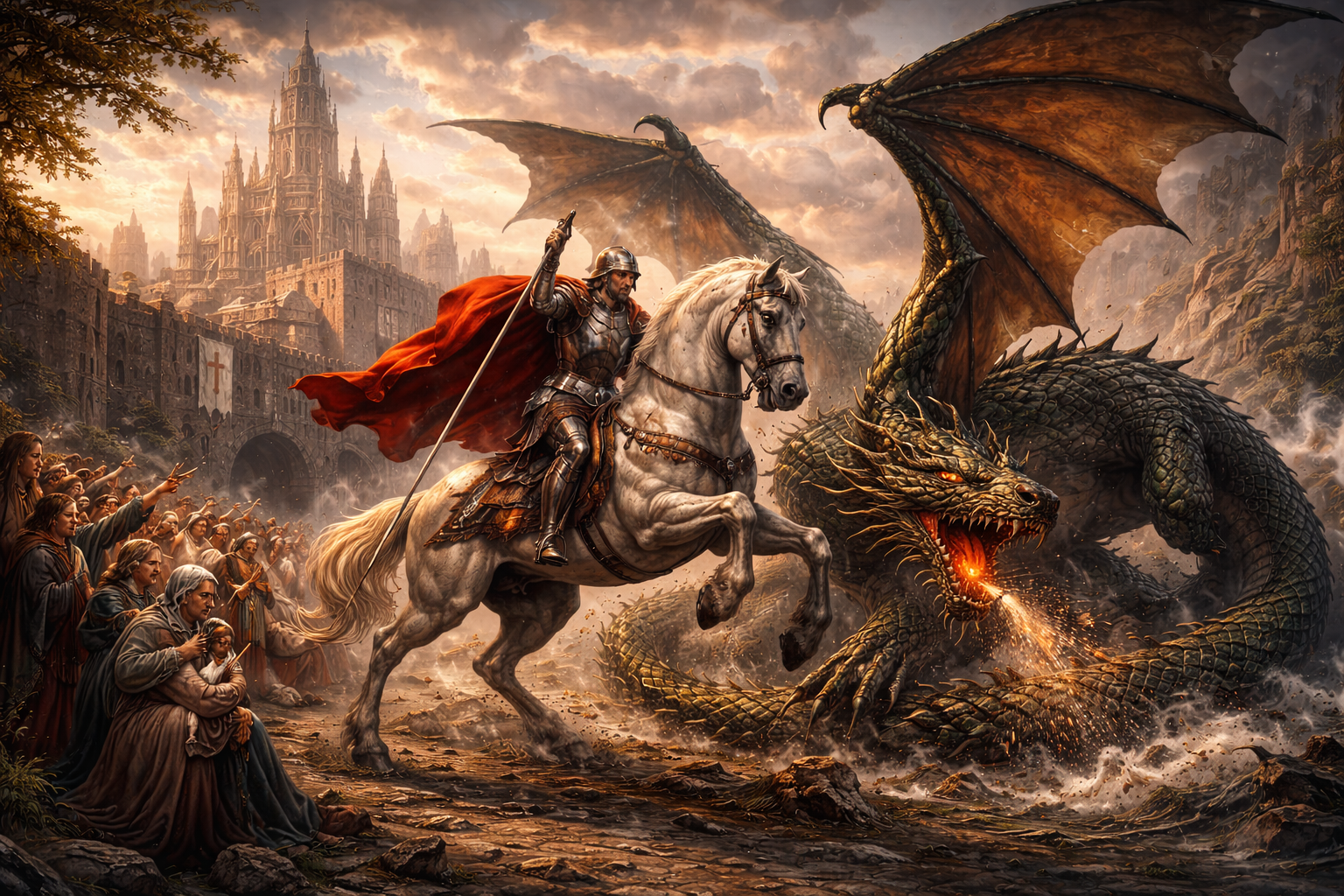
Something decisive happens to dragons when Christianity takes hold of the mythic imagination. They are no longer conditions of the world, nor guardians of thresholds, nor inevitable forces coiled around fate. They become wrong.
This shift is not cosmetic. It is structural. The dragon moves from being part of the cosmos to being opposed to it. From ambiguity to indictment. From something to be reckoned with to something to be eradicated.
Christian dragons are not born from nature. They are born from theology.
In earlier traditions, dragons represented chaos, excess, or imbalance, but they were rarely framed as moral agents. They did not sin. They did not tempt. They did not lie. They existed, and that existence created pressure. Christianity reframes the problem. Disorder is no longer a feature of creation. It is a corruption of it. Evil is not an absence of order but a rebellion against it.
The dragon becomes the perfect vessel for this idea.
Serpents already carry weight in biblical symbolism. They are associated with deception, disobedience, and the fracture between humanity and divine authority. Over time, older serpent and dragon imagery is folded into this moral framework. What was once primordial becomes adversarial. What was once vast becomes personal.
The dragon is no longer simply dangerous. It is wrongly dangerous.
Early Christian thinkers were instrumental in this transformation. Augustine and Gregory do not invent the dragon, but they define how it is to be read. The dragon becomes a symbol of pride, of unchecked desire, of spiritual corruption. Its physical traits are no longer descriptive; they are allegorical. Wings signify arrogance. Fire becomes lust or wrath. Scales represent hardness of heart. The hoard is no longer natural accumulation but avarice.
This is the moment when the dragon becomes legible in a very specific way. It is no longer open to interpretation. It means something, and that meaning is fixed.
This clarity has consequences.
Where earlier myths allowed for negotiation, appeasement, or coexistence, Christian dragon stories demand resolution. The dragon must be defeated. Not delayed. Not redirected. Destroyed. Its continued existence is an affront to cosmic order.
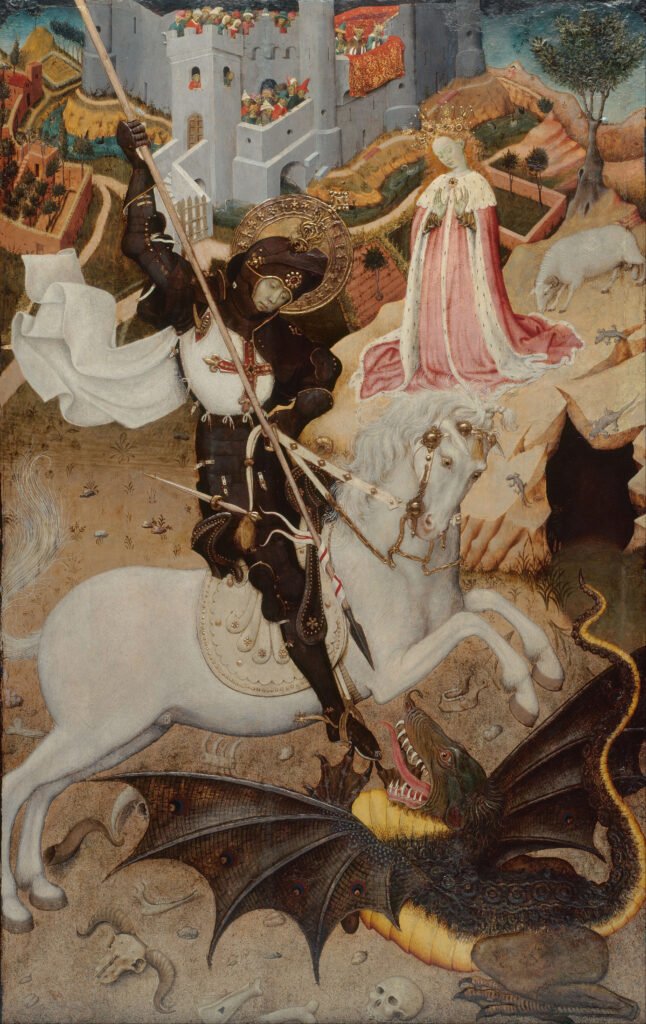
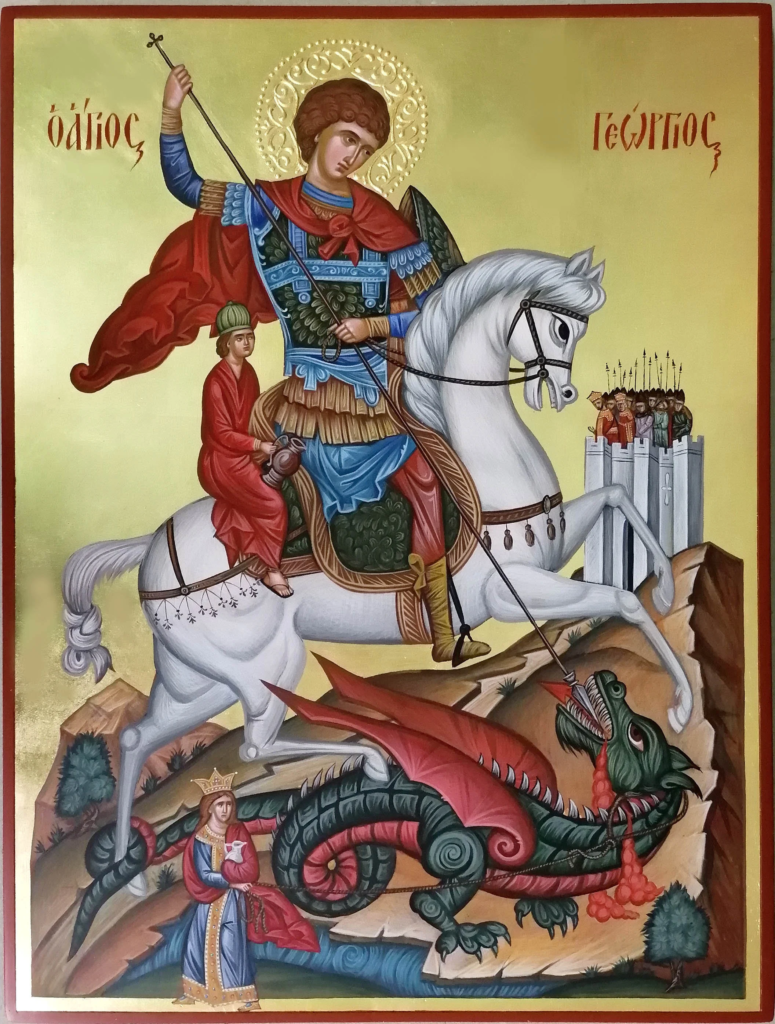
That demand gives rise to one of the most enduring images in Western imagination: the saint versus the dragon.
Saint George is the most famous, but he is not alone. Across medieval Europe, saints confront serpents, dragons, and worm-like beasts. The details vary, but the structure is consistent. The dragon terrorizes a community. The people are helpless. The saint arrives armed not merely with weapons but with faith. The dragon is slain or subdued. Order is restored. The community converts or reaffirms belief.
This is not mythology in the older sense. It is instruction.
The dragon functions as a visual sermon. It externalizes sin so it can be seen, feared, and conquered. The saint’s victory is not about physical strength. It is about correct alignment with divine authority. The dragon loses not because it is weaker, but because it is illegitimate.
What is lost in this process is ambiguity.
The dragon no longer guards anything worth protecting. It hoards for the sake of hoarding. It destroys for the sake of destruction. It exists to be overcome. Its interiority collapses. It does not speak unless it lies. It does not teach unless it tempts.
Medieval bestiaries reinforce this flattening. These illustrated compendiums catalogue animals both real and imagined, assigning each a moral lesson. Dragons appear alongside lions and ants, but their purpose is singular. They warn. They exemplify vice. They demonstrate the consequences of excess.
The bestiary dragon does not surprise. It instructs.
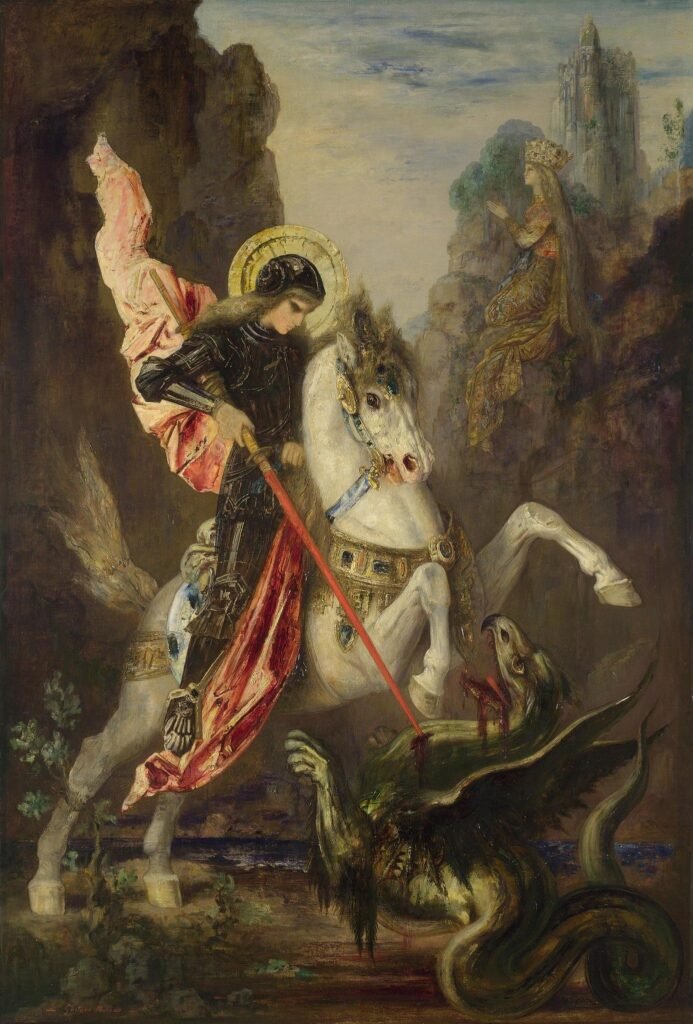

This symbolic clarity makes dragons incredibly useful. They become portable metaphors. They can be carved into church walls, painted into manuscripts, embroidered onto banners. Their meaning is instantly legible. You do not need to know the story to understand the message. Dragon bad. Saint good. Faith triumphs.
But something else happens alongside this simplification. Dragons shrink.
Earlier dragons were vast. Cosmic. Unavoidable. Christian dragons are often localized. They terrorize a village, not a world. They block a road, not a river system. They demand sacrifices, not submission to fate. This reduction makes them manageable. It turns existential dread into a solvable problem.
This is not accidental. Christianity is a universalizing religion, but it spreads through local conversion. The dragon must fit the scale of the community it threatens. It must feel immediate. Slayable. Close enough for the saint to reach.
In doing so, the dragon becomes an enemy of progress. Its defeat clears space for churches, towns, and order. The wild is tamed. The old fears are replaced with sanctioned ones.
And yet, the dragon never disappears entirely.
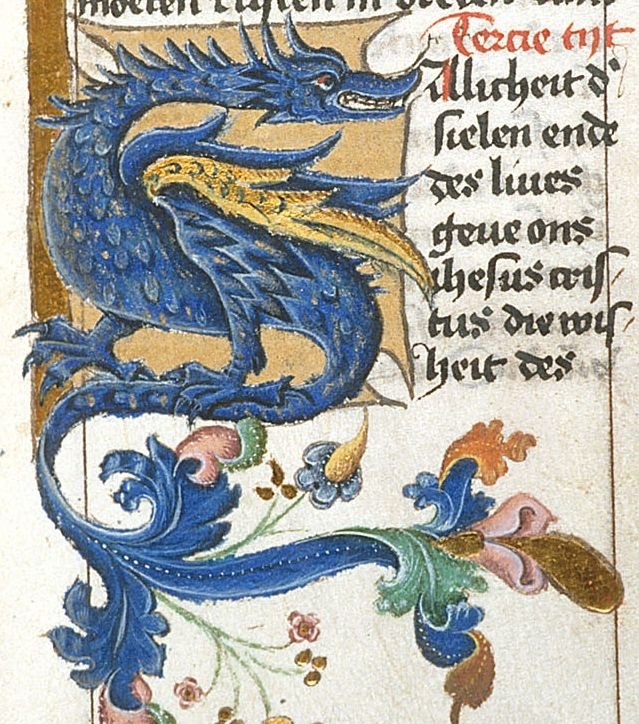
Even as theology insists on its eradication, art betrays fascination. Medieval dragons are elaborate, expressive, sometimes even beautiful. Illuminated manuscripts lavish attention on their coils, wings, and jaws. Stone carvings give them presence and personality. There is an undeniable tension between what the dragon is supposed to represent and how much care is taken in depicting it.
This tension suggests something unresolved.
Christian symbolism wants the dragon to be a lie made flesh, but artists keep treating it as a truth made visible. The dragon refuses to become merely didactic. It resists becoming just a warning sign. It retains a gravity that exceeds its assigned role.
Perhaps this is because, even within a moralized framework, the dragon continues to carry older meanings. It still represents power beyond human control. It still evokes fear that is not easily explained away. It still occupies liminal spaces: caves, swamps, ruins, edges of maps. Places where certainty falters.
The saint may kill the dragon, but the terrain remains dangerous.
There is also an irony at work. By casting the dragon as the embodiment of evil, Christianity inadvertently preserves it. Evil requires imagery. It requires narrative. It requires something to struggle against. The dragon becomes indispensable. It cannot be eliminated without weakening the story itself.
So the dragon is killed again and again, but never finally.
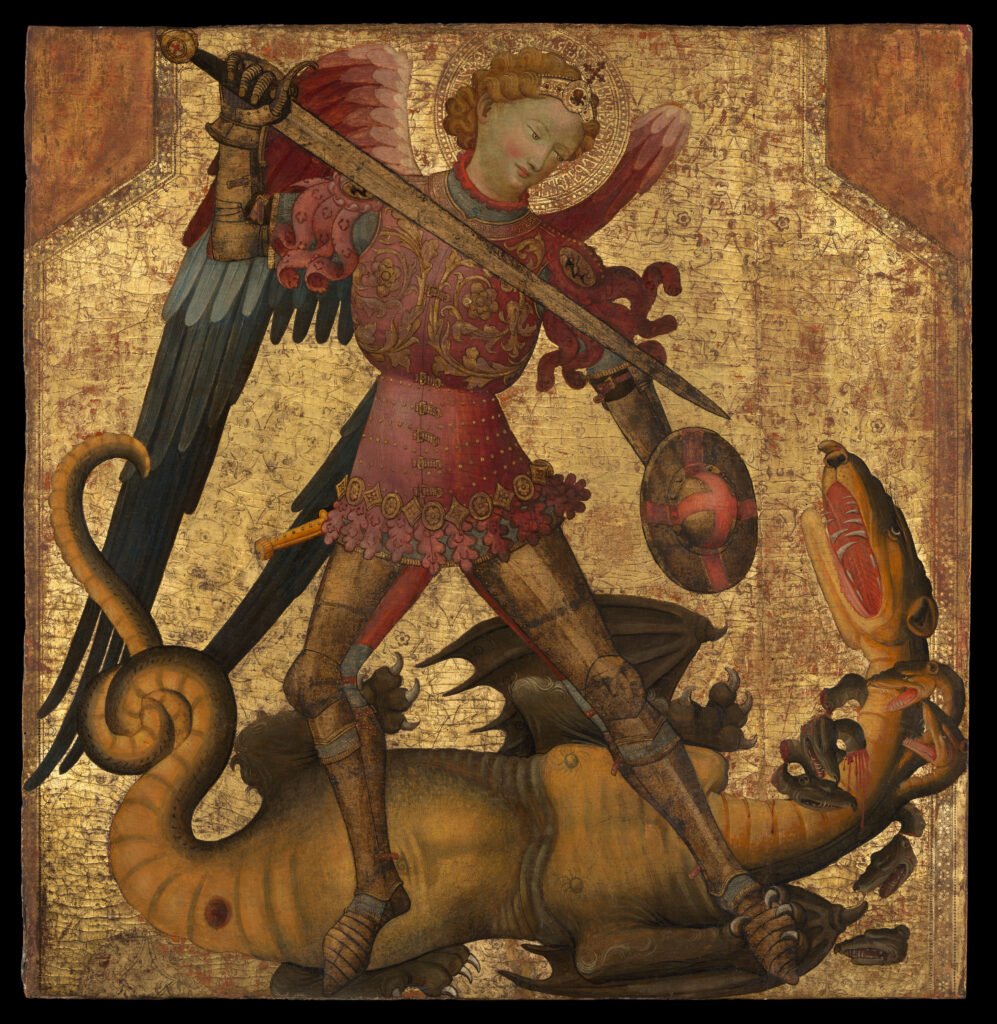
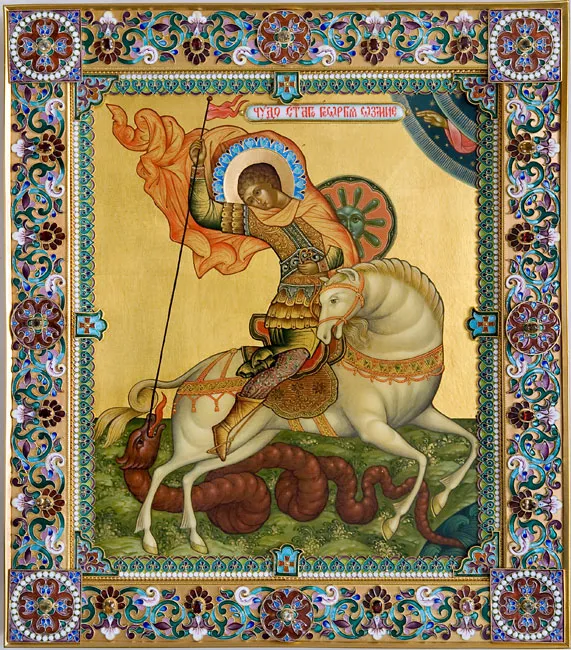
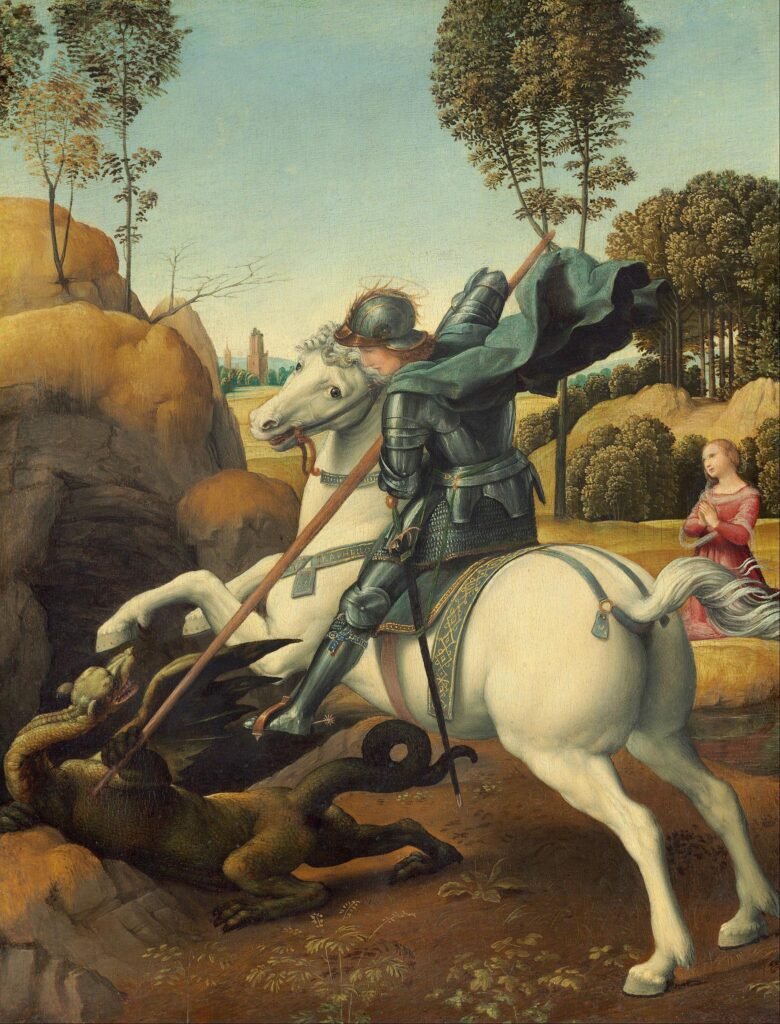
This repeated slaying creates a paradox. The dragon is always defeated, yet always present. It becomes a ritual enemy. A necessary antagonist that confirms the righteousness of the hero and the order of the world.
Over time, this ritualization strips the dragon of its earlier cosmic dignity, but it also prepares the ground for later reinterpretation. Once the dragon is no longer terrifying because it is vast, it becomes interesting because it is constrained. It can be questioned. Reimagined. Given voice again.
But that comes later.
For now, in the Christian imagination, the dragon is the enemy of the soul. It tempts, deceives, corrupts, and must be resisted. Its fire burns not cities but consciences. Its hoard is not gold but attachment to the world. Its defeat is not survival but salvation.
This moral clarity is powerful. It reshapes Western storytelling for centuries. It teaches audiences how to read monsters. It trains them to expect that evil will look a certain way and that good will confront it directly.
Yet the cost of this clarity is depth.
The dragon loses its role as a mirror of the world’s indifference and becomes a mirror of human failure. Chaos is no longer a shared condition. It is a personal fault. The dragon no longer asks how we live with forces beyond us. It asks how we avoid becoming them.
That is a different question entirely.
And still, beneath the sermons and symbols, the older dragon waits. Coiled in the margins of manuscripts. Carved into stones where saints never stood. Glimpsed in art that lingers a little too lovingly on scales and wings.
Christianity may have invented the dragon as evil, but it never fully succeeded in convincing artists, storytellers, or audiences to stop being fascinated by it.
The dragon survives this transformation by adapting once more. It accepts its role as villain, knowing that villains are remembered just as vividly as saints.
In the next part of this series, the dragon will slip free of theology and return to the people. It will shrink again, become local, awkward, sometimes even absurd. It will haunt villages instead of cosmologies.
But here, in the age of saints and sermons, the dragon becomes what Western culture needs it to be most: a visible enemy, slain in public, so that order can feel secure.
Even if it never truly is.
Other posts in this series:
- How Dragons found me: My lifelong fascination with them
- Dragons, Part 1: When Chaos Had Scales, or Dragons of the Ancient World
- Dragons, Part 2: Beneath Clouds and Currents – Dragons of the East
- Dragons, Part 3: Coiled Around the World – Wyrms of the Northern Lands
- Dragons, Part 4: Saints, Serpents, and the Invention of Evil
- Dragons, Part 5: Village Nightmares and Clever Beasts: Dragons of Fable and Folklore
- Dragons, Part 6: From Fire to Ink: Dragons in Literature
- Dragons, Part 7: Where Dragons Still Live
👁️ 655 views