
Thirty years ago, I met my friend Dhruv’s grandmother at his home in New Delhi. I still remember one thing she said to me:
ਤੁਸੀਂ ਮੇਰੇ ਪੁੱਤਰ ਨੂੰ ਪੰਜਾਬੀ ਸਿਖਾ ਦਿੱਤੀ।
Tusi mere puttar nu Punjabi sikha ditti.
تُسیں میرے پُتّر نوں پنجابی سِکھا دِتّی۔
“You taught my son Punjabi.”
Her words returned to me when I began thinking about writing on the languages of Punjab.
People carry language in their hearts as they move from one place to another, sometimes by choice and sometimes because history leaves them no choice at all. Those who settled in regions where a dialect of Punjabi was still widely spoken often preserved it at home. Their children, however, grew up speaking Hindi or Urdu, while their grandchildren were educated in English-medium schools.
The shift was gradual, but profound. A language that once shaped everyday life slowly became the language of grandparents, family memories, songs and occasional expressions.
Even in my own case, growing up in Amritsar, I began formally learning my mother tongue only in the fourth grade. I had already started learning English and Hindi in kindergarten.
That contradiction stayed with me. Punjabi surrounded me, yet it entered my education much later than the other two languages.
This is a three part essay about the languages of Punjab. This is part one.
When we use the word Punjabi today, it often sounds singular.
One language. One identity. One cultural tradition.
Depending on where we live, we may associate Punjabi with the Majhi spoken around Amritsar and Lahore, with the Malwai heard across central Punjab, or with the standardized Punjabi taught in schools and written in Gurmukhi. Across the border, Punjabi may bring to mind Shahmukhi, Sufi poetry, folk music and the everyday language of millions of people in Pakistan.
But the Punjab that existed before 1947 did not speak with one voice.
It spoke through many voices.
The language changed as one travelled from Lahore to Multan, from Rawalpindi to Jalandhar, from Jammu to Bahawalpur, and from the foothills near Kangra to the dry lands around Dera Ghazi Khan. Pronunciation shifted. Vocabulary changed. Grammar bent in different directions. Songs followed local rhythms. Proverbs carried the wisdom of particular landscapes.
The people still belonged to Punjab, but Punjab itself was not linguistically uniform.
It was a vast conversation.
The Punjab Before the Borders
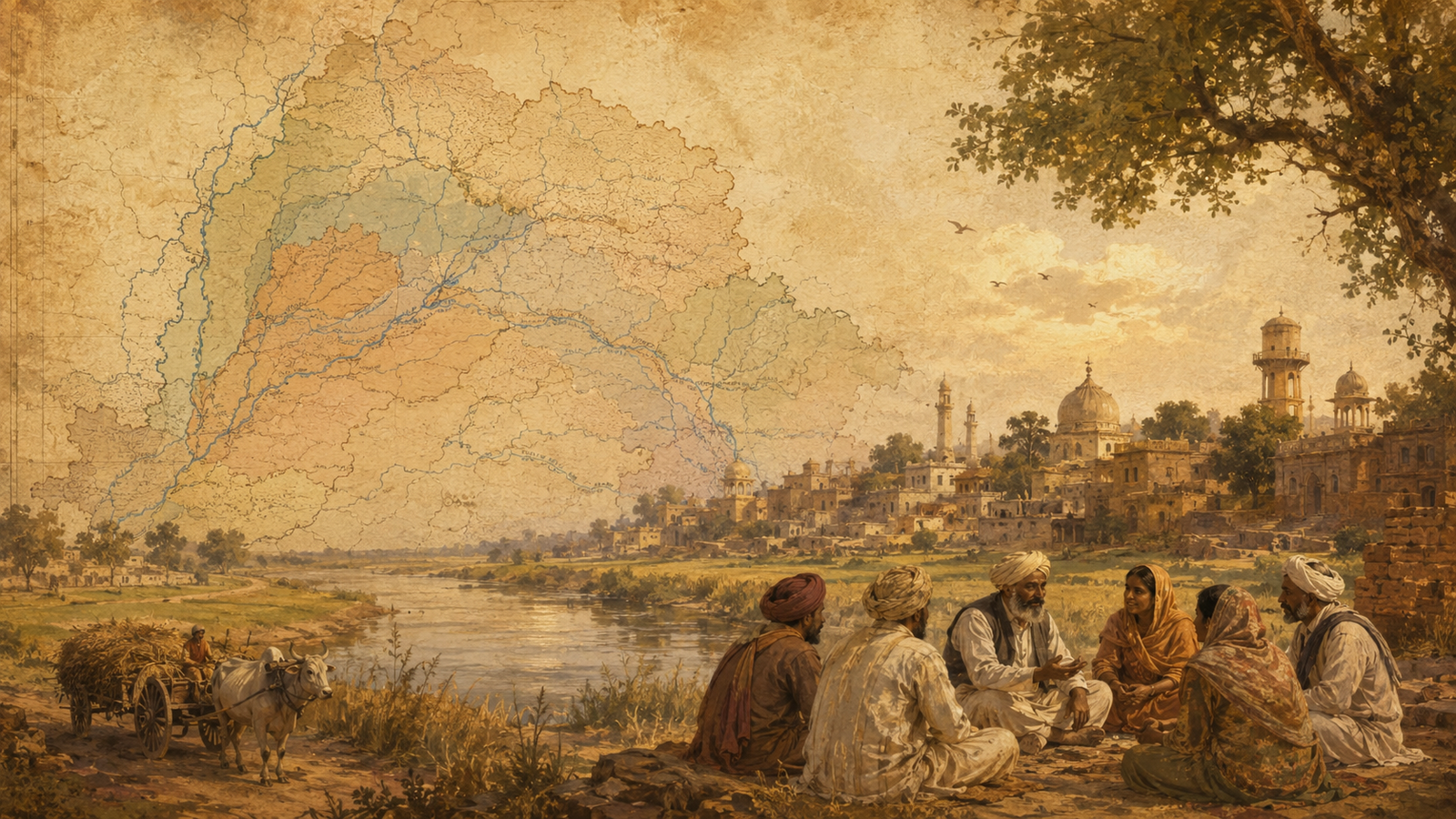
The modern map makes it difficult to imagine the older Punjab.
Today, Punjab is divided among political and administrative regions in India and Pakistan. The name itself is most closely associated with the Indian state of Punjab and the Pakistani province of Punjab. Yet the historical Punjab was much larger and more fluid.
It stretched across regions that now fall within Punjab, Haryana, Himachal Pradesh, Jammu, Delhi, Khyber Pakhtunkhwa and parts of Rajasthan in India and Pakistan.
Its boundaries changed repeatedly under empires, kingdoms and colonial administration. More importantly, the cultural boundaries were rarely as precise as the political ones.
People travelled for trade, marriage, pilgrimage, military service and seasonal work. Merchants carried words from one town to another. Soldiers returned with unfamiliar expressions. Farmers shared songs across neighbouring districts. Sufi shrines and religious centres brought together communities that did not always speak exactly the same way.
There was no invisible line where one dialect suddenly ended and another began.
Language changed gradually.
A traveller might move through several towns and notice only small differences from one place to the next. Yet after travelling a few hundred miles, the speech could sound dramatically different.
This is what linguists describe as a dialect continuum. Neighbouring communities understand each other easily, while those living farther apart may find the differences more significant.
Punjab was full of such continuums.
The Rivers Did More Than Water the Land
Punjab means the land of five rivers.
Those rivers did not merely shape agriculture. They shaped movement, settlement, trade and language.
The Ravi, Beas, Sutlej, Chenab and Jhelum created natural regions known as doabs, the lands between two rivers. Communities living within these regions developed their own networks, markets, marriage patterns and cultural habits.
Over time, these connections influenced speech.
The language around Lahore and Amritsar evolved differently from the language around Multan. The people of Jalandhar and Hoshiarpur developed speech patterns distinct from those around Rawalpindi and Jhelum. The foothills produced different rhythms and vocabularies from the plains.
This does not mean that every village spoke an entirely separate language. It means that Punjabi existed as a family of related forms, each shaped by geography and history.
The rivers connected Punjab, but they also created regional worlds within it.
Majhi and the Central Heartland
Majhi is often considered the basis of Standard Punjabi.
Its name comes from the Majha region, traditionally associated with the area between the Ravi and Beas rivers. Lahore and Amritsar emerged as major political, cultural and commercial centres of this region.
Majhi was spoken across places such as Lahore, Amritsar, Kasur, Gujranwala, Sheikhupura and Sialkot, although local variations existed even within this belt.
Its later prominence was not simply the result of linguistic superiority. Languages do not become standard because they are inherently better than other forms. They become standard because certain cities, institutions, writers, publishers and political movements acquire greater influence.
Lahore became one of the most important intellectual and publishing centres in northern India. Amritsar became a major religious and commercial centre. The speech of the region gained visibility because the region itself became powerful.
Over time, Majhi came to be treated as the central or standard form of Punjabi.
That process, however, should not be mistaken for proof that the rest of Punjab spoke Majhi.
It did not.
Doabi, Malwai and Puadhi
To the east and south of the Majha region, Punjabi changed again.
Doabi
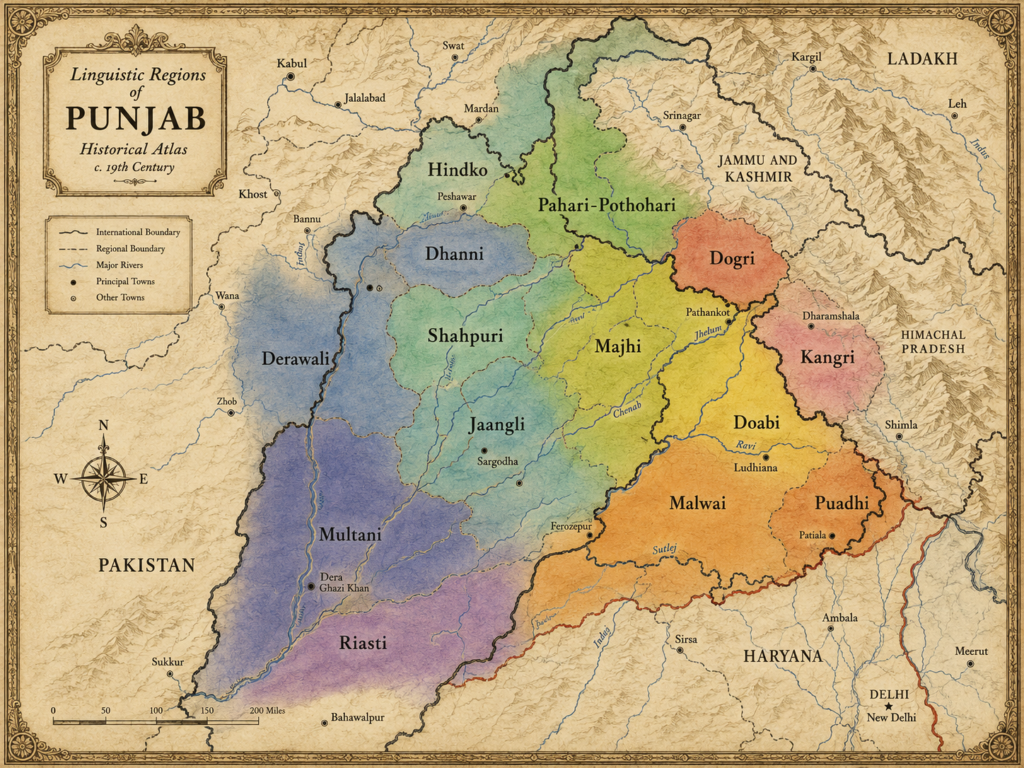
Doabi developed in the land between the Beas and Sutlej rivers. It was spoken across Jalandhar, Hoshiarpur, Kapurthala and surrounding areas.
The region had its own agricultural patterns, migration histories and social networks. In later decades, large numbers of people from the Doaba migrated overseas, particularly to the United Kingdom, Canada and the United States.
As a result, Doabi speech travelled far beyond Punjab.
Words and pronunciations that once belonged mainly to villages around Jalandhar or Hoshiarpur became part of Punjabi communities across the world.
Malwai
Malwai was spoken across a large part of southern and central eastern Punjab, including Ludhiana, Patiala, Sangrur, Bathinda, Mansa, Faridkot and Ferozepur.
The Malwa region developed its own powerful cultural identity. Its speech became prominent through folk music, rural storytelling and, more recently, Punjabi cinema and popular music.
Many expressions now heard widely in contemporary Punjabi entertainment carry a strong Malwai influence.
This creates an interesting reversal. A dialect that once belonged to a particular region can, through music and media, begin to shape how an entire generation imagines Punjabi.
Puadhi
Puadhi occupied the transitional region around Ambala, Rupnagar, Fatehgarh Sahib, Mohali and parts of eastern Patiala.
It stood at the meeting point of Punjabi, Haryanvi and other north Indian speech traditions. As a result, Puadhi reflected the movement and interaction of communities across what later became state boundaries.
Today, administrative maps encourage us to think of Punjab and Haryana as clearly separate linguistic spaces. Historically, the transition was far less abrupt.
Languages did not obey the borders that governments would later draw.
Western Punjab and Its Many Voices
The linguistic diversity of western Punjab was even greater than many modern accounts acknowledge.
The speech of Rawalpindi was not identical to that of Lahore. Multan did not speak like Sialkot. Jhang, Shahpur, Bahawalpur and Dera Ghazi Khan each belonged to different linguistic and cultural zones.
Pothohari
Pothohari was associated with the Pothohar plateau, including Rawalpindi, Gujar Khan, Jhelum, Murree and Mirpur.
Its sounds, vocabulary and rhythm differ noticeably from Standard Punjabi. It also shares features with neighbouring Hindko and Pahari speech traditions.
Pothohari survives strongly in Pakistan and among diaspora communities, particularly families connected to Mirpur and surrounding areas. Yet it is frequently compressed under the broader label of Punjabi.
This reflects one of the central problems in discussing Punjab’s languages. A regional variety may be widely spoken and culturally distinctive, yet still be treated merely as a dialect of a larger language.
The classification is rarely only linguistic. It is also political and social.
Dhanni, Chenavari and Shahpuri
Dhanni was associated with areas such as Chakwal and Talagang.
Chenavari developed along the Chenab belt.
Shahpuri was spoken around Shahpur, Sargodha and Khushab.
These names may be unfamiliar to many Punjabis today, but they once represented meaningful regional identities. They described how people spoke, where they came from and which cultural landscape they inhabited.
Some of these varieties later became absorbed into broader classifications. Others survived as local speech without receiving recognition in education, publishing or formal scholarship.
A language can remain alive in conversation even while disappearing from maps and textbooks.
Jhangvi, Multani and the Saraiki Question
The regions around Jhang, Multan, Bahawalpur and the Deras present an especially complex linguistic history.
Jhangvi, sometimes called Jhangochi or Rachnavi, was associated with Jhang, Chiniot and Toba Tek Singh. Shahpuri occupied neighbouring areas. Multani was spoken around Multan. Derawali was associated with Dera Ghazi Khan and Dera Ismail Khan. Bahawalpuri developed around Bahawalpur and Rahim Yar Khan. Thalochi was spoken around Bhakkar and Layyah.
Today, many of these speech traditions are connected with the broader identity of Saraiki.
Saraiki is now widely recognized as a distinct language by its speakers, scholars and cultural institutions. It possesses its own literary movement, political identity and standardized forms.
Yet historical classifications were less settled. Some colonial scholars grouped these varieties under terms such as western Punjabi or Lahnda. Others treated them as regional dialects. Modern communities have increasingly rejected those older labels.
This is why any reconstruction of Punjab’s linguistic past must remain careful.
The names used today do not always match the names used in 1900, 1947 or 1970. Linguistic identity evolves. Communities redefine themselves. Speech forms that were once described as dialects may later gain recognition as languages.
There is no entirely neutral vocabulary.
To name a language is also to make a statement about history, culture and belonging.
The Northern Hills and Borderlands
Punjab’s linguistic landscape extended into the northern hills and frontier regions.
Hindko was spoken across places such as Peshawar, Abbottabad, Haripur and Mansehra. Dogri was associated with Jammu, Kathua, Udhampur and Samba. Kangri was spoken around Kangra, Dharamshala and Hamirpur.
These forms existed at the edges of several cultural zones.
They shared features with Punjabi while also connecting to Pahari, Kashmiri and other Himalayan language traditions. Their speakers often lived within political structures connected to Punjab while maintaining distinct regional identities.
Dogri is now officially recognized as a separate language in India. Hindko has its own literary traditions and organizations in Pakistan. Kangri continues to be spoken in Himachal Pradesh, although its institutional position remains limited.
Their modern classifications remind us that the linguistic map of the past cannot simply be recreated using today’s categories.
The past was more entangled.
Where Did Punjabi End?
This seems like a simple question.
It is not.
Did Punjabi end where Dogri began? Where Pothohari became Hindko? Where Multani became Saraiki? Where Puadhi met Haryanvi?
There was no single answer.
People living near these linguistic frontiers often understood several neighbouring varieties. They adjusted their speech depending on the listener. A person might speak one form at home, another in the market and a more formal language in school or administration.
Identity was layered.
Someone could belong to a village, a district, a religious community, a caste, a kingdom and the wider Punjab at the same time. Language reflected those layers.
The modern desire to place every person into a single linguistic category does not always fit the historical reality.
Before states standardized education, censuses classified populations and political movements organized around language, people often lived comfortably within ambiguity.
They did not always need to decide whether their speech was a dialect, a language or something in between.
They simply spoke it.
A Shared Civilization, Not a Single Voice
The linguistic diversity of Punjab did not prevent a shared Punjabi civilization from emerging.
People across the region participated in overlapping traditions of poetry, music, storytelling, faith, food and folklore. The verses of Baba Farid, Bulleh Shah, Shah Hussain, Waris Shah and other poets travelled far beyond the dialects in which they were composed.
Stories changed as they moved.
A tale told in Multan might sound different in Amritsar. A song sung near the Chenab might acquire new words near the Sutlej. A proverb could survive across regions while shifting in pronunciation.
This was not cultural fragmentation.
It was cultural abundance.
Punjab’s unity came not from sameness, but from constant exchange.
Its people understood that a familiar idea could wear different words.
The Mistake of Looking Backward Through Modern Borders
Partition did more than divide Punjab geographically. It changed how later generations remembered the Punjab that came before it.
Indian Punjabis often grew up with a map centred on Amritsar, Ludhiana, Jalandhar and Patiala. Pakistani Punjabis grew up with one centred on Lahore, Faisalabad, Rawalpindi, Multan and Gujranwala.
Each inherited only part of the older landscape.
Over time, the linguistic diversity of undivided Punjab became harder to see. Regional speech traditions were grouped into national, provincial and educational categories. Some became standardized. Some were renamed. Some were pushed to the margins. Others survived mainly in homes, villages, songs and memories.
We began to imagine that Punjab had always spoken the Punjabi we know today.
It had not.
Before the Silence, There Was a Chorus
The Punjab before 1947 was not a place where everyone spoke the same language in the same way.
It was a place where language flowed across rivers, plains, hills and markets. It changed from district to district and sometimes from village to village. It carried traces of migration, trade, conquest, faith and geography.
Majhi, Doabi, Malwai, Puadhi, Pothohari, Jhangvi, Shahpuri, Multani, Derawali, Dhanni, Hindko, Dogri, Kangri and many other forms belonged to this vast linguistic world.
Some remain strong.
Some have gained recognition as separate languages.
Some survive quietly within families.
Some are remembered only through songs, expressions and the speech of elders.
Before we ask what Partition did to Punjabi, we must first understand what existed before Partition.
There was never one Punjabi voice waiting to be divided.
There was a chorus.
And in 1947, the map changed while that chorus was still singing.
Languages and Dialects of Punjab:
- Before 1947, Punjab Did Not Speak One Punjabi, Part I
- Partition Divided Punjab. It Also Divided Its Voices, Part II
- The Language Survived. Its Written World Did Not Remain Whole, Part III
Folklore of Punjab:
- Echoes of the Five Rivers: A Journey Through Punjabi Folklore
- Echoes of the Five Rivers, Part 1: The Soul of Punjab and Its Stories
- Echoes of the Five Rivers, Part 2: Themes, Motifs & the Soul of Punjabi Storytelling
- Echoes of the Five Rivers, Part 3: Folk Beliefs, Rituals & the Living Spirit of Punjab
- Echoes of the Five Rivers, Part 4: Folk Music, Songs & the Voice of the Land
- Echoes of the Five Rivers, Part 5: The Qissas – Love, Rebellion, and the Eternal River
- Echoes of the Five Rivers, Part 6: Saints, Seekers & the Soul of Punjab
- Echoes of the Five Rivers, Part 7: Legends of Valor, Justice & the Everyday Hero
- Echoes of the Five Rivers, Part 8: Folklore & Modernity – The Stories That Refuse to Die
- Echoes of the Five Rivers, Part 9: Reflections, Continuity & the River That Remembers
Rise and Fall of Sikh Empire:
- The Rise and Fall of the Sikh Empire: Part 1 – The Rise and Fall of Banda Bahadur
- The Rise and Fall of the Sikh Empire: Part 2 – Sikh Persecution
- The Rise and Fall of the Sikh Empire: Part 3 – Persian & Afghan Invasions
- The Rise and Fall of the Sikh Empire: Part 4 – The Rise of the Sikh Empire
- The Rise and Fall of the Sikh Empire: Part 5 – The Fall of Sikh Empire
👁️ 79 views