
The Last Client Post-Script: Rain, Shadows, and Unanswered Questions

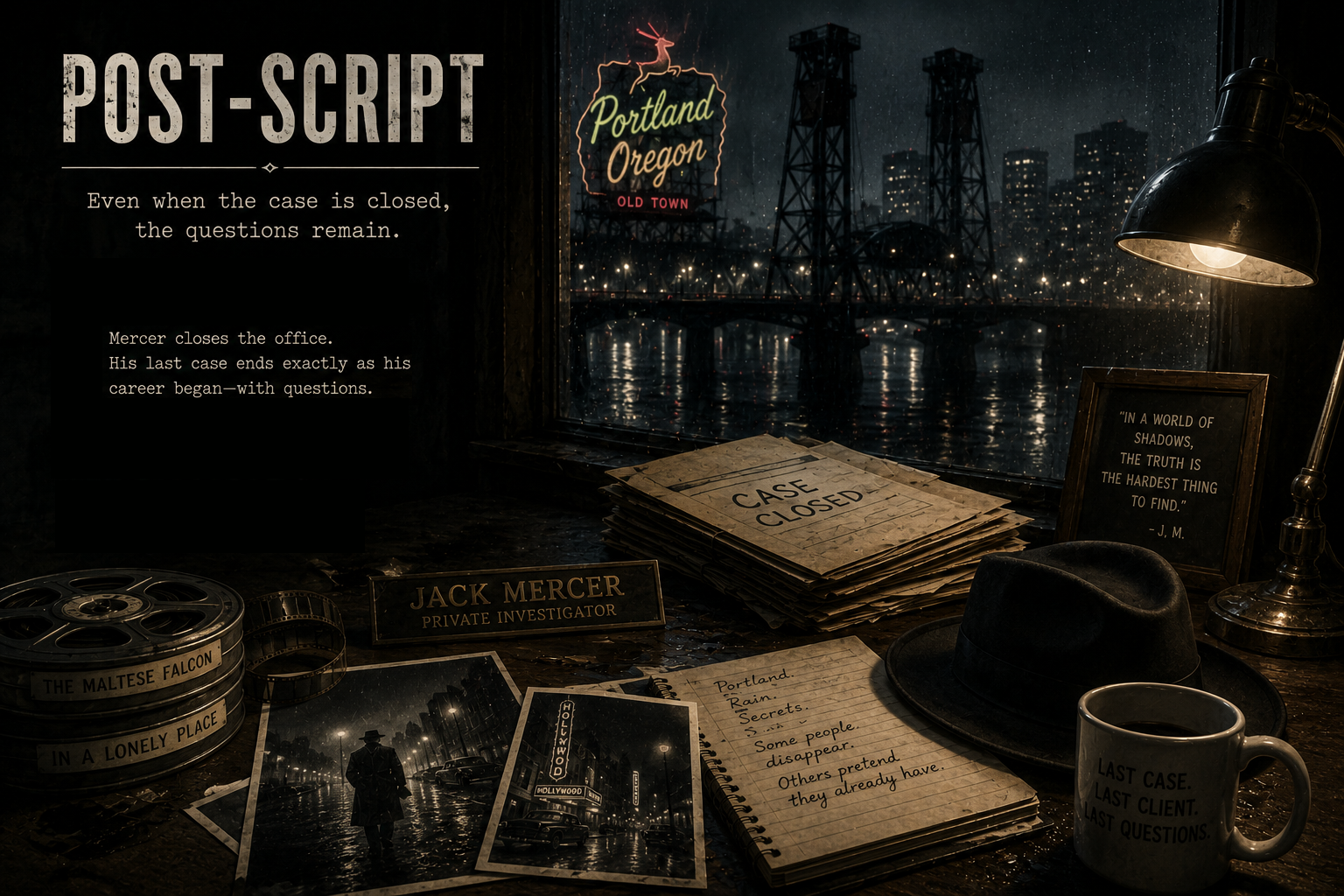
Every writer eventually stumbles upon a genre they have enjoyed for years but never attempted to write. For me, that genre was noir.
In May, while attending a sales conference in San Diego, I found myself unwinding in the evenings by watching some of the classic black-and-white noir films. Among them were The Maltese Falcon and In a Lonely Place. These films were made decades ago, yet they possess a timeless quality. The stories move at their own pace. The heroes are flawed. The villains are not always obvious. The cities themselves become characters. Most importantly, the endings often leave the audience with a lingering sense of unease.
As I watched those films, I began making notes. Not detailed outlines or character sketches, just fragments of ideas. A weary detective. A rainy city. A woman who may not be who she claims to be. A mystery that begins with a simple question and slowly reveals something darker beneath the surface.
Naturally, my thoughts drifted toward Portland, Oregon.
Portland is not usually the first city people associate with noir fiction. Yet on a rainy evening, it feels perfectly suited for it. The Willamette River disappears into mist. Bridges emerge from the darkness like steel skeletons. Streetlights reflect on wet pavement. Downtown streets become quieter, and every stranger seems to carry a story. The city possesses an atmosphere that rewards mystery.
That was the seed from which The Last Client grew.
The story follows Jack Mercer, a private investigator preparing to close his office after a long and unremarkable career. On his final evening, a woman named Eleanor Gray walks through the door with what appears to be a routine missing-person case. By the next morning, the missing husband is dead, and Mercer discovers that the woman who hired him officially died years earlier.
From there, the story becomes less about solving a murder and more about uncovering the truth behind a life built on deception.
Unlike many modern mysteries, I deliberately kept the plot relatively straightforward. The mystery is not designed to be an intricate puzzle box with dozens of suspects and endless twists. Instead, it follows a tradition common to many noir stories: revenge. Not revenge carried out in anger, but revenge patiently planned and carefully executed over many years.
The noir stories that inspired this tale often share a similar characteristic. Justice and the law are not always the same thing. The police do not necessarily solve the case. The truth does not always lead to an arrest. Sometimes the guilty escape punishment. Sometimes the wrong people suffer. Sometimes all that remains is understanding what happened.
That idea fascinated me.
By the end of The Last Client, Mercer uncovers the truth, but the case remains officially unsolved.
The city moves on.
The records remain incomplete.
The newspapers eventually lose interest.
What happened becomes known only to a handful of people.
Mercer closes his office.
His final case ends much the same way his career began: with unanswered questions.
In many ways, that feels more honest than a neat resolution.
Life rarely provides complete explanations. We do not always learn every motive. We do not always witness every consequence. We often settle for fragments of the truth and continue forward.
Perhaps that is why noir stories endure.
Beneath the murders, the detectives, the cigarette smoke, and the rain-soaked streets lies a simple recognition: people are complicated, truth is elusive, and some mysteries are never completely solved.
As for Jack Mercer, his office door may be closed, but somewhere in Portland the rain is still falling, the river is still moving, and there are undoubtedly more secrets waiting in the shadows.
Read other posts in this series:
- The Last Client, Act I
- The Last Client, Act II
- The Last Client, Act III
- The Last Client, Post Script
👁️ 147 views