
The Last Client, Act III – The Woman Who Died

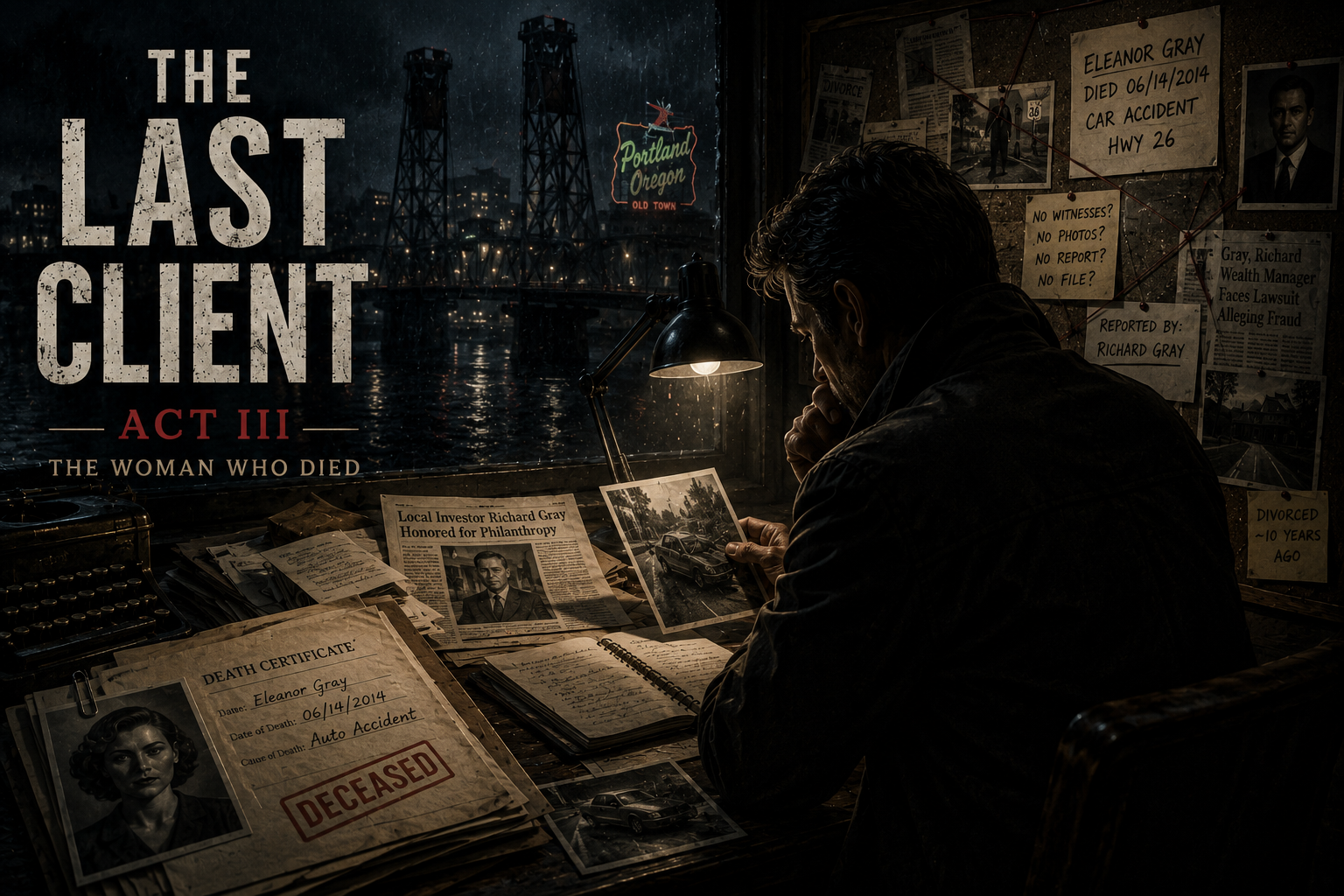
There are moments in an investigation when facts stop behaving like facts.
They stop lining up neatly.
They stop pointing in a direction.
Instead they begin circling each other like strangers in a dark room.
That was where I found myself the morning after discovering Eleanor Gray’s death certificate.
I had a dead husband.
A dead wife.
And a dead wife who had somehow walked into my office and hired me.
The sensible explanation was fraud.
The problem was that none of the evidence seemed interested in being sensible.
The rain had settled into one of those Portland downpours that looked permanent.
Water streamed off rooftops and pooled along the curbs. The city moved slower. Pedestrians hunched beneath umbrellas. Even traffic seemed reluctant.
I spent the morning learning about Richard Gray.
The real Richard Gray.
Not the smiling man in the photograph.
Not the successful investment manager praised in business journals.
The other Richard Gray.
The one hidden beneath the surface.
Those are always the interesting ones.
By noon, I was sitting across from a woman named Helen Vickers.
She managed human resources at the investment firm where Gray had worked for nearly fifteen years.
Her office overlooked the Willamette.
On a clear day the view was probably impressive.
Today all you could see was rain.
“Richard was respected,” she said.
“By whom?”
She blinked.
“Most people.”
“Most isn’t everyone.”
“No.”
“Who didn’t like him?”
The hesitation told me enough.
“His first wife.”
That got my attention.
“I thought his current wife was Margaret Gray.”
“She is.”
“Then who’s the first wife?”
“Eleanor.”
The name seemed to hang in the room.
The first confirmation I’d received that Eleanor Gray had actually existed.
“Tell me about her.”
Helen shifted uncomfortably.
“They divorced.”
“When?”
“About ten years ago.”
The timing immediately bothered me.
Ten years.
The same year Eleanor supposedly died.
“Friendly divorce?”
“No.”
“Why not?”
Helen looked toward the window.
“Richard wasn’t a pleasant man.”
That surprised me less than it should have.
People who seem perfect usually have something to hide.
“Abusive?”
“I didn’t say that.”
“You didn’t have to.”
She folded her hands.
“There were rumors.”
“About what?”
“Control. Manipulation. Affairs.”
That fit the picture much better. The charming smile. The expensive suit. The carefully managed reputation.
I’d met enough men like Richard Gray.
People mistook charm for character. The two rarely traveled together.
“Did Eleanor ever work here?”
“No.”
“What happened after the divorce?”
“I don’t know.”
“Did anyone keep in touch?”
“No.”
“Not even Richard?”
She laughed softly.
“There was no reason to.”
The answer sounded rehearsed.
I made a note.
People rehearse lies.
Truth usually arrives unprepared.
The second stop was less respectable.
A bar near the waterfront.
The kind of place where dockworkers, drifters, and off-duty cops occasionally shared the same whiskey.
The sign outside read:
THE PILOT HOUSE
The “I” had long broken. It read PLOT HOUSE. Half the letters no longer lit up fully.
Inside, the air smelled of beer and old wood.
The bartender knew Richard Gray.
That alone told me I was finally asking the right questions.
“Sure,” he said.
“Used to come in here.”
“When?”
“Years back.”
“Before or after the divorce?”
“Before.”
I slid a twenty across the bar.
His memory improved immediately.
“They’d fight.”
“Richard and Eleanor?”
He nodded.
“Bad?”
“I’ve seen worse.”
He paused.
“Not many.”
The rain hammered against the windows.
A freight train horn echoed somewhere beyond the river.
“What happened?”
The bartender polished a glass.
People always find something to polish when they don’t want to answer.
“Richard liked being in charge.”
“And Eleanor?”
“Didn’t.”
That sounded promising.
“Any violence?”
He stopped polishing.
“One night she came in with a bruise.”
Silence.
“Did she say where it came from?”
“No.”
“Did you believe her?”
“No.”
The bartender finally looked up.
“Neither did she.”
By evening I had assembled a picture.
Not a complete one.
Just enough pieces to see the outline.
Richard Gray wasn’t the victim everyone assumed.
He wasn’t beloved.
He wasn’t admired.
He wasn’t even particularly liked.
He was tolerated.
Feared.
Respected in the way people respect a loaded gun.
The more I learned, the less surprised I became that somebody had eventually shot him.
The mystery wasn’t why he died.
The mystery was why it took so long.
At six that evening, Lieutenant Donnelly called.
“Jack.”
“Frank.”
“We identified next of kin.”
I sat up.
“Margaret?”
“Current wife.”
“What’d she say?”
“Interesting thing.”
Frank paused.
“She says Richard never mentioned an Eleanor.”
I frowned.
“Impossible.”
“Gets better.”
“How?”
“Margaret says Richard told her his first wife died before they met.”
I stared at the receiver.
Outside, thunder rolled across the city.
“You’re sure?”
“That’s what she told us.”
“Did she seem truthful?”
“As truthful as anyone who’s husband got shot yesterday.”
That wasn’t an answer.
Frank continued.
“There’s something else.”
I waited.
“The accident report.”
“What about it?”
“We pulled it.”
My pulse quickened.
The accident.
The death certificate.
The woman who shouldn’t exist.
“What did you find?”
“Nothing.”
“Nothing?”
“No police photographs.”
“No witness statements.”
“No autopsy.”
“No investigation file.”
The silence stretched.
“How does that happen?”
“It doesn’t.”
A cold feeling settled in my stomach.
Missing paperwork wasn’t unusual.
Missing everything was.
“What are you saying?”
“I’m saying somebody wanted that file gone.”
Two hours later I sat alone in my office.
The boxes still waited beside the desk.
Half a lifetime packed and ready to leave.
The rain continued its endless conversation with the city.
I spread the evidence across my desk.
The photograph.
The death certificate.
My notes.
The accident report number.
The disconnected telephone number.
All of it.
I stared at Eleanor’s name.
Over and over.
Something refused to fit.
Then I saw it.
Not a clue.
A question.
The one thing nobody had asked.
If Eleanor Gray had truly died ten years ago … Who reported the accident?
I opened the death certificate again.
My eyes moved down the page.
Cause of death.
Location.
Coroner.
Witness.
Then finally: Reporting Party: Richard Gray.
I sat back.
The office suddenly felt very quiet.
Because out of everything I’d learned during the past two days, that detail disturbed me most.
Richard Gray had reported the death.
Richard Gray had identified the body.
Richard Gray had signed the paperwork.
Richard Gray had closed the case.
And now Richard Gray was dead.
Outside, a siren wailed somewhere in the distance.
The city kept moving.
The rain kept falling.
But for the first time since Eleanor Gray walked into my office, I knew where to look next.
Not for a murderer.
For a body.
Because I was beginning to suspect that ten years ago, nobody had ever proven Eleanor Gray was the woman in that wrecked car.
And if that was true, then somewhere in Portland there might still be a living woman who had spent a decade pretending to be dead.
Read other posts in this series:
- The Last Client, Act I
- The Last Client, Act II
- The Last Client, Act III
- The Last Client, Post Script
👁️ 111 views
Share this post :
Archives
| M | T | W | T | F | S | S |
|---|---|---|---|---|---|---|
| 1 | 2 | 3 | 4 | |||
| 5 | 6 | 7 | 8 | 9 | 10 | 11 |
| 12 | 13 | 14 | 15 | 16 | 17 | 18 |
| 19 | 20 | 21 | 22 | 23 | 24 | 25 |
| 26 | 27 | 28 | 29 | 30 | 31 | |
Categories
Missives from Planet Nagi
Sign up for our newsletter.
Get insightful stories, updates, and inspiration delivered straight to your inbox. Be the first to know what’s new and never miss a post!