

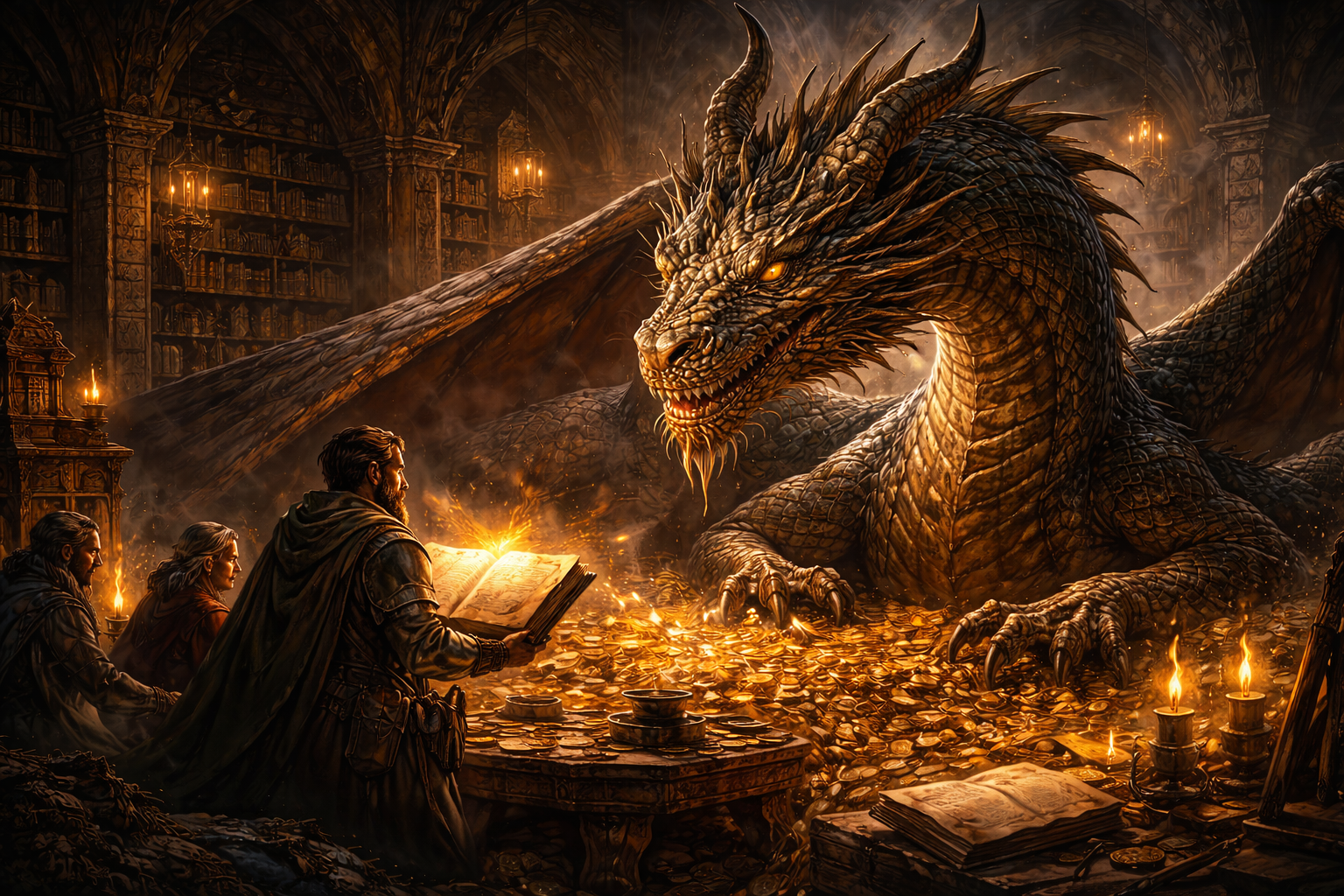
When dragons enter literature, they learn to speak.
Not always aloud, at first. Sometimes they speak through allegory, through inheritance, through bloodlines and symbols. But something essential changes once dragons move from oral tradition and folklore into sustained written narrative. They are no longer only forces or problems. They become subjects. They acquire memory, intention, and voice.
Literary dragons are born at the moment when stories stop asking only how the world works and begin asking what it means.
Early literary dragons still carry the weight of earlier traditions. They arrive from myth and theology burdened with symbolism. In romantic epics and medieval romances, dragons are often tests rather than characters. They guard maidens, borders, or virtues. They exist so the hero can demonstrate courage, purity, or divine favor.
But even here, something is shifting.
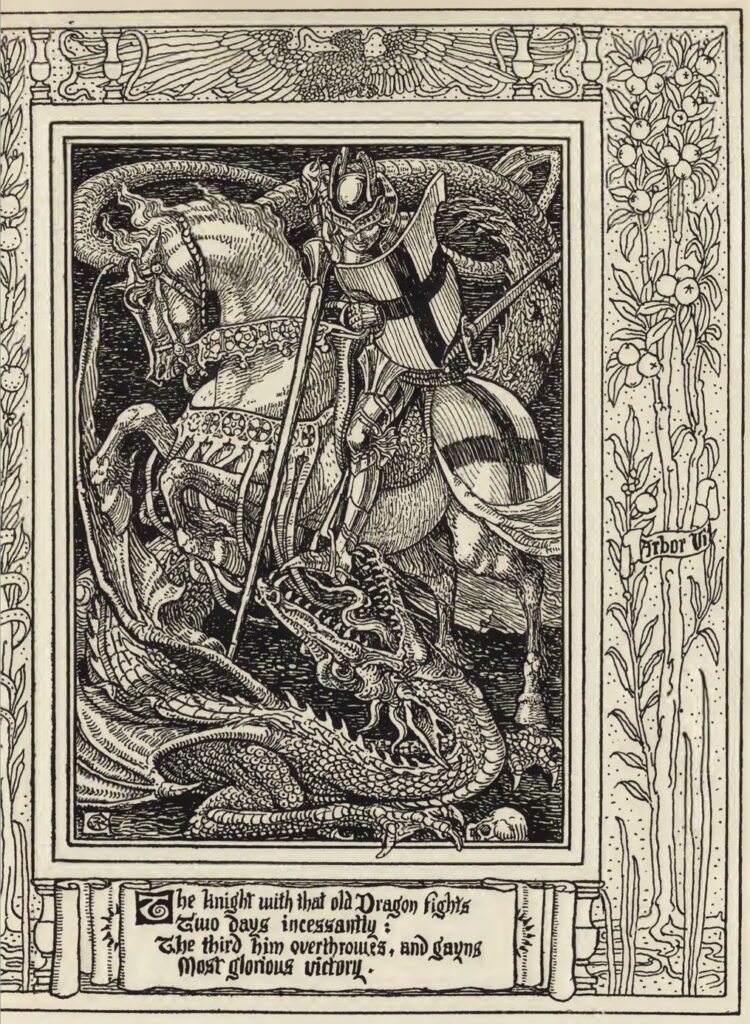
In Edmund Spenser’s The Faerie Queene, dragons are no longer merely beasts to be slain. They are allegorical engines. The dragon embodies error, falsehood, or corruption at a scale large enough to justify epic struggle. Its defeat is not simply a plot point. It is a philosophical assertion. Truth triumphs. Order is restored. The world aligns with its moral architecture.
Yet Spenser’s dragon is already more than a sermon illustration. It has presence. It occupies space in the poem. It requires sustained engagement. The fight takes time. The dragon adapts. It is wounded. It is dangerous.
This length matters. It signals that the dragon can no longer be dispatched casually. It deserves narrative attention.
As literature matures, dragons begin to accumulate ancestry. They are no longer isolated encounters. They are descended from earlier dragons, tied to ancient curses, embedded in long histories. Heroes become “sired by a dragon” figuratively or literally. Bloodlines matter. Dragon-slaying leaves marks that persist beyond the story’s end.
This is the point where dragons begin to exert gravity on narrative itself.
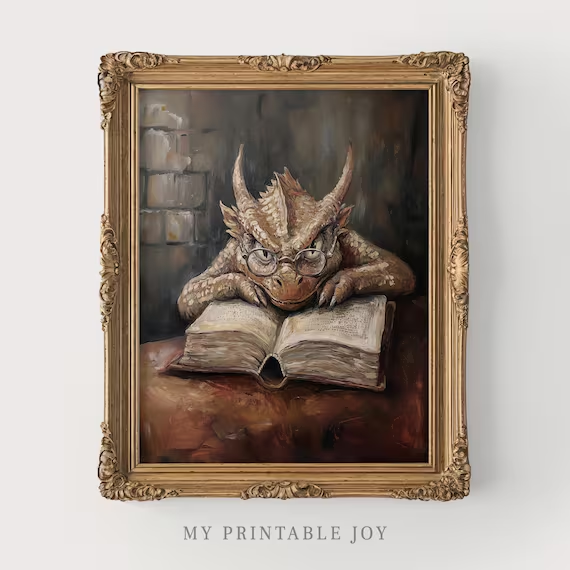
Children’s literature plays a surprising role in this transition. While often dismissed as simplistic, it experiments boldly with dragon psychology. Dragons become grumpy, lonely, misunderstood. They hoard not gold but habits. They burn villages because that is what dragons are expected to do. They are trapped by reputation.
These stories do not redeem dragons so much as complicate them. They ask whether the dragon’s role is chosen or imposed. Whether identity can be rewritten. Whether a creature born into fear can ever be seen otherwise.
That question echoes forward.
The real inflection point arrives when dragons gain intellect equal to or exceeding that of humans. When they become conversational partners rather than obstacles. This is where modern fantasy begins.
And no discussion of literary dragons can avoid the shadow cast by one in particular.
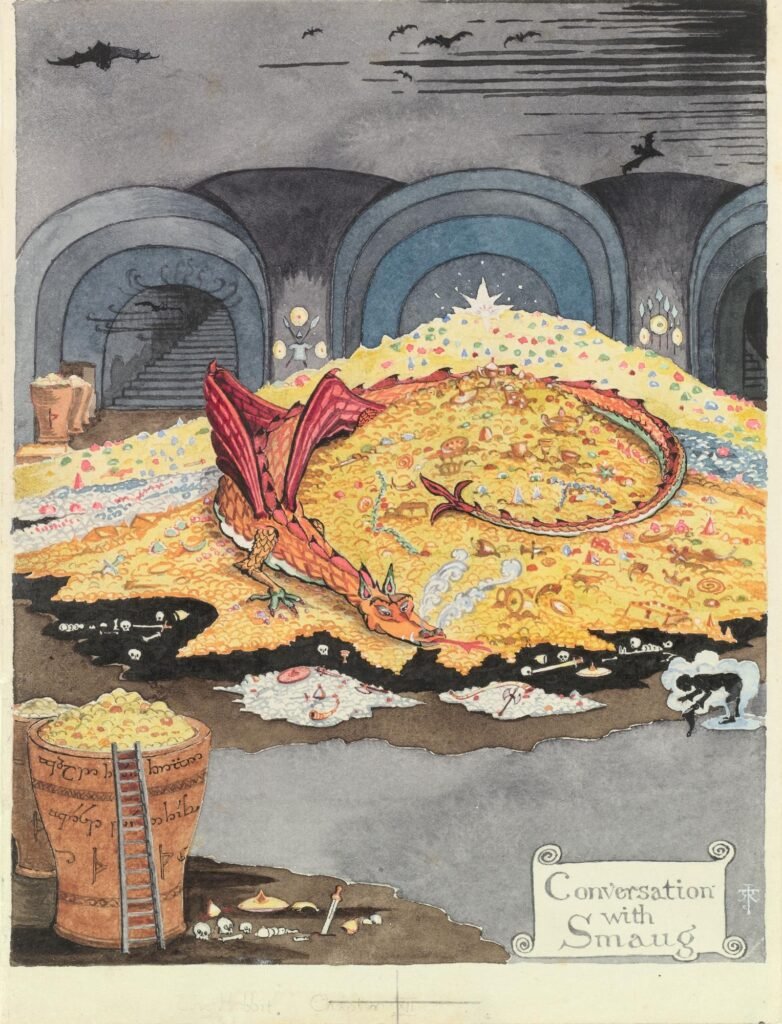
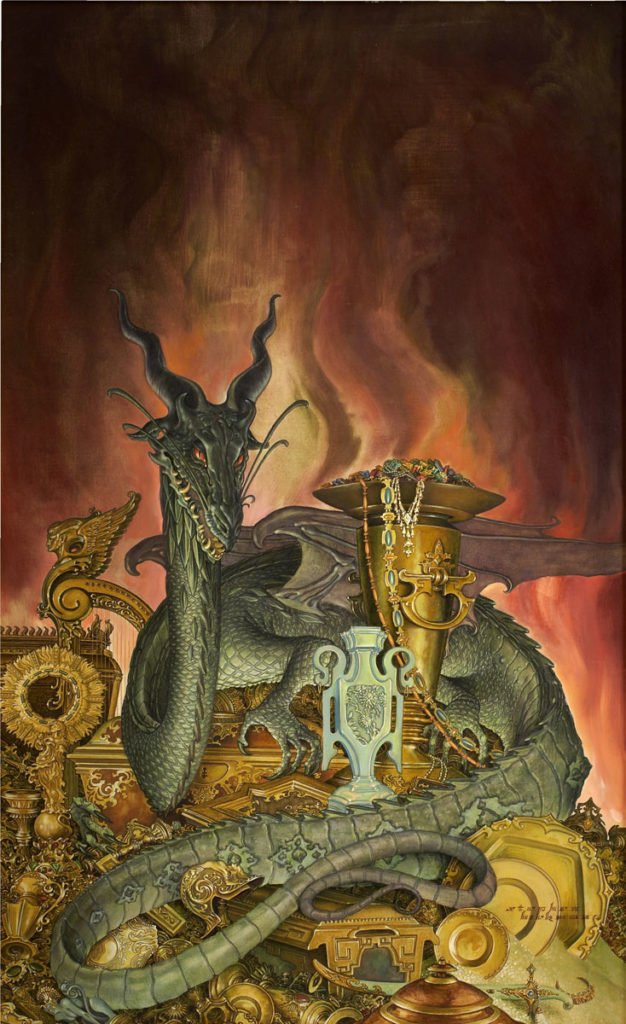
Smaug is not the first intelligent dragon in literature, but he is the one who made intelligence unavoidable. He does not simply threaten. He taunts. He does not merely guard treasure. He understands it, counts it, lies upon it with proprietary intimacy. His speech is seductive, precise, and cruel. He knows the effect of words. He uses them as weapons.
What makes Smaug extraordinary is not his power, but his awareness. He knows he is feared. He enjoys it. He understands history well enough to manipulate it. He can reduce heroes to instruments in his own narrative.
This changes the relationship between dragon and reader.
Earlier dragons demanded awe or fear. Smaug demands attention. You cannot skim his scenes. You must listen. He forces the story to slow down, to linger in dialogue rather than combat. The dragon becomes a scene-stealer, not because of spectacle, but because of presence.
With Smaug, the dragon is no longer merely symbolic. He is specific.
This specificity opens the floodgates. Once dragons are allowed to think, remember, and speak, they proliferate in every direction. Modern fantasy fills with them: ancient dragons bound by oaths, philosophical dragons who question humanity, weary dragons who have outlived their relevance, playful dragons who undercut their own menace.
Some are monstrous. Some are noble. Some are tragic. Some are absurd.
What unites them is interiority.
Literary dragons become mirrors. They reflect human anxieties about power, memory, greed, isolation, and time. They ask uncomfortable questions. What does it mean to live too long? What happens when accumulation replaces participation? What is the cost of being untouchable?
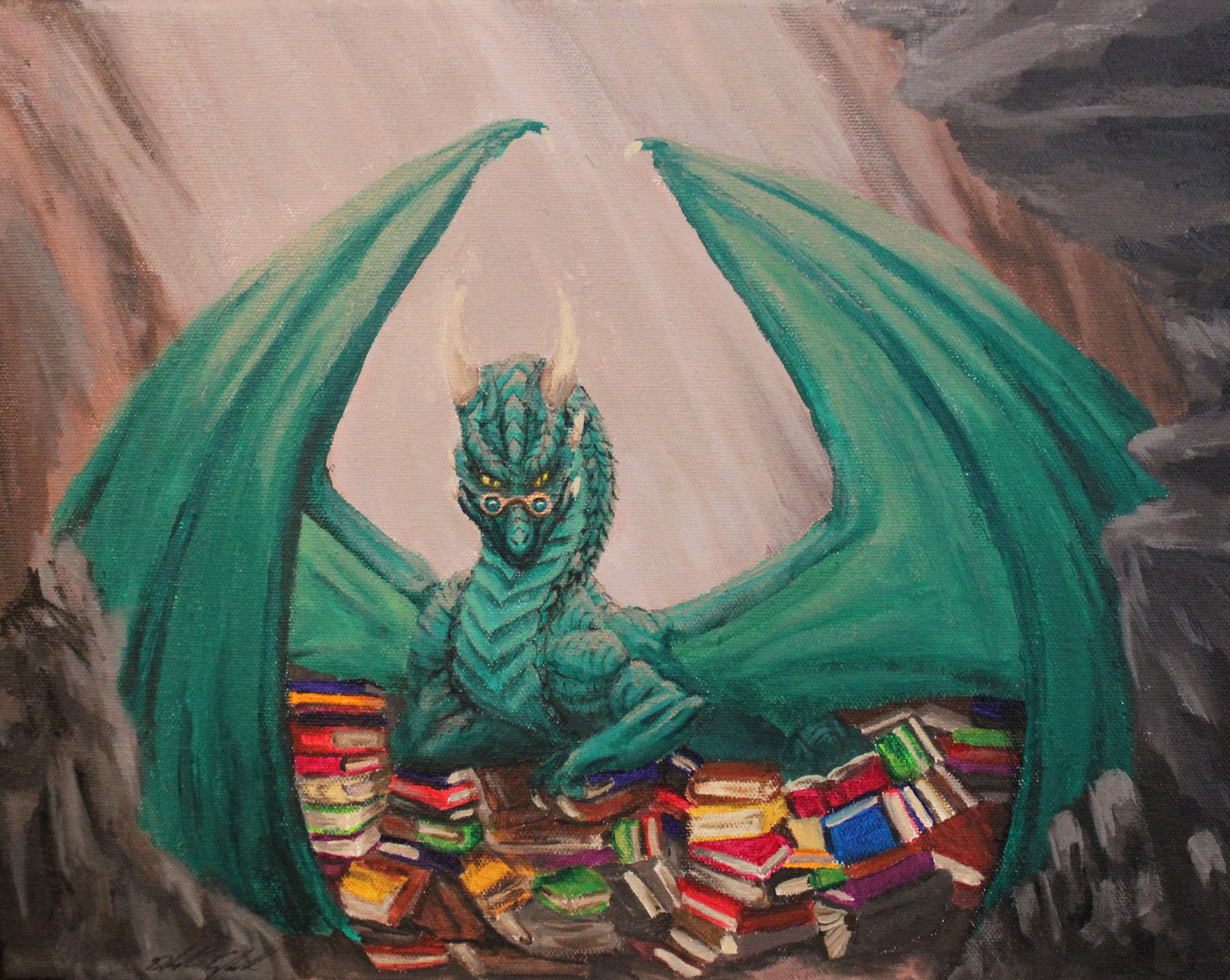
The hoard, once a simple plot device, becomes metaphor again. It is wealth, yes, but also memory. Knowledge. History. Everything the dragon refuses to release. The dragon becomes the ultimate archivist, preserving the past by sitting on it.
This makes dragons uniquely suited to long-form storytelling. They stretch across generations. They remember things the narrative has forgotten. They impose continuity on worlds that might otherwise feel episodic.
As fantasy literature evolves, dragons also become tools for examining perspective. A dragon’s scale forces a rethinking of stakes. What matters to a creature that has seen empires rise and fall? How trivial do human conflicts appear from that vantage point? How frustrating must it be to live among creatures who constantly mistake urgency for importance?
Some modern dragons are explicitly weary. They are tired of being hunted, misunderstood, summoned, or symbolized. Others embrace their role with irony. They lean into the expectations placed upon them, using myth as camouflage.
This self-awareness marks the final stage of literary dragon evolution. The dragon knows it is a dragon. It understands the stories told about it and uses that knowledge strategically.
At this point, the dragon becomes almost impossible to classify. Villain, ally, antagonist, mentor. It can be all of these without contradiction. Its moral alignment is situational rather than fixed.
This flexibility explains why dragons dominate fantasy while other mythic creatures remain niche. Dragons scale with narrative ambition. They can support epic history or intimate conversation. They can anchor a world or disrupt it. They can be background or foreground without losing coherence.
They are, in a sense, the perfect literary invention.
But there is a cost to this sophistication. As dragons become more articulate, they risk losing their strangeness. A dragon that thinks exactly like a human in scaled form is no longer a dragon. It is a costume. The best literary dragons resist this flattening. They remain alien even when sympathetic. Their values diverge. Their timelines mismatch. Their ethics do not map cleanly onto human ones.
The “impossible dragon” emerges here. A creature that is both intelligible and unknowable. One that can converse without reassuring. One that remembers too much, values differently, and refuses to resolve into allegory.
This is where dragons reach their full literary potential.
They are no longer simply about fear or power. They are about difference. About the difficulty of coexistence across scales of experience. About the tension between continuity and change. About what it means to live in a world where not all intelligence shares the same priorities.
In this sense, literary dragons are deeply modern. They reflect anxieties about technology, longevity, inequality, and legacy. They ask what happens when power concentrates and time stretches. They ask who gets to decide what matters.
And they do so without sermons.
That is the triumph of the literary dragon. It carries the weight of ancient myth, the scars of theology, the humor of folklore, and the voice of modern introspection. It is a palimpsest, layered with meaning, impossible to reduce to a single function.
In the next and final part of this series, the dragon leaves the page and returns to the world. It appears in art, architecture, relics, museums, and modern imagination. It becomes something we seek rather than flee. Something we curate rather than kill.
But here, in literature, the dragon becomes fully itself. No longer merely a thing encountered, but a presence that reshapes the story simply by being there.
Fire has become ink. And the dragon, at last, has learned how to write itself into permanence.
Other posts in this series:
- How Dragons found me: My lifelong fascination with them
- Dragons, Part 1: When Chaos Had Scales, or Dragons of the Ancient World
- Dragons, Part 2: Beneath Clouds and Currents – Dragons of the East
- Dragons, Part 3: Coiled Around the World – Wyrms of the Northern Lands
- Dragons, Part 4: Saints, Serpents, and the Invention of Evil
- Dragons, Part 5: Village Nightmares and Clever Beasts: Dragons of Fable and Folklore
- Dragons, Part 6: From Fire to Ink: Dragons in Literature
- Dragons, Part 7: Where Dragons Still Live
👁️ 148 views