
Some Pleasures Need No Business Case

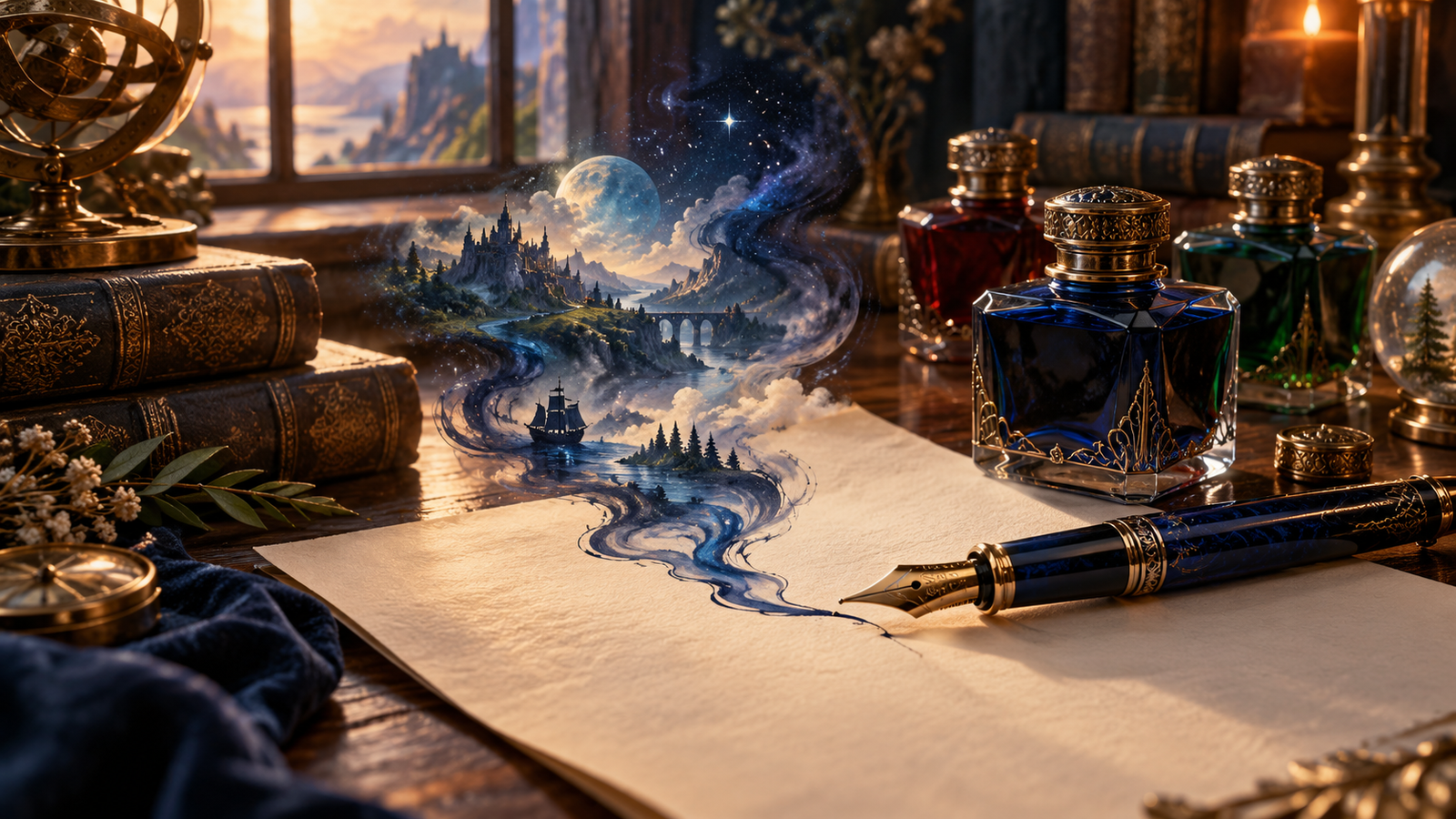
Recently, I acquired several bottles of ink from Ferris Wheel Press. These were inspired by The Lord of the Rings, Superman, and Harry Potter. They came in unusual colors, beautiful bottles, and elaborate packaging designed to evoke the worlds behind them.
Someone looked at the collection and asked me a practical question.
“What will you do with all that ink?”
“Use it in my fountain pens, of course,” I replied.
It seemed like an obvious answer. Ink goes into fountain pens. Fountain pens write on paper. Case closed.
Except it was not.
The question stayed with me because I knew I already had more ink than I reasonably needed. Unless I planned to copy the entire history of Middle-earth by hand, annotate every Superman comic ever published, and then write my own expanded version of the Hogwarts curriculum, I was unlikely to finish it all.
Why, then, did I want it?
Perhaps it was nostalgia. The inks were connected to stories I had loved at different stages of my life. They were small bottles filled not only with color, but also with memories. A green or brown inspired by Middle-earth could take me back to the first time I encountered Tolkien. A Superman ink could recall the uncomplicated heroism of childhood comics. A Harry Potter ink could reopen the excitement of discovering a magical world alongside millions of other readers.
But nostalgia alone did not seem to explain it.
I was not trying to return to the past. I was looking for a way to slow down in the present.
We now live in a world where nearly everything is designed for speed. We type faster than we write. We send messages before we have fully considered them. We skim articles, scroll past photographs, and watch videos at increased playback speeds because apparently normal time has become too slow for us.
Our devices constantly promise to save us time. Yet somehow, we never seem to have any.
The fountain pen does not participate in this race. It saves no time. It does not automatically correct spelling, complete sentences, reorganize paragraphs, or synchronize thoughts across devices. It asks you to sit down, open a notebook, uncap the pen, and begin.
That may be precisely its value.
Writing by hand creates friction. In the language of modern technology, friction is considered undesirable. Every extra step must be removed. Every experience must become seamless. We want one-click purchases, instant responses, automatic recommendations, and information delivered before we know we need it.
But not all friction is bad.
Sometimes friction forces us to pay attention. A fountain pen makes us conscious of the paper, the nib, the movement of the hand, and the formation of each letter. Thoughts cannot escape onto the page as quickly as they arrive. They must wait their turn. In that waiting, some thoughts disappear. Others become clearer.
The slower pace becomes a filter.
When typing, I can produce a paragraph quickly and delete it just as quickly. The words feel temporary. They can be rearranged, copied, corrected, or erased without leaving a trace. On paper, even a mistake remains faintly visible. A crossed-out sentence records a change of mind. An inserted word reveals hesitation. The page preserves not only the final thought but also some of the journey that produced it.
That makes handwriting imperfect, but it also makes it honest.
A handwritten page carries evidence that a human being was there. The pressure changes. The letters lean. The spacing expands when the writer is relaxed and contracts when the writer is in a hurry. The ink may grow lighter as the pen begins to run dry. A smudge may mark the moment when patience failed.
None of this would survive in a perfectly formatted digital document.
I am not opposed to digital technology. I have spent much of my professional life working with it. I write on computers, communicate through screens, and store more information electronically than I could ever maintain on paper. Digital tools are faster, more efficient, and often indispensable.
But efficiency is not the purpose of every activity.
We have gradually allowed the logic of productivity to enter almost every part of life. Reading must produce knowledge. Walking must produce steps. Hobbies must become side businesses. Collections must appreciate in value. Even rest is discussed as a way to improve future performance.
We seem increasingly uncomfortable doing something simply because it gives us pleasure.
Perhaps I do not need to justify the ink.
Perhaps it is enough that I enjoy filling a pen, watching the feed darken, and seeing the first line appear on paper. It is enough to notice how an ink shades differently depending on the nib. It is enough to tilt the page and discover a sheen that was invisible a moment earlier.
Some pleasures do not need a business case.
Still, fountain pens and inks offer something deeper than pleasure. They represent continuity in a disposable age.
Most of the objects around us are not expected to grow old with us. Electronics are replaced every few years. Applications disappear. File formats become obsolete. Online services shut down. Messages that once felt important become buried beneath thousands of newer messages.
We generate an extraordinary quantity of information, but much of it feels strangely impermanent.
A fountain pen is different. It can be cleaned, repaired, refilled, and used again. A good pen may pass from one generation to another. It may carry scratches from one owner and acquire new ones from the next. Its value is not diminished by evidence of use. The evidence becomes part of its story.
Paper also has a stubborn physical presence. A notebook occupies space. It can be found unexpectedly at the bottom of a drawer. It can fall open to a page written years earlier. The handwriting may belong to a younger version of ourselves whose ambitions, anxieties, and certainties we barely recognize.
Digital archives wait to be searched. Paper can surprise us.
There is also a difference between remembering something and encountering the object connected to that memory. A digital photograph of an old letter may preserve its content, but it does not preserve the experience of holding the paper, seeing the faded ink, or recognizing the pressure of a familiar hand.
The object is not the memory, but it gives the memory somewhere to live.
That may be what attracts me to these inks inspired by fictional worlds. Stories are intangible. Middle-earth does not exist on any map. Hogwarts cannot be reached by train. Krypton is not somewhere we can travel. Yet stories become part of our lives because of what they awaken within us.
An ink inspired by one of those worlds makes the connection physical. The color leaves the bottle, travels through the pen, and becomes part of something I write. The story that once lived only in a book or on a screen now leaves a small trace on my page.
It is not merchandise pretending to be meaning. Meaning comes from the relationship we create with it.
Of course, there is another uncomfortable question. Who will eventually read the pages we write?
Perhaps no one.
Not every notebook becomes a family heirloom. Not every handwritten reflection contains wisdom. Future generations may not carefully examine our journals and declare that they have discovered the lost philosophy of an ancestor. They may look at the shelves, wonder why one person needed so many pens and inks, and start searching for a large cardboard box.
That possibility does not make the writing meaningless.
The value may exist in the moment of writing itself. The notebook allows us to think without performing for an audience. It does not count likes, invite comments, or reward outrage. It does not require us to become a public version of ourselves.
On paper, we can write something uncertain.
That freedom has become rare. Online, every statement can feel permanent even though the medium itself is fragile. A careless sentence may travel widely, while a thoughtful one disappears unnoticed. The audience is always present, even when we pretend it is not.
A private page changes the conversation. We can contradict ourselves, explore uncomfortable ideas, and admit that we do not know. We can think before we announce what we think.
This is not merely nostalgia. It is contemplation.
So, what will I do with all that ink?
Some of it will fill fountain pens. Some will become swatches. Some will be used for notes, unfinished essays, stray observations, and ideas that may never go anywhere. A few bottles may remain almost untouched because admiring them will prove easier than choosing the right pen.
And yes, some of the ink may outlive me.
I am surprisingly comfortable with that.
We do not ask a bookshelf to be empty before buying another book. We do not insist that every piece of music be heard only once. The things we love are rarely valuable because we have efficiently consumed them. They are valuable because they remain available to us, holding possibilities.
The bottles on my desk hold color, certainly. But they also hold stories, rituals, attention, and time. They remind me that not every meaningful act must be fast, optimized, or useful.
Perhaps I am collecting ink because it connects me to the past. Perhaps I am using it to protect a small part of the present from constant distraction. Perhaps I am leaving something for the future, even if it is only a few handwritten pages that prove I once sat quietly and paid attention.
The ink is not really the point.
The point is what happens when the world grows quiet, the nib touches the paper, and a thought is finally given enough time to become a sentence.
Link to other posts:
👁️ 2 views