
Jaane Bhi Do Yaaron: The Joke That Refused to Get Old

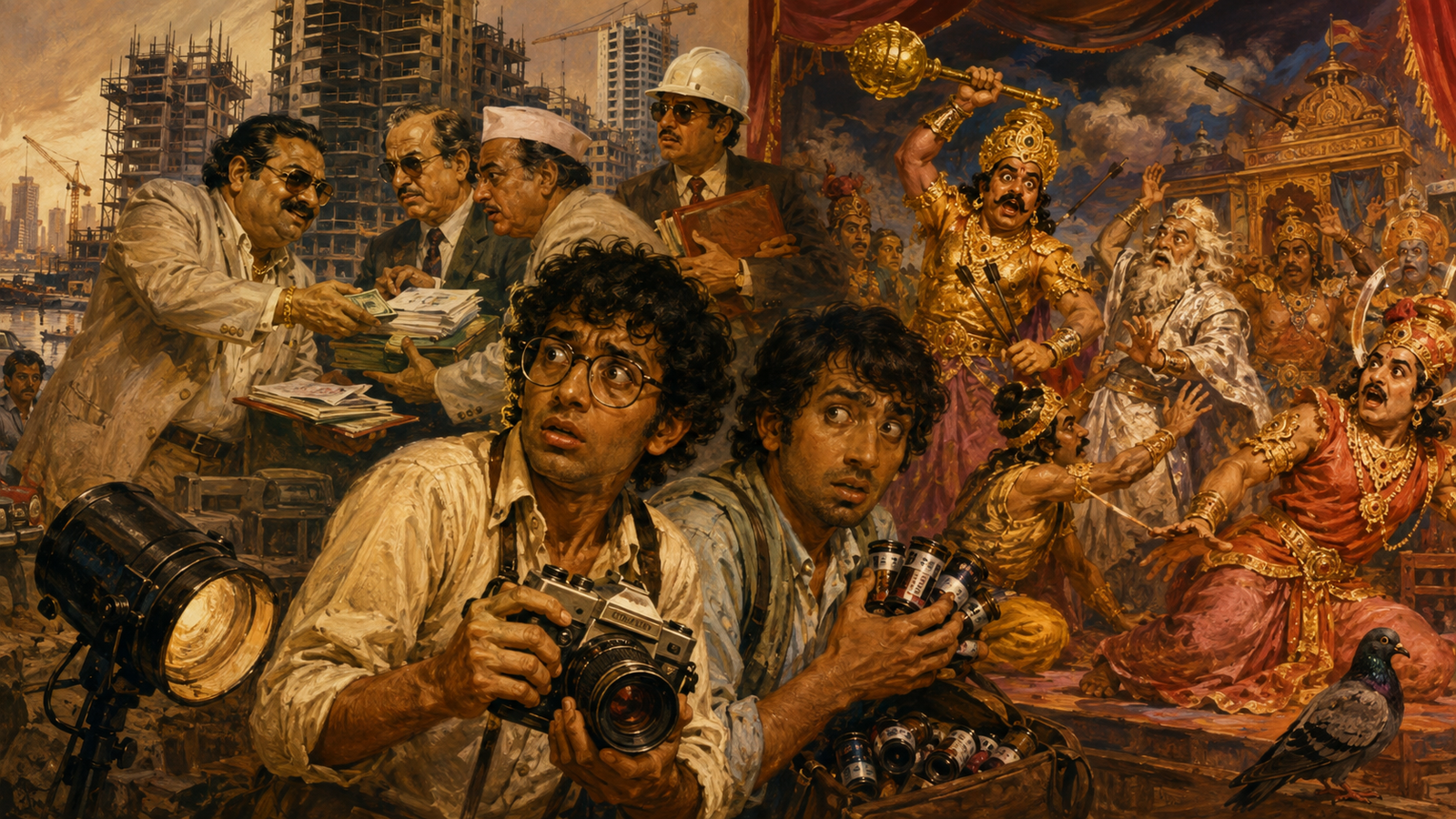
There are films that age because the world moves on. Then there are films that become more relevant because the world stubbornly refuses to move on. Kundan Shah’s Jaane Bhi Do Yaaron belongs to the second category. Released in 1983, it was a low-budget satire about two struggling photographers who stumble into a murder and discover that corruption is not an aberration in the system. It is the system. More than four decades later, the clothes and Bombay skyline may look dated, but the machinery around Vinod and Sudhir feels disturbingly familiar.
The premise begins almost innocently. Vinod Chopra, played by Naseeruddin Shah, and Sudhir Mishra, played by Ravi Baswani, open a photography studio and wait for customers who never arrive. They are broke, hopeful and naive enough to believe that honesty should eventually matter. A newspaper editor, Shobha Sen, hires them to expose corrupt builder Tarneja. Their camera accidentally captures something much bigger: Tarneja murdering Municipal Commissioner D’Mello. What follows is part detective story, part slapstick, part political satire, and eventually controlled cinematic insanity.
Even the names Vinod Chopra and Sudhir Mishra contain an inside joke. Vidhu Vinod Chopra was the film’s production controller, while Sudhir Mishra worked on the screenplay and assisted Kundan Shah. Both would later become significant filmmakers. The film was filled with people who were not yet the institutions we now recognize: Naseeruddin Shah, Om Puri, Pankaj Kapur, Satish Shah, Satish Kaushik, Neena Gupta, Ravi Baswani, cinematographer Binod Pradhan and editor Renu Saluja. Looking at the credits today feels like discovering an old college photograph in which almost everyone became famous.
The movie itself was made with almost no money. NFDC reportedly sanctioned about Rs 6.85 lakh, with the final cost rising to roughly Rs 7.25 lakh. Naseeruddin Shah was paid Rs 15,000. Satish Kaushik, who helped write the dialogue and also played Ashok, recalled receiving Rs 5,000. The cast did not even get free passes for the premiere. Kaushik remembered arriving at Maratha Mandir expecting the trappings of a premiere, only to find Kundan Shah outside with tickets and asking everyone to reimburse him. Afterward, there was no party. Kaushik walked to the railway station and ate dinner at a dhaba.
There are other stories perfectly suited to a film this chaotic. Kundan Shah reportedly recruited Om Puri after narrating the story to him on a local train. Puri agreed without reading the script. Vidhu Vinod Chopra later recalled an early cut that ran seven or eight hours. Anupam Kher had an entire role as a visually challenged “Disco Killer,” a murderer whose aim was so bad that he could hit a mango while aiming at a man. Every scene was removed. Even the title came from a song sequence, featuring the photographers singing to a dog, that was cut from the film.
All of this makes Jaane Bhi Do Yaaron sound like a film that somehow survived its own making. Perhaps that is part of its charm. Kundan Shah later remembered the shoot as exhausting, full of arguments and uncertainty. Yet underneath the apparent disorder was a sharp understanding of power. Everyone in the film is willing to sell something. Builders buy officials. Officials sell decisions. Journalists sell principles. The truth itself becomes a commodity, valuable only until someone offers a better price.
That is why the film’s most famous sequence is not merely comic relief. It is the logical destination of everything that came before it.
Vinod and Sudhir, dragging D’Mello’s corpse through Bombay while being chased by nearly every corrupt character in the story, stumble backstage into a performance of the Mahabharata. The corpse is mistaken for Draupadi. One character after another hijacks a role while simultaneously fighting over a dead body. Duryodhana suddenly develops moral objections to Draupadi’s disrobing. Bhim becomes confused. Then history collapses as characters from the Salim-Anarkali story wander into the Mahabharata. The blind Dhritarashtra keeps asking the only sensible question left: what exactly is going on?
The sequence took around ten days to write. Satish Kaushik recalled that the screenplay had initially said only that the characters enter a theatre and chaos follows. The writers could not figure out what play should be on stage. The breakthrough came when Kaushik saw inexpensive comic books featuring Laila-Majnu, Shirin-Farhad and Mughal-e-Azam. The idea of mixing unrelated historical and mythological characters unlocked the climax. The chaos extended behind the camera too. Vidhu Vinod Chopra ended up playing Dushasana when the actor hired for the role demanded more money just before shooting.
It works because the Mahabharata scene is not random nonsense. It is structured nonsense. Kundan Shah apparently liked to say there was “grace in nonsense.” Here the nonsense becomes a metaphor. Everyone knows the script they are supposed to follow, but everyone manipulates it for personal benefit. Morality is rewritten in real time. Roles change depending on who holds the corpse. Ancient epic, Mughal romance, modern corruption and theatrical farce collapse into one another. The stage becomes India in miniature.
And then Kundan Shah does something even more audacious. He stops making us laugh.
Vinod and Sudhir finally possess the evidence. They have the corpse. They know the murderer. We have been trained by cinema to expect the truth to triumph. Instead, the corrupt characters negotiate among themselves. The builders, bureaucrats and journalist discover that cooperation is safer than exposure. Vinod and Sudhir, the two fools who still believed that evidence mattered, are framed and sent to prison.
That ending is why Jaane Bhi Do Yaaron has survived.
Naseeruddin Shah, looking back at Kundan Shah years later, described him as a serious man with “a very wicked sense of humor” and “a very sharp eye about things.” He joked that you might mistake Kundan for an accountant or college lecturer rather than a filmmaker. Naseer also saw it as a loss to Indian cinema that Kundan never got to make many more films with the same satirical force, suggesting that the industry simply could not comprehend a filmmaker like him. Kundan later made the warm Kabhi Haan Kabhi Naa, but even Naseer felt it was not in the same league. Kundan tried writing a sequel to Jaane Bhi Do Yaaron, but it never came together.
Naseer made another observation that has stayed with me. The issues of 1983 could not simply be copied into a sequel because India had changed. He noted that there was a time when losing fifty paise mattered. The scale had shifted. Corruption had grown, money had grown, and the absurdity had grown with it.
Perhaps that is the final joke Kundan Shah left us.
Jaane Bhi Do Yaaron does not remain relevant because nothing has changed since 1983. It remains relevant because everything has changed, while the basic choreography of power has not. The numbers are larger, the buildings taller, the media louder and the technology infinitely more sophisticated. Yet somewhere, Vinod and Sudhir are still carrying the evidence, convinced that if only they can show it to the right person, truth will win.
And somewhere nearby, everyone else is negotiating.
👁️ 68 views
4 Comments on “Jaane Bhi Do Yaaron: The Joke That Refused to Get Old”
Excellent 👌🏼
Glad you enjoyed it.
Very nice writeup, Gianiji.
Hahaha. It was fun to write this.