
Before He Became Rumi: The Scholar Who Walked Away from Certainty

History has a peculiar way of remembering people. A man may spend decades building a reputation, earning respect, accumulating knowledge, and becoming exactly what his society expects him to be, only for posterity to remember him for the moment when he began walking away from all of it.
That, in many ways, is the story of Jalaluddin Muhammad Balkhi, the man the world would eventually know simply as Rumi.
Today, we encounter Rumi primarily as a poet. His words travel across languages and cultures, quoted in books, lectures, social media posts, and conversations about love, spirituality, grief, and self discovery. He seems to belong to everyone now. Yet the Rumi who speaks so freely about love and the dissolution of boundaries did not begin his life as a wandering mystic or an unconventional poet. He began inside the very structures of religion, scholarship, and social prestige that he would later learn to look at differently.
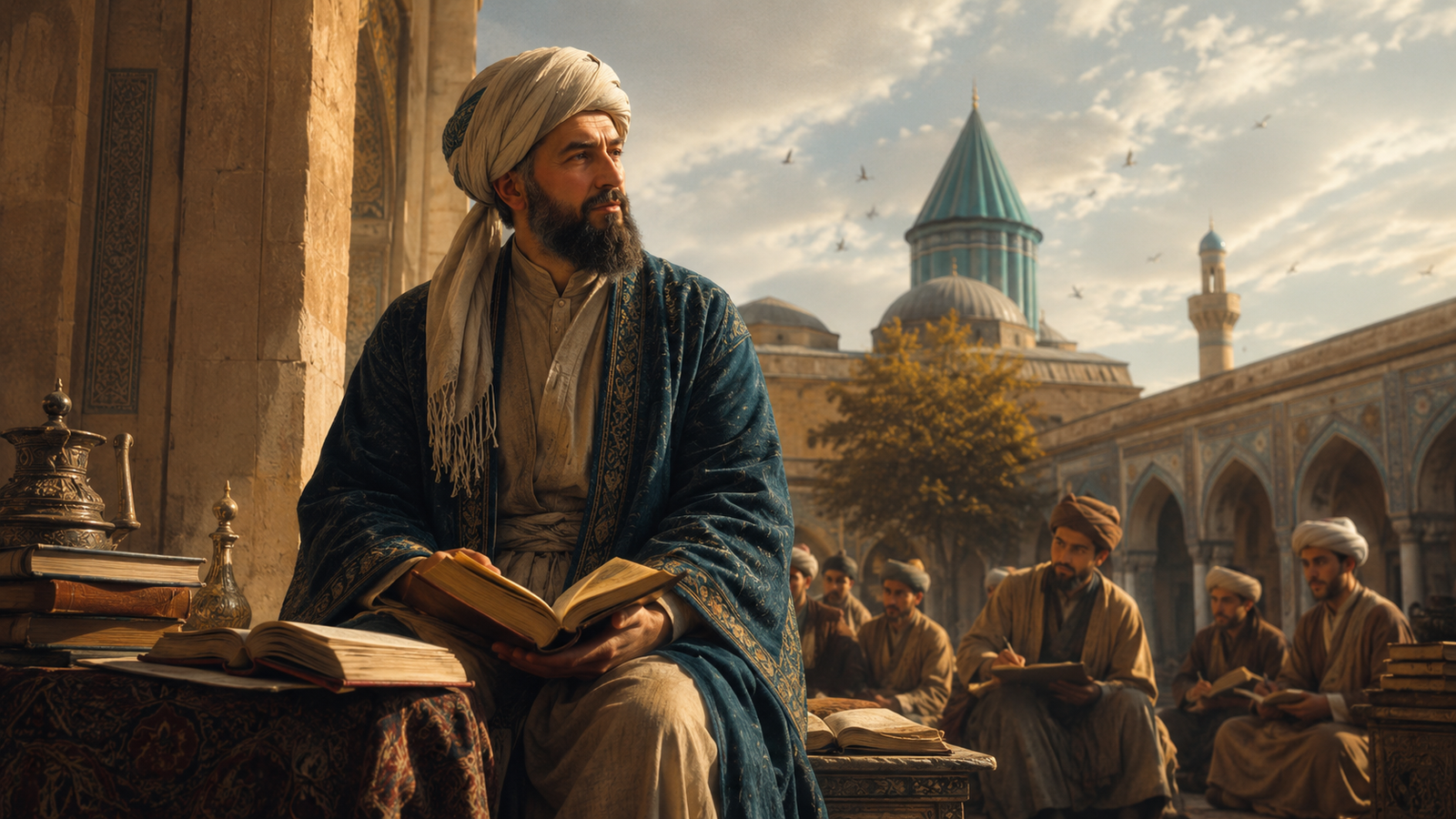
Before he became the Rumi we recognize, he was a respected scholar, teacher, jurist, theologian, and preacher. He had students who followed him, crowds who gathered to hear him speak, and admirers who treated him with extraordinary reverence. By the standards of his time, Jalaluddin Muhammad had already succeeded.
What makes his story interesting is that his transformation did not begin in failure. It began after success.
The Man Before the Name
Even the name by which we remember him tells a story of movement.
Jalaluddin Muhammad was born in Balkh, a city that today lies in Afghanistan. The political map of the thirteenth century, however, looked nothing like the one we know. Balkh belonged to a much larger Persian cultural and intellectual world, and identities were not contained within the modern national borders we instinctively use today.
His family eventually migrated westward and settled in Anatolia, in the region that came to be associated with the old Roman lands. In Persian and Arabic usage, that territory was known as Rum. Jalaluddin Muhammad lived much of his adult life there, particularly in Konya, and over time he came to be called Rumi, the man from Rum.
There is something almost fitting in the fact that a man later associated with the transcendence of labels should himself resist easy categorization. Was he Afghan because Balkh is now in Afghanistan? Persian because Persian was the language of his great literary works? Turkish because he spent much of his life in what is now Turkey?
The question reveals more about our need for categories than it does about Rumi.
He belonged to a world before our map existed, and perhaps his later philosophy would suggest that the map was never the most important thing anyway.
What mattered initially was the household into which he was born.
Rumi’s father, Bahauddin Walad, was himself an important religious scholar. Rumi therefore grew up immersed in theology, scripture, religious law, interpretation, and debate. Learning was not a rebellion for him. It was an inheritance. Religion was not something he discovered late in life. It was the intellectual and cultural air of his childhood.
Rumi embraced that inheritance seriously. He became a scholar of considerable reputation in his own right, and eventually an important religious authority in Konya.
This is the Rumi modern readers often overlook.
The Scholar Before the Mystic
Accounts of his life describe large gatherings when he taught. Students accompanied him through the streets. People crowded around him after sermons. Some kissed his hands or the hem of his robe. He occupied the sort of position that comes not only with respect but with expectation.
People knew who he was.
Or at least they believed they did.
He was the scholar. The teacher. The authority. The son of a distinguished religious family. He had inherited a tradition, mastered it, and earned the approval of the society around him.
That detail matters because questioning the world from outside it is one thing. Questioning it after it has rewarded you is something quite different.
A rejected outsider loses little by criticizing an institution. A successful insider risks much more.
Rumi was not turning away from a system that had failed him. He was beginning to question whether success within that system was enough.
There are, perhaps, two ways of asking who someone is.
The first is the biographical way. Where was he born? Who were his parents? What did he study? Where did he travel? What books did he write? When did he die?
Those questions are essential because without them historical personalities quickly dissolve into mythology. But there is another question that often matters more.
What was he?
What occupied his mind? What did he fear? What did he question? What did he notice in society that others accepted without examination? What happened inside him that made the person at the end of his life so different from the person at the beginning?
It is through that second question that Rumi begins to become interesting.
A Scholar Who Began to Distrust Appearances
The society in which Rumi lived placed enormous importance on religion, status, authority, community, and tradition. Rumi understood each of these deeply. Yet somewhere along the way he became increasingly uncomfortable with the gap between outward appearance and inward reality.
The problem was not religion itself. Rumi did not abandon the tradition that had shaped him. His later mystical thought remained rooted in Islam, scripture, and the spiritual vocabulary of his world.
What increasingly disturbed him was performance.
Outward piety could become theatre. Ritual could become reputation. Scholarship could become vanity. Religious language could give the appearance of spiritual depth without producing compassion, humility, or inner transformation.
A person could memorize scripture and remain arrogant. A scholar could win every argument and remain untouched by the truths he defended. A society could speak continuously about God while remaining deeply divided by ego, status, and rivalry.
Rumi had spent years mastering the vocabulary of religion. He was beginning to ask a much more uncomfortable question.
What had that knowledge actually done to the person who possessed it?
The distinction is subtle, but it changes everything.
The scholar asks what a text means.
The mystic eventually asks what the meaning has done to him.
Rumi had not yet become that mystic, but something was already beginning to shift.
The Weight of Admiration
There was another obstacle to transformation, perhaps an even greater one.
People admired him.
Admiration sounds like a gift, and often it is. But public admiration has an interesting side effect. It can quietly imprison the person receiving it.
Once people decide who you are, they expect consistency. A teacher must continue behaving like the teacher they recognize. A leader must preserve the image that made others follow him. A scholar must continue giving the kinds of answers that earned him authority.
The more successful one becomes at being a particular version of oneself, the more expensive change becomes.
Rumi had accumulated expectations around him. Students expected instruction. Followers expected sermons. His family had its own expectations. The city of Konya believed it understood the role he occupied.
Later, when Rumi began behaving differently, the reaction would be severe. People would accuse him of losing his reason. Some would say he had been bewitched. His family would experience the consequences of his transformation. His admirers would become confused, disappointed, and sometimes angry.
But transformations rarely begin on the day everyone else notices them.
Long before the public rupture, something usually moves quietly beneath the surface.
The later Rumi did not suddenly appear from nowhere. He must already have existed, in some unfinished form, inside the respected scholar.
You Have Come to Join
One idea would eventually become central to Rumi’s thought: the belief that human beings exist to connect rather than divide.
A teaching associated with him expresses it with remarkable simplicity. You have come to join, not to separate.
The sentence sounds gentle until one begins to think about what it demands.
Human beings are astonishingly skilled at classification. We divide ourselves by religion, nation, language, tribe, caste, profession, social class, ideology, and countless smaller loyalties. Some of those identities are meaningful and necessary. They give us history, belonging, and community.
The problem begins when identity stops telling us who we are and starts deciding who deserves our compassion.
Rumi increasingly searched beneath these divisions for something more fundamental. He did not necessarily seek sameness. His idea of unity did not require humanity to become culturally or religiously identical.
He was looking for a thread capable of passing through all the beads without requiring the beads to become the same.
That thread was love.
Not sentimental love. Not merely romantic love. Something more demanding.
Love as the erosion of ego. Love as the recognition of the divine beyond appearances. Love as the movement away from separation. Love as a way of seeing another person without first calculating whether that person belongs to us.
These are beautiful ideas when read in a poem.
They become more difficult when life asks us to live them.
Rumi’s life was about to do exactly that.
The Difference Between Speaking and Becoming
Writers and philosophers have always been able to describe experiences they have not fully lived. A poet can write brilliantly about heartbreak while sitting comfortably at a desk. A preacher can speak about humility while secretly enjoying every moment of admiration. A thinker can celebrate tolerance while reacting angrily to contradiction.
There is nothing unusual in that. Human beings have always been better at describing ideals than embodying them.
What eventually gave Rumi’s work unusual power was that his philosophy would stop being theoretical.
His reputation would be tested. His family life would be disturbed. His followers would question him. His city would gossip about him. He would discover attachment, separation, grief, and longing not as poetic themes but as lived experience.
The scholar who had spent years teaching others would have to become a student again.
That may be the real beginning of the Rumi we remember.
Not his birth in Balkh. Not his arrival in Konya. Not even his success as a scholar.
Perhaps Rumi begins at the moment when Jalaluddin Muhammad becomes willing to be changed by something he does not yet understand.
And change was already walking toward him.
A Stranger Comes to Konya
Somewhere beyond the respectable scholarly circles of Konya was a man who possessed almost none of the things Rumi had accumulated.
He had no great institution behind him. He had no large following. He did not seem interested in reputation. He wandered from place to place, meeting scholars and mystics, questioning them, challenging them, and frequently leaving dissatisfied.
His name was Shams of Tabriz.
Shams had spent years searching for someone who could understand him. According to one tradition, he once complained that even his teachers did not fully grasp what he was trying to express. Someone asked what he would give if he finally found the person he was searching for.
Shams is said to have answered that he would give his head.
Eventually, someone told him that there was a man in Konya he should meet.
A respected scholar.
A teacher surrounded by students.
A man named Jalaluddin Muhammad.
And so the wandering dervish began moving toward Konya.
Inside the city sat a scholar surrounded by books, followers, status, and the accumulated certainty of a lifetime.
Approaching him was a man who seemed to respect none of those things merely because the world did.
Neither man could have known what their meeting would set in motion.
One of them would disappear.
The other would never again be the person he had been before.
Posts in this series:
- Before He Became Rumi: The Scholar Who Walked Away from Certainty
- When Rumi Met Shams: The Man Who Broke Open His World (Coming Soon)
- After Shams: The Rumi Who Remained (Coming Soon)
Other similar Posts:
- Zikr in Six Movements: On Sai by Satinder Sartaaj (Six-part series on Sai)
- Echoes of the Divine: Hamds, Naats & Qawwalis in Sufism
- Listening as Devotion: The Sufi World of the Wadali Brothers
👁️ 6 views
Share this post :
Archives
| M | T | W | T | F | S | S |
|---|---|---|---|---|---|---|
| 1 | ||||||
| 2 | 3 | 4 | 5 | 6 | 7 | 8 |
| 9 | 10 | 11 | 12 | 13 | 14 | 15 |
| 16 | 17 | 18 | 19 | 20 | 21 | 22 |
| 23 | 24 | 25 | 26 | 27 | 28 | 29 |
| 30 | ||||||
Categories
Missives from Planet Nagi
Sign up for our newsletter.
Get insightful stories, updates, and inspiration delivered straight to your inbox. Be the first to know what’s new and never miss a post!
1 Comment on “Before He Became Rumi: The Scholar Who Walked Away from Certainty”
Wow