


“The first sky god fell long before the planets formed – yet in Uranus, the heavens still remember the blow.”
The First Father, the First Sky
Long before Zeus battled Titans or heroes roamed the earth, the Greek cosmos began with something far simpler and far more immense: Gaia, the Earth, and Uranus, the Sky. In the earliest myths, Uranus wasn’t just the sky – he was the sky itself, stretched endlessly over Gaia like a celestial dome. Their union produced the first generation of divine beings: the Titans, the Cyclopes, and the fearsome Hundred-Handers.
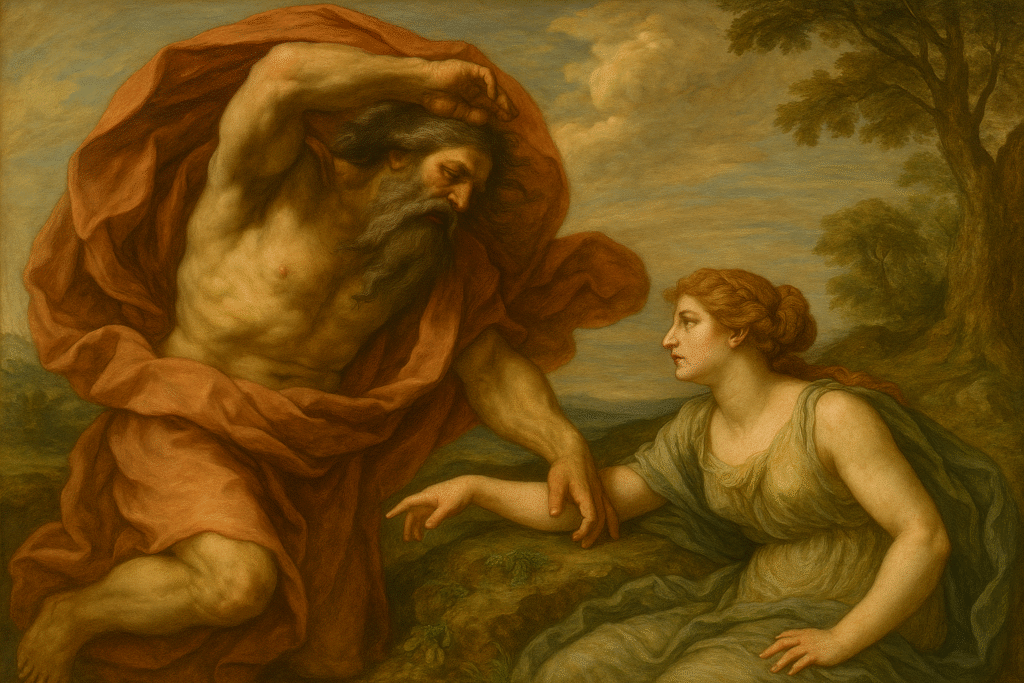
But Uranus was not a benevolent father. Fearing the power of his own children, he pushed them back into Gaia’s depths, imprisoning them in the womb of the Earth. It was an act of cruelty that caused Gaia such agony that she could no longer bear it. She forged a plan – not alone, but with one child bold enough to challenge the heavens themselves: Cronus, the youngest Titan.
Gaia fashioned a sickle of adamantine, and Cronus ambushed Uranus as he descended to lie with the Earth. With one decisive stroke, Cronus struck down the sky-god, separating heaven from earth forever. Uranus fell, dethroned by his own son, and from his blood and remnants sprang new mythic beings – the Furies, the Giants, and Aphrodite from the foam of the sea.
It is, in many ways, the first cosmic rebellion, a theme the Greeks would repeat in myth after myth. Yet nowhere does the symbolism linger as hauntingly as it does when we look upward and behold the planet named after the fallen sky god.
A Planet That Shouldn’t Be Standing
Uranus, the seventh planet from the Sun, is unlike anything else in our solar system. Astronomers describe it as an ice giant, but that barely conveys how strange it truly is. While most planets spin upright or slightly tilted, Uranus lies almost completely on its side tilted at a staggering 98 degrees. It doesn’t rotate like a top the way Earth or Mars does; instead, it rolls through space like a celestial barrel.
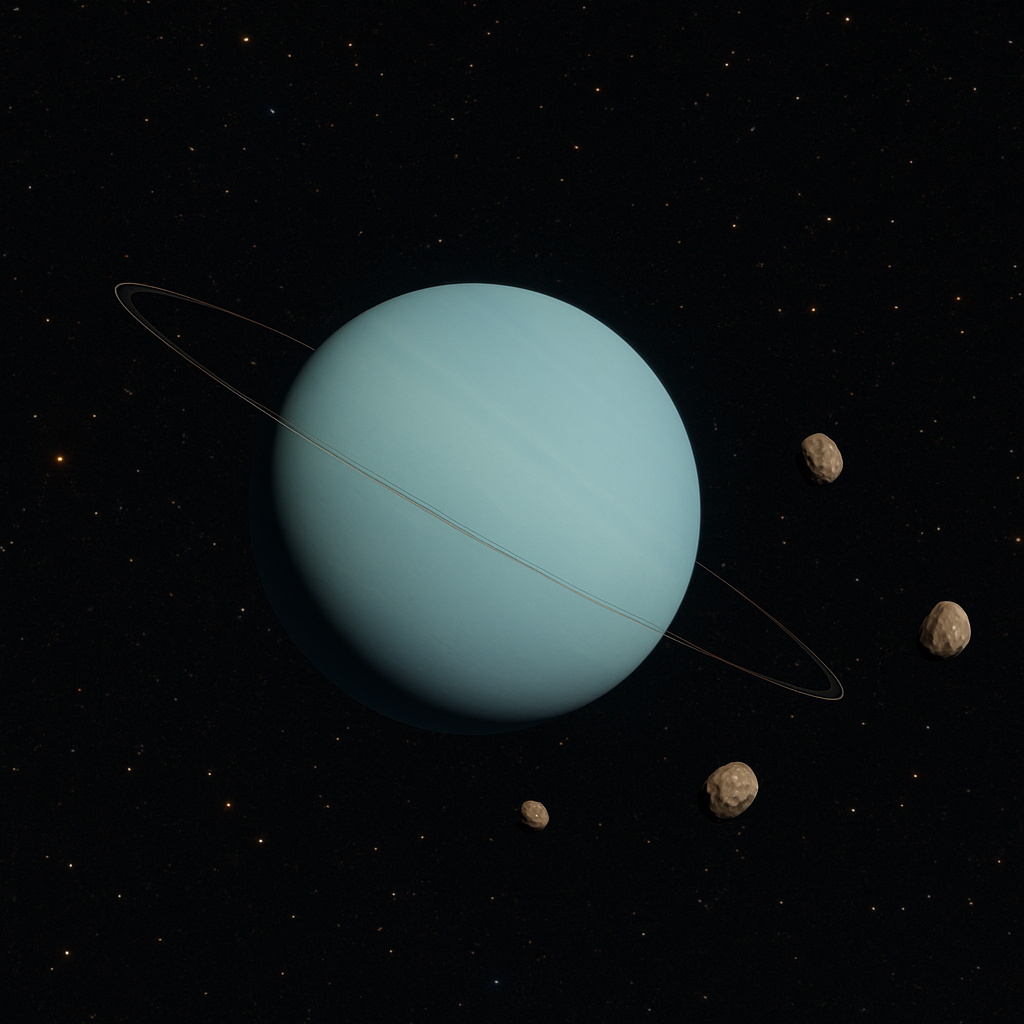
Its poles take turns facing the Sun. Its rings tilt sideways. Its seasons last decades and when summer arrives, one hemisphere is bathed in sunlight for 21 straight years while the other remains in darkness.
It is as if the sky god really did fall.
Uranus’s tilt is one of astronomy’s greatest curiosities. Scientists suspect that billions of years ago, something catastrophic happened – a collision with a massive protoplanet, or even several impacts, powerful enough to tip the entire world over. A cosmic ambush. A literal strike from below. The parallel to Cronus’s mythic coup is impossible to ignore.
A planet knocked on its side by a violent blow.
A sky god dethroned by his own child.
Myth and astronomy intersect in uncanny harmony.
The Symbolism of a Fallen Sky God
Most planets keep their “faces” toward the stars in fairly predictable patterns. But Uranus? Uranus tumbles. It struggles against the darkness. It turns on its side as if the entire sky had been shoved violently off balance.
In myth, Uranus loses his dominion over the cosmos. In astronomy, Uranus loses its upright stance in the solar system. Both stories are about a fall – one metaphorical, one literal, one born from human imagination, the other from astrophysical catastrophe.
Look at Uranus through a telescope, and the planet appears serene bluish, smooth, quiet. But beneath that calm exterior lies a world shaped by ancient violence. Winds howl at hundreds of kilometers per hour. Its atmosphere holds methane that absorbs red light, giving Uranus its iconic blue-green hue. Deep inside lies an icy mantle of water, ammonia, and methane, swirling around a rocky core.
A calm surface. A turbulent past. A wounded god.
No wonder astronomers and mythologists both find Uranus irresistible.
Gaia’s Role: The Earth That Remembers
Gaia’s part in the myth is equally profound. She is the Earth, not just a goddess who personifies the ground, but the very foundation of existence in Greek cosmology. She births the sky, yet the sky turns oppressive. She births the Titans, yet they are trapped by the sky. And in the end, she orchestrates Uranus’s fall, empowering her children to reshape the cosmos.
If Uranus symbolizes the heavens made unstable, Gaia symbolizes the earth that endures, adapts, and reclaims power.
Modern astronomy has its own echo of this relationship. From Earth, from Gaia, we observe Uranus’s strange posture, its 83-degree axial tilt relative to the Sun. We watch it roll rather than spin. And we marvel at how this fallen planet, this toppled sky-god, still carries the scars of its ancient tilt for all to see.
We, Earth-bound observers, become the storytellers who witness both myth and science at once.
The Moons of Uranus: A Chorus of Stories
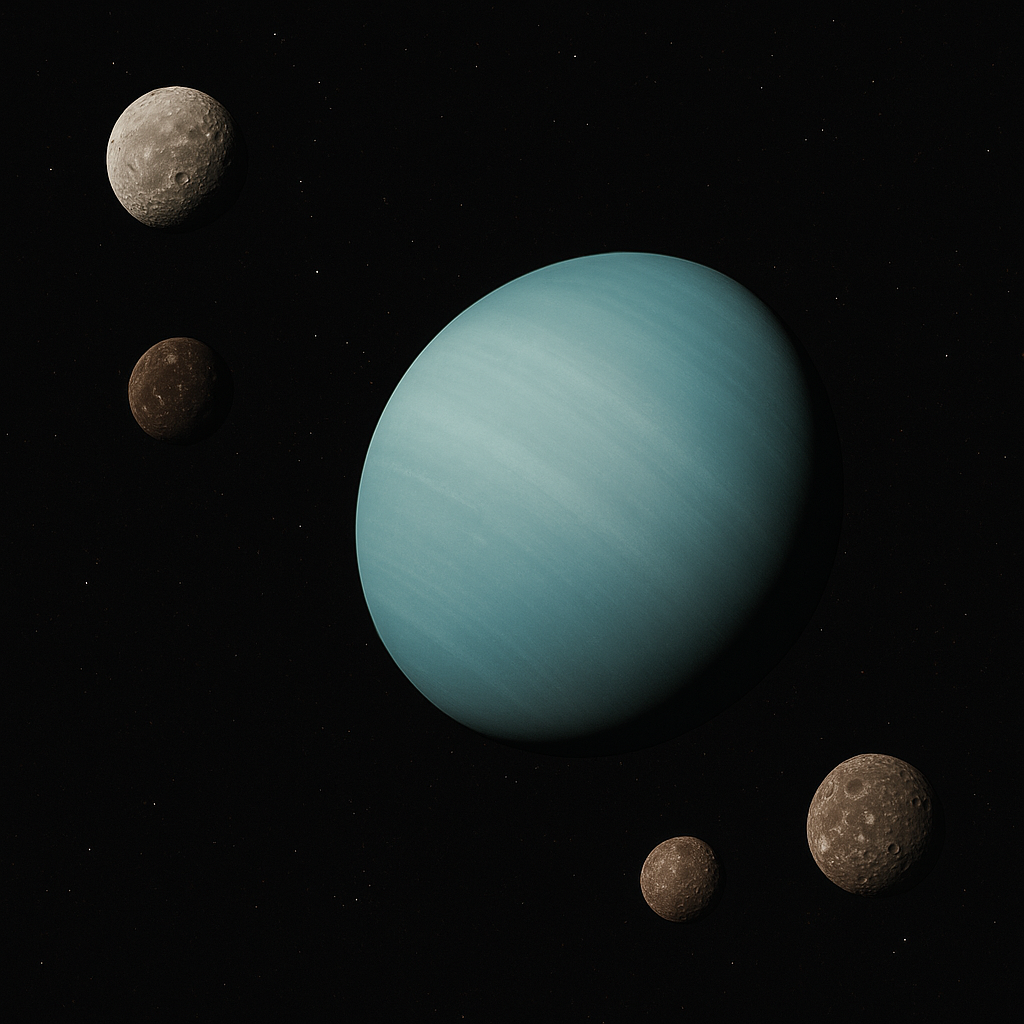
While the planet carries the name of a primordial Greek deity, its moons tell a different story – one borrowed from Shakespeare and Alexander Pope. Miranda, Ariel, Umbriel, Titania, Oberon… they form a celestial literary ensemble.
It’s an unusual choice, but it adds an unexpected layer: Uranus, a Greek sky god, is surrounded not by Titans or Greek heroes, but by characters from The Tempest, A Midsummer Night’s Dream, and The Rape of the Lock. A fallen god with an orbiting audience of poets.
Even in its nomenclature, Uranus is unconventional. Tilted planet, tilted tradition.
Science Reflecting Myth
It is easy to dismiss mythology as fanciful storytelling from humanity’s past. But again and again, science reveals patterns, coincidences, and metaphors that align with ancient tales, not because myth predicted physics, but because humans have always looked upward and found meaning in what we saw.
Uranus is a perfect example.
A sky god who falls.
A planet that tumbles.
A cosmic scar that mirrors a mythic wound.
Astronomy gives us the mechanics. Myth gives us the metaphor. Together, they give us a story that transcends time.
Why Uranus Captivates Us Still
For thousands of years, humans have looked at the sky and wondered where the gods went when they fell. We wrote myths to explain the world, then wrote science to understand it. Uranus, with its sideways spin and improbable tilt, bridges that divide beautifully.
If any planet embodies ancient drama in modern physics, it is this one:
a world forever rolling through darkness, its axis broken, its posture skewed, its name a memory of a god struck down.
A sky that once dominated now tilts at the edge of the solar family – still present, still vast, but humbled by time and celestial violence.
Links to other posts in the Astronomy & Mythology Series:
- Mars: Panic will leave and Fear will be destroyed
- Cassiopeia: The Queen Condemned to Spin Among the Stars
👁️ 68 views