
Venus shines with beauty, but burns with truth

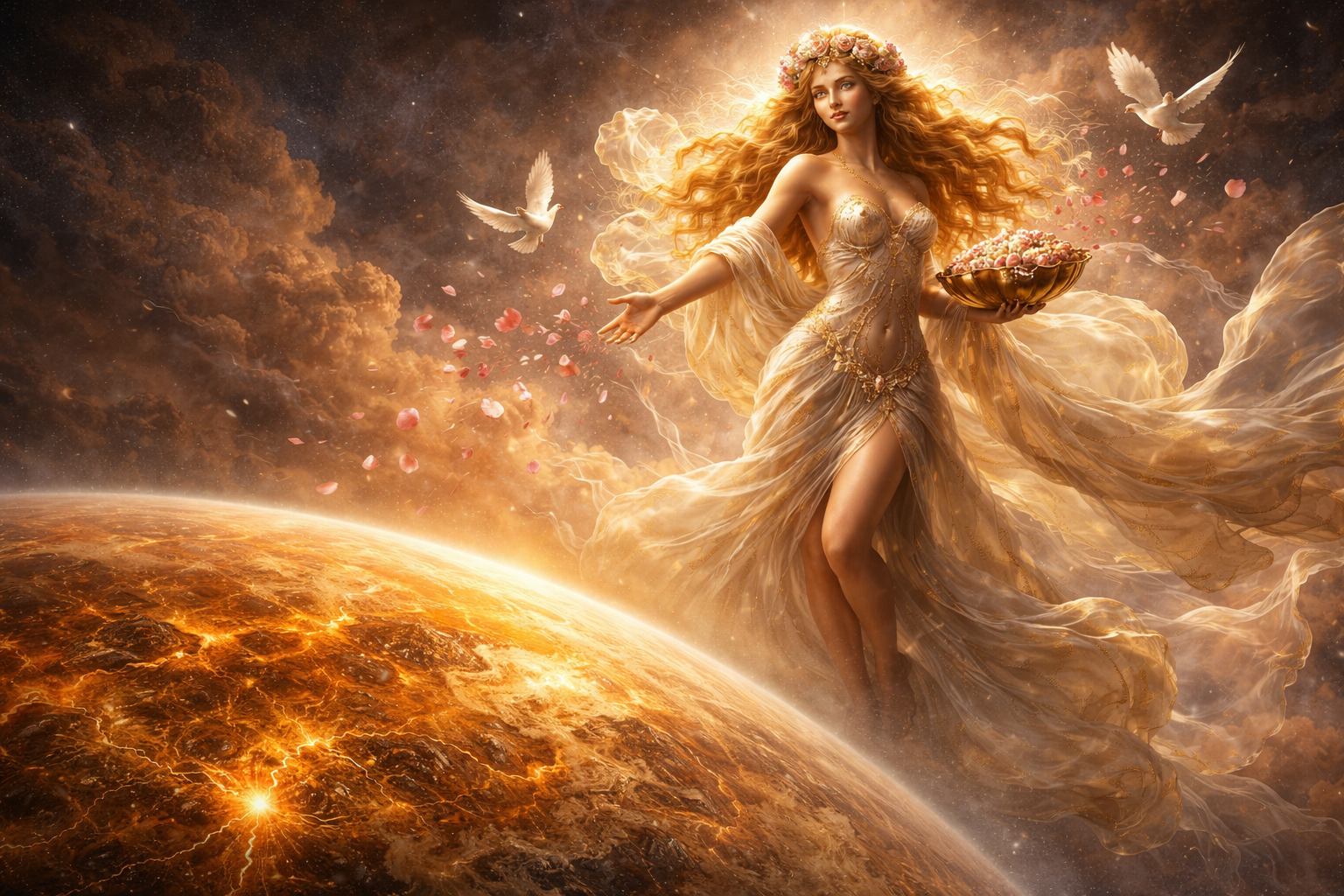
The Most Beautiful of the Gods
In the mythology of the Greeks and Romans, few figures command as much attention as Aphrodite, known to the Romans as Venus. She was the goddess of love, beauty, desire, and attraction. Wherever she appeared, she captivated gods and mortals alike. Beauty was not just her gift. It was her power.
Her origin itself is poetic and strange. According to one of the oldest myths, Aphrodite rose from the sea foam, born from the remnants of Uranus after his fall. She emerged fully formed, radiant, irresistible, and eternal. The moment she stepped onto the shore, the world changed. Flowers bloomed beneath her feet. Hearts turned. Even the gods were not immune to her influence.
But Aphrodite was not simply gentle or kind. Her beauty carried consequences. Love in her domain was rarely calm. It was often consuming, irrational, and destructive. She inspired passion, but also jealousy, rivalry, and war. The story of the Judgment of Paris, which led to the Trojan War, begins with her promise of love.
Beauty, in myth, is never just surface. It is force. It draws you in. It reshapes your choices. It can elevate, but it can also undo.
And in the night sky, there is one object that carries this same paradox.
The Brightest Star That Is Not a Star
If you look toward the horizon just before sunrise or just after sunset, you may notice a brilliant point of light that outshines everything else. It is steady, not twinkling like a star, and it commands attention without effort.
This is Venus, often called the Morning Star or the Evening Star.
To ancient observers, Venus was the most beautiful object in the sky after the Sun and the Moon. It appeared luminous, pure, and almost serene. It was only natural that they named it after the goddess of beauty herself.
Venus does not wander the sky aimlessly. It moves in a graceful pattern, always staying close to the Sun, appearing at dawn or dusk as if it were escorting the light itself. It is a presence that feels deliberate, almost symbolic.
For centuries, Venus represented perfection. Harmony. Radiance.
But what lies beneath that brilliance tells a very different story.
A World of Fire and Pressure
Beneath its shining exterior, Venus is one of the most hostile worlds in the solar system.
Its surface temperature reaches around 465 degrees Celsius, hot enough to melt lead. This heat is not a temporary condition. It is constant, day and night, across the entire planet.
The atmosphere of Venus is thick and crushing, composed mostly of carbon dioxide, with clouds of sulfuric acid drifting high above the surface. The pressure at ground level is more than 90 times that of Earth, equivalent to being deep beneath the ocean.
If you could stand on Venus, which you cannot, the sky would appear yellowish and dim, filtered through dense clouds. The heat would be unbearable. The pressure would be fatal. The air itself would be toxic.
Spacecraft that have landed on Venus have survived only for minutes or hours before being destroyed.
This is not a world of gentle beauty.
It is a world that burns.
The Greenhouse That Never Ended
The extreme conditions on Venus are the result of what scientists call a runaway greenhouse effect.
At some point in its distant past, Venus may have had conditions not entirely unlike Earth. It may have had oceans. It may have had a more balanced atmosphere. But as the Sun’s energy interacted with its environment, something irreversible began.
Heat was trapped. More heat led to more evaporation. More evaporation led to more greenhouse gases. The cycle fed on itself until the planet became what it is today.
A beautiful world, transformed into a furnace.
This transformation is one of the most important lessons Venus offers to science. It is a warning written in planetary scale, a demonstration of how delicate balance can be lost and how difficult it is to restore.
The Paradox of Venus
From Earth, Venus appears flawless. It is bright, smooth, and luminous. Its thick cloud cover reflects sunlight so efficiently that it becomes the most brilliant object in our night sky after the Moon.
But those same clouds hide everything.
They conceal a surface shaped by volcanic plains, crushing pressure, and relentless heat. They hide a world that is not just inhospitable, but actively destructive.
This duality makes Venus unique among the planets. It is not merely different. It is deceptive.
And this is where mythology and astronomy meet in a way that feels almost intentional.
Aphrodite, the goddess of beauty, was never just about attraction. Her presence often brought complexity. Desire could lead to joy, but also to conflict. Love could inspire, but also destabilize. The surface promise did not always reveal the deeper consequence.
Venus the planet reflects that same truth.
Beautiful from afar.
Unforgiving up close.
Love, Illusion, and Distance
There is something deeply human in the way we perceive Venus.
We see its brightness and assume purity. We see its glow and imagine serenity. From a distance, it feels comforting, almost gentle.
Distance creates illusion.
In mythology, love often begins this way. It draws you in with beauty, with promise, with something that feels effortless and natural. But as stories remind us again and again, closeness reveals complexity. What appears simple from afar becomes layered and unpredictable when experienced directly.
Venus embodies this idea perfectly.
It reminds us that observation is not understanding. That appearance is not truth. That beauty, while powerful, is not always benign.
The Planet That Mirrors Us
Venus is often called Earth’s twin because of its similar size and composition. Yet the two worlds could not be more different.
One supports life. The other destroys it.
One has oceans, weather, and breathable air. The other has acid clouds, crushing pressure, and relentless heat.
And yet, they began with similar ingredients.
This contrast makes Venus one of the most important planets for understanding our own. It forces us to ask difficult questions about balance, change, and sustainability. It shows how small differences can lead to vastly different outcomes.
In a way, Venus is not just a story about itself. It is a reflection of what could be, and what must be avoided.
Beauty That Demands Respect
The ancient Greeks did not separate beauty from consequence. Their stories often reminded listeners that power, even when attractive, must be approached with awareness.
Venus, both goddess and planet, carries that lesson forward.
It teaches us that beauty is not always gentle. That attraction is not always safe. That what shines brightest may also hide the greatest extremes.
And yet, we continue to look up at Venus with admiration.
Perhaps that is the final irony.
Even knowing what it truly is, we still find it beautiful.
Closing Reflection
When you see Venus in the sky, shining quietly at dawn or dusk, it is easy to forget what lies beneath its clouds.
It is easy to believe in the illusion.
But Venus is not just a light. It is a story. A reminder that the universe, like mythology, is full of contrasts. That what appears perfect may carry hidden complexity. That beauty and danger often walk together.
The ancients named it well.
Because even now, Venus remains exactly what Aphrodite always was.
Irresistible.
Radiant.
And far more dangerous than it first appears.
Other posts in the series
- Mars: Panic will leave and Fear will be destroyed
- Cassiopeia: The Queen Condemned to Spin Among the Stars
- When the sky fell, it never stood upright again
- The fastest messenger of Olympus still races through the heavens
👁️ 3 views