

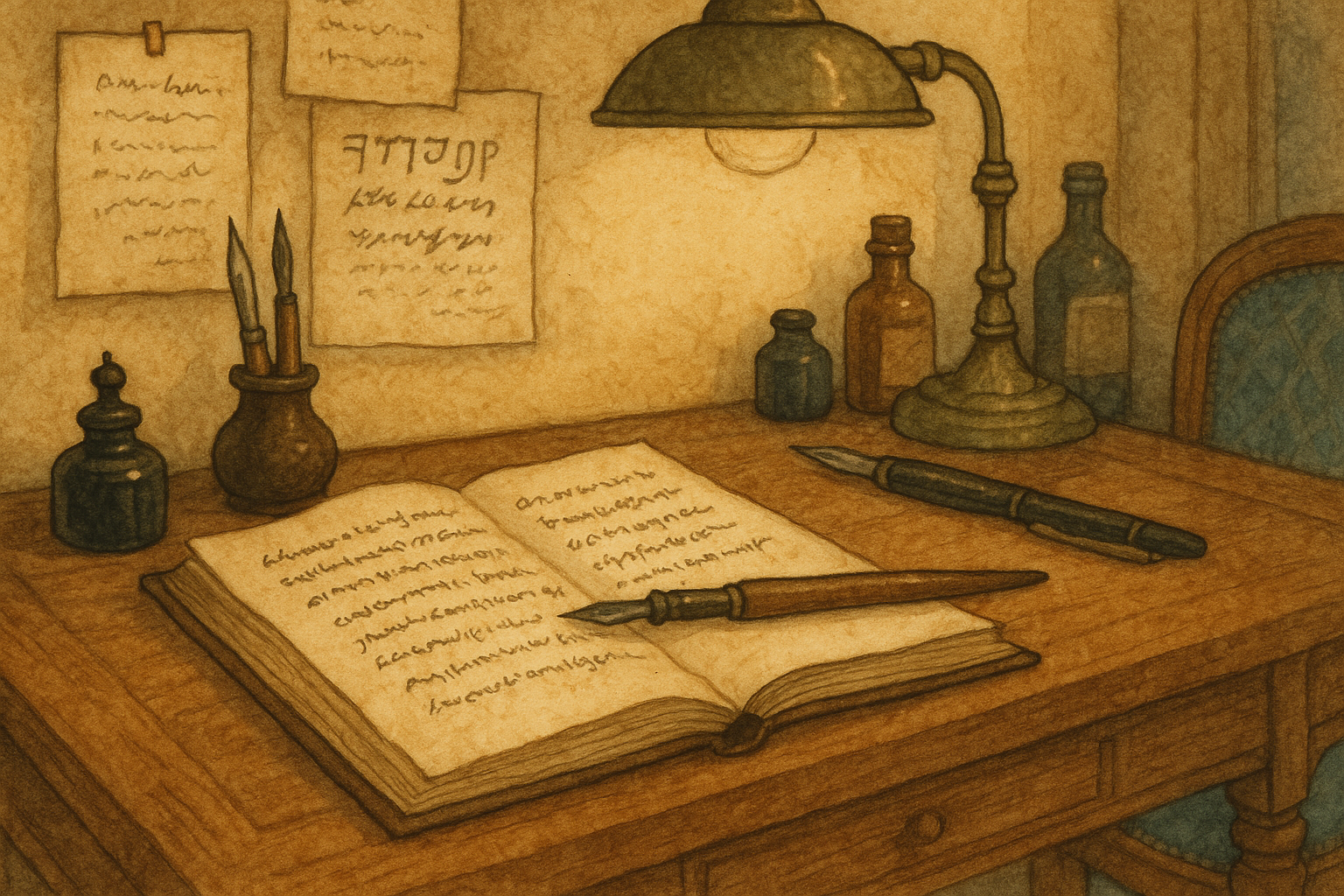
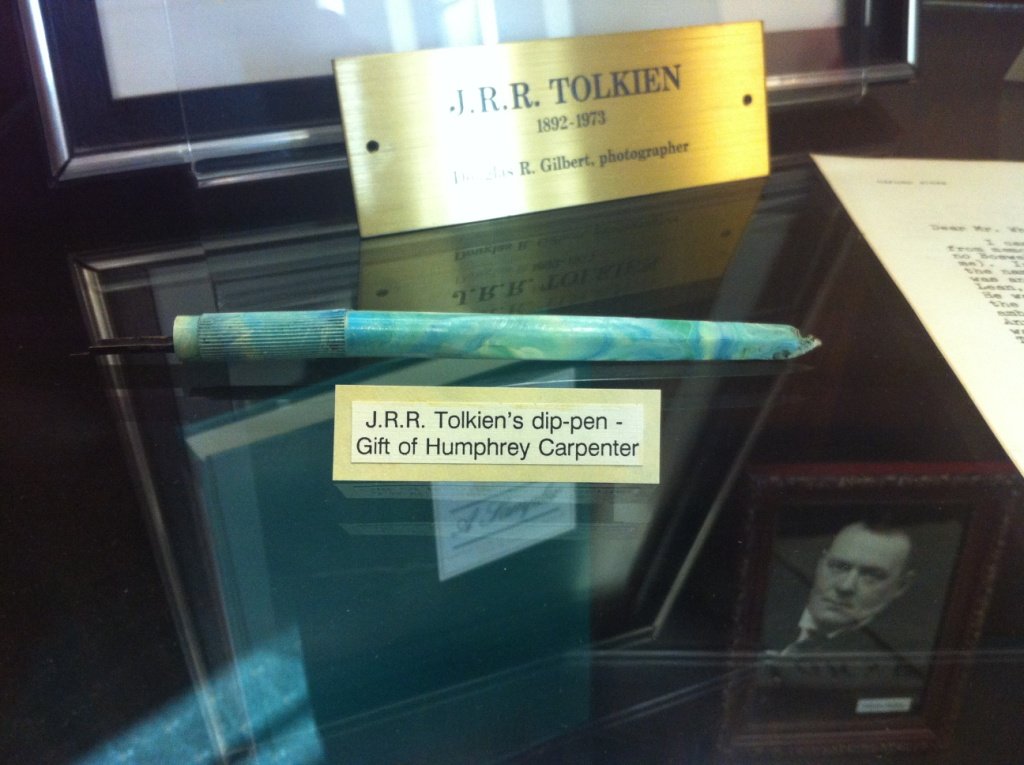
If Part I was about the hand, this one is about the instruments that hand wielded – the quiet, unglamorous tools that carried the burden of Middle-earth. Tolkien didn’t conjure his worlds from the ether. He wrote them into existence, one dip at a time, with metal, wood, ink, and paper that resisted him just enough to slow him down.
The Desk in Oxford
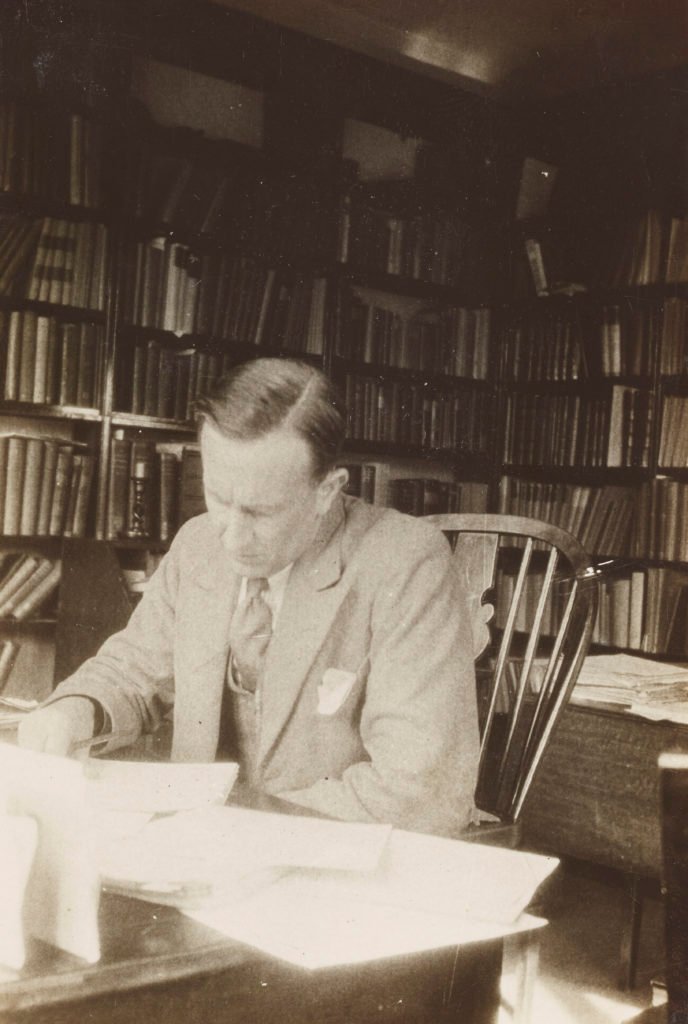
Tolkien’s desk still survives – a simple dark-wood table scarred with decades of use. It sits today at the Marion E. Wade Center at Wheaton College, alongside C.S. Lewis’s wardrobe and typewriter. On its surface, visitors can see a small dip pen, a bottle of ink, and a worn blotter. The setup looks almost monastic. No electric lamp glare, no clattering of typewriter keys. Just wood, paper, and ink – the trinity of imagination.

He didn’t need much else. The modestness of the workspace almost mocks modern creative setups. And yet from that humble table came languages, maps, genealogies, and some of the most enduring prose of the twentieth century.
The Pen That Drew Worlds
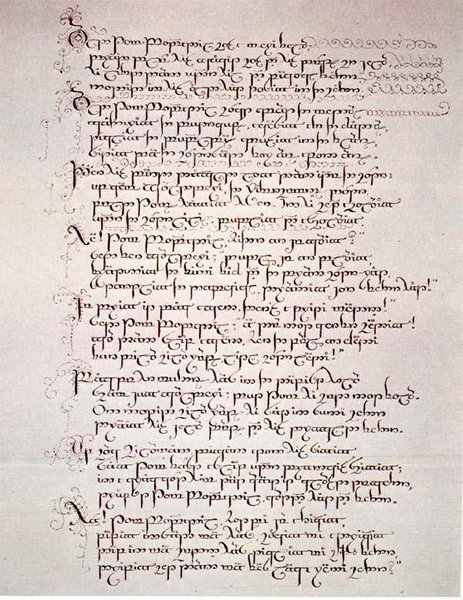
Among collectors and scholars, one name recurs when discussing Tolkien’s writing tools: the Esterbrook #314 Relief nib. It’s a slanted, oblique dip-pen nib designed to create graceful variation in line width – exactly the kind of rhythm seen in Tolkien’s Elvish calligraphy.
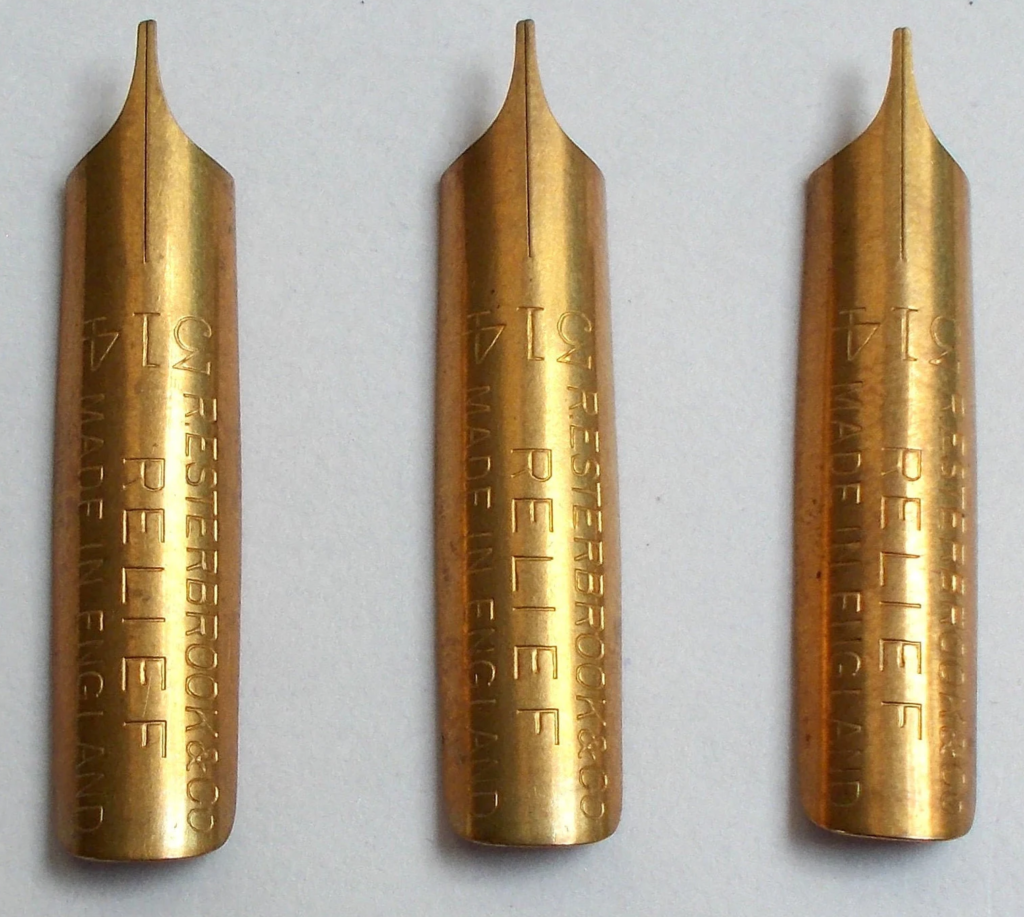
The Esterbrook series was affordable, durable, and loved by academics. The “Relief” nibs, in particular, mimicked broad-edge calligraphy without requiring a flexible hand. They offered precision, not drama – a quality Tolkien valued. He was not an expressive, swooping writer; his hand was disciplined, his strokes deliberate.
A Redditor who examined one of Tolkien’s dip pens at the Wade Center claimed the nib was an Esterbrook 314, mounted on a simple wooden holder. Whether or not that’s definitive, the geometry of the line work in his manuscripts supports it: oblique nib, 15-degree slant, fine on the cross, thick on the downstroke. It’s a nib for linguists, not for poets.
Ink and the Ritual of Writing
Tolkien used whatever ink was available in post-war Britain: iron-gall formulations for letters, brown or sepia for personal notes, and India-ink for illustrations. His manuscripts often show subtle changes in tone – some pages start blue-black and fade to russet brown where the ink oxidized.
That wasn’t accidental. Iron-gall ink reacts with paper fibers, eating its way in slowly. The result is an almost sculptural texture – the words literally etched into the page. Over time, they darken and settle like fossils. There’s a strange symmetry in that: Middle-earth was supposed to be ancient, and the ink itself aged with the myth.
Refilling a dip pen is an act of patience. You dip, shake, wipe, and write. After every few sentences, you repeat. It’s the opposite of the modern creative process, where speed equals progress. Tolkien’s instruments forced reflection. His pauses became part of the rhythm of thought. You can almost sense it: the moment he lifted the pen to dip again, weighing a word like Eärendil in his mind before committing it to the page.
Fountain Pens and Everyday Writing
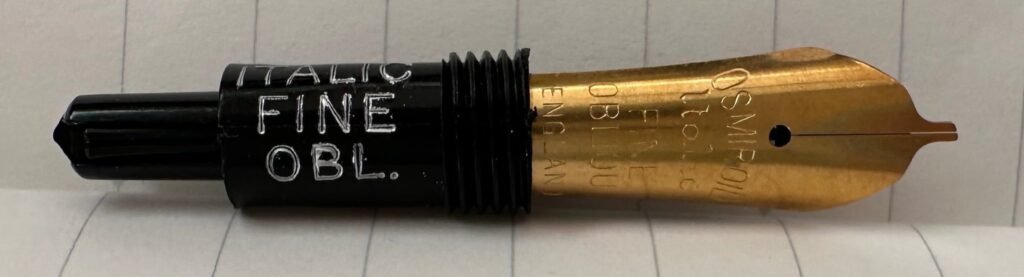
By the mid-20th century, Tolkien – like most academics – owned at least one fountain pen. Osmiroid 65s were popular among British scholars; their interchangeable italic nibs made them natural successors to dip pens. Some anecdotes claim he used one for correspondence and grading.
But when it came to his imaginative work – maps, scripts, drafts – he often returned to the dip pen. The fountain pen was for efficiency; the dip pen was for creation. It gave him line variation, tactile resistance, and the sense that he was crafting rather than recording.
The Tools as Extensions of Thought
There’s an old craftsman’s saying: “The tool teaches the hand.” In Tolkien’s case, the pen may have taught the mind. The constraints of his instruments – the drag of nib, the frequent pauses for ink – slowed his thinking to a deliberate pace. That pace is visible in his writing: sentences that unfold like ancient epics, syntax that meanders and resolves with ceremonial grace.
He was a man of language, and language is shaped by rhythm. His rhythm came from ink.
What His Tools Tell Us About the Man
There’s a strange humility in the fact that the architect of Middle-earth used tools any schoolteacher could afford. No gold-trimmed Montblanc, no designer stationery. Just practical instruments designed for clarity. That modesty feels consistent with everything we know about him.
His pens were not statements of luxury but vehicles of precision. The beauty of his handwriting came from mastery, not materials. He was the rare writer whose imagination didn’t need expensive tools – it needed disciplined ones.
The Philosophy of the Desk
Tolkien’s writing environment says more about him than his biography ever could. Every object on that desk – ink bottle, blotter, the creased paperweights – belonged to a world that valued patience. Writing was a craft, not a performance. He built Middle-earth with the same instruments a scribe might have used to copy Beowulf centuries before.
That continuity between past and present is perhaps his greatest secret. He lived in modernity but wrote with medieval tools. His characters were mythic, yet his process was tactile and real. The pen wasn’t an accessory – it was a bridge across time.
Reflection
When you stand before his desk today, the air seems to hum with absence. The ink has dried; the nib rests silent. But the tools remain, like relics of creation. They remind us that every world begins with something physical – a scratch, a stroke, a pause.
Middle-earth didn’t emerge from convenience. It emerged from craft.
And if there’s one lesson in those old pens, it’s that imagination doesn’t need to be fast to be vast.
Essays in this series:
- The Pen of Middle-Earth: Tools that shaped J.R.R. Tolkien’s worlds
- The Pen of Middle-earth, Part I: Ink and Imagination – The Hand That Built Middle-earth
- The Pen of Middle-earth, Part II: The Instruments of Creation – Tolkien’s Pens, Nibs, and Inkwells
- The Pen of Middle-earth, Part III: The Script of Arda – How Tools Shaped Language
- The Pen of Middle-earth, Part IV: Recreating Tolkien – Modern Calligraphers and Fountain Pen Enthusiasts
- The Pen of Middle-earth, Part V: The Slowness of Creation – What Tolkien’s Pen Teaches Us
👁️ 125 views