
Lineage, Language, and the Long Echo of Punjab in Sai

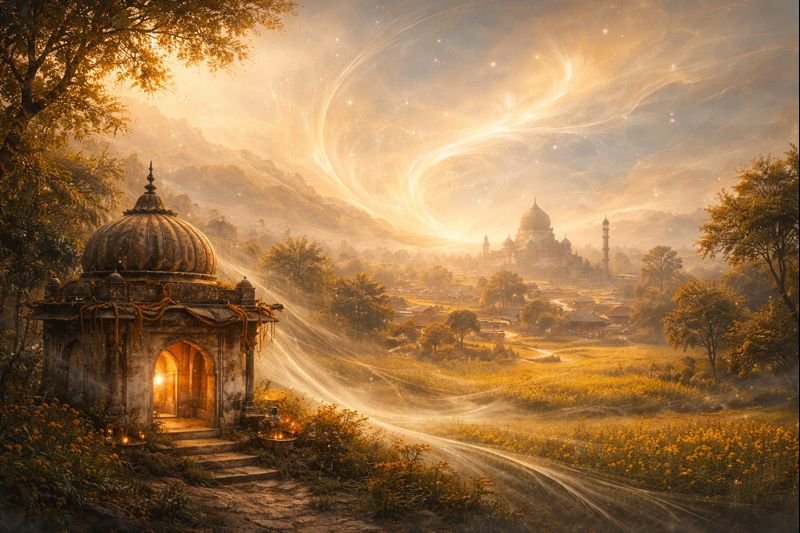
If the first Movement established the conditions under which Sai was born, and the second Movement explored the method – hunger as attentiveness, surrender as grammar – then this Movement must address something even older and more enduring: lineage.
Because Sai does not emerge in isolation.
It belongs to a long, living continuum of Punjabi mystical expression – one that predates modern nation-states, predates academic categories, and resists neat religious labeling. To understand Sai fully is to hear not just one voice, but an echo chamber: centuries of poets, singers, mendicants, and seekers whose words traveled orally long before they were written down.
In this sense, Sai is not merely a song by Satinder Sartaaj.
It is a continuation.
Punjab as a Mystical Geography
Punjab is often described in terms of geography – five rivers, fertile land, contested borders. But its deepest identity is cultural and spiritual, shaped by movement, encounter, and permeability.
For centuries, Punjab has been a meeting ground:
- Between Indic and Persian worlds
- Between Hindu, Muslim, Sikh, and Sufi thought
- Between oral folk culture and refined poetic traditions
Mysticism in Punjab did not develop behind walls. It developed in fields, streets, shrines, and gatherings. It was sung as often as it was written. It belonged as much to the illiterate as to the learned.
This matters because Punjabi mysticism is not primarily doctrinal. It is experiential.
It asks:
- What does love do to the self?
- What happens when ego dissolves?
- How does truth feel in the body?
Sai speaks fluently in this idiom.
The Punjabi Sufi Tradition: Love as Disruption
The great Punjabi Sufi poets, like Baba Bulleh Shah, Shah Hussain, Sultan Bahu, Waris Shah; were not theologians in the institutional sense. They were disturbers. Their poetry unsettled rigid religious boundaries, mocked hollow ritual, and elevated love over law.
Bulleh Shah famously wrote lines that defied orthodoxy, caste, and clerical authority. Shah Hussain lived as an ecstatic rebel, embracing social marginality. Waris Shah told a love story (Heer Ranjha) that doubled as a metaphysical treatise.
What unites them is not style, but stance:
- Suspicion of external piety
- Emphasis on inner transformation
- Love as annihilating force, not comfort
Sai inherits this stance quietly.
It does not argue against institutions. It simply bypasses them.
There is no priest, no intermediary, no rulebook in Sai. There is only address, repetition, and surrender. This is entirely in keeping with Punjabi Sufi ethos: God is not reached through correctness, but through exposure.
“Make Us Dance Like the Sufis”
One line in Sai carries disproportionate weight:
“Sūfiyā̃ de vā̃grā nachāī̃”
Make us dance like the Sufis
This is not decorative language. It is a compressed philosophy.
In Sufi practice, dance (sama) is not entertainment. It is an embodied theology, especially associate with Baba Bulleh Shah. When the body enters rhythm, the mind’s grip weakens. When movement overtakes intention, ego loosens.
To dance like the Sufis is to accept:
- Loss of control
- Loss of composure
- Loss of authorship
It is to allow oneself to be carried.
This request could only come from someone deeply familiar with the tradition. It is not an exotic reference. It is a knowing invocation, one that assumes the listener understands that dance here means disappearance, not display.
Language Without Ornament
Another striking feature of Sai is its language.
There is no verbal excess. No ornamental complexity. No show of virtuosity for its own sake. The Punjabi is clean, direct, and almost austere.
This is not because Sartaaj lacks linguistic range; his academic background makes that impossible. It is because restraint is a choice.
Punjabi Sufi poetry has always valued clarity over cleverness. The goal is not to impress, but to reach. Complex metaphors appear, but they are anchored in lived experience: mills, boats, dust, iron, stone.
Sai continues this tradition.
The metaphors are domestic, tactile, grounded:
- The grinding wheel of the world
- The boat tied to shore
- Iron touching the philosopher’s stone
These are not abstract philosophical constructs. They are images drawn from daily life, recognizable to farmer and scholar alike.
This accessibility is not simplification. It is hospitality.
Repetition as Cultural Memory
Repetition in Sai – especially the recurring “Sai ve…” – functions on more than one level.
Spiritually, it is zikr.
Musically, it is refrain.
Culturally, it is memory.
Punjabi oral traditions rely heavily on repetition. Songs were meant to be remembered, passed on, sung together. Repetition creates grooves in memory. It allows participation rather than observation.
In this sense, Sai does not position the listener as an audience member. It positions them as a participant.
You are not meant to consume the song once. You are meant to return to it. To let it settle. To let it wear away something rigid inside you.
This participatory ethic is deeply Punjabi.
Beyond Religion, Without Rejecting It
One of the quiet strengths of Sai is how it navigates religious identity.
The song uses terms and concepts recognizable across traditions:
- Ali and Wali (Islamic/Sufi)
- Zikr (Sufi practice)
- Anhad naad (Indic/Sikh mystical concept)
Yet it never insists on affiliation. It never names a religion. It never draws boundaries.
This is not ambiguity; it is fidelity to Punjabi mysticism, which historically preceded hard boundaries. Saints and poets spoke to mixed audiences. Shrines were shared. Songs crossed communal lines.
Sai belongs to this older ethic.
It does not dilute belief. It de-centers labels.
The devotion is intense, but unclaimed.
The Scholar’s Restraint
Sartaaj’s academic training plays an important role here, not in what he includes, but in what he refuses to overstate.
There is no explanatory footnoting in the song. No attempt to teach Sufism. No translation of metaphysics into didactic form. The scholarship remains invisible, shaping the structure without announcing itself.
This restraint is itself a scholarly virtue.
To truly understand a tradition is to know when not to explain it.
Sai as Cultural Bridge
In a contemporary world fractured by speed, outrage, and identity performance, Sai feels almost anachronistic.
It asks for patience.
It asks for listening.
It asks for surrender without spectacle.
In doing so, it bridges several divides:
- Between academia and folk culture
- Between music and prayer
- Between hunger and abundance
- Between past lineage and present voice
This bridging is not forced. It happens naturally because Sartaaj stands comfortably in all these worlds without needing to dominate any of them.
The Long Echo
Perhaps the most accurate way to describe Sai is not as a song, but as an echo.
An echo of:
- Saints who sang without stages
- Poets who wrote without ownership
- Seekers who asked not to be answered, but to be erased
When Sai ends, it does not conclude. It returns to repetition. To sound. To name.
This refusal to end is intentional.
In Punjabi Sufi tradition, remembrance has no closure. Love does not resolve. The seeker does not arrive and stop. The echo continues.
Where Movement III Leaves Us
By now, Sai stands revealed not just as a personal composition born of hunger, but as a cultural and spiritual artifact rooted deeply in Punjabi Sufi lineage.
It speaks a language older than the modern moment, yet remains fully present within it.
In the next Movement, we will move toward the closing arc of this journey: how Sai ultimately dissolves the boundary between singer and seeker, song and silence and what remains when even the echo begins to fade.
Not an answer.
But a nearness.
Links to the essays in this series:
- Zikr in Six Movements: On Sai by Satinder Sartaaj
- The Making of a Voice: Satinder Sartaaj Before Sai
- Surrender and the Grammar of Remembrance in Sai
- Lineage, Language, and the Long Echo of Punjab in Sai
- Dissolution, Silence, and What Remains After the Song Sai
- When Sai Falls Silent: What the Song Leaves Behind
- Satinder Sartaaj’s Sai: The Song, Line by Line (Coming soon)
👁️ 58 views