


There’s a moment, just before dawn, when the fields of Punjab turn silver – the world hushed, the air thick with stillness.
In that pause, if you listen closely, you can almost hear it: the faint hum of an old song, the echo of a voice that refuses to fade.
That’s what Punjabi folklore feels like to me – a river that remembers.
Over the past seven parts of this journey, we have walked with lovers and saints, rebels and musicians, grandmothers and wanderers. We’ve crossed rivers with Sohni, argued with Sahiban, prayed with Puran Bhagat, and danced with the dhadi singers under village stars.
Now, as the journey nears its end, it feels less like closing a book and more like coming home.
Because folklore, I’ve come to realize, isn’t a collection of stories.
It’s a mirror and if you look long enough, you’ll see yourself.
What Stories Remember When We Forget
The Punjabi word lok-virsa (ਲੋਕ ਵਿਰਸਾ) means “the people’s heritage.”
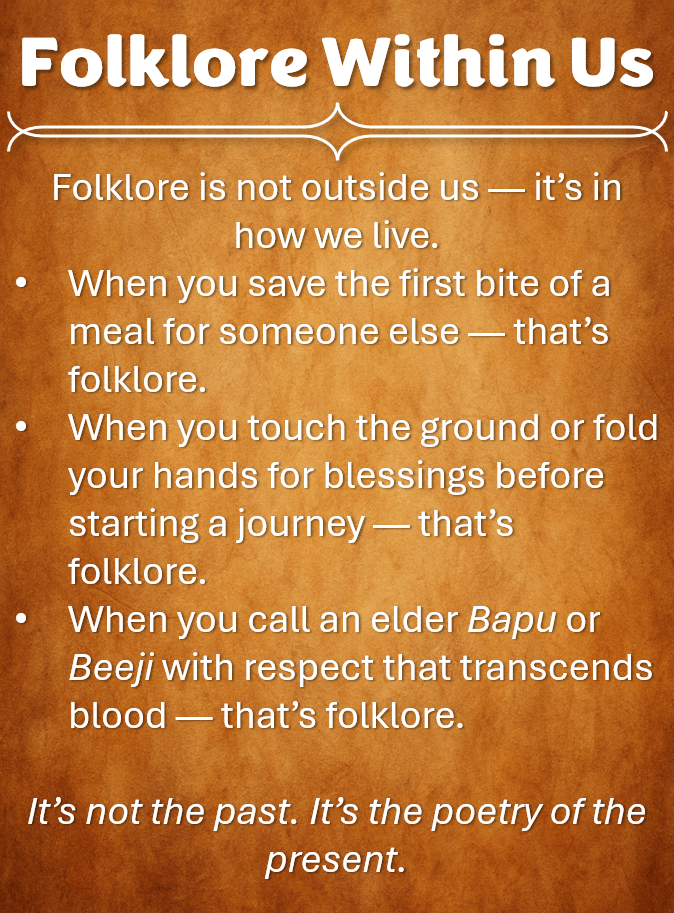
It isn’t housed in museums. It lives in the folds of language, the rhythm of daily speech, the scent of food, the sound of laughter.
When a farmer hums an old boli while working the fields, when a bride’s friends sing suhag songs the night before her wedding, when children light a lamp for Lohri – these are acts of remembrance disguised as routine.
They are quiet promises to the past: We remember you.
Folklore’s genius lies in its endurance. Empires rise and crumble, cities rename themselves, borders redraw the map – but the qissa still travels.
It carries what history cannot: emotion.
History tells us what happened. Folklore tells us how it felt.
Where the Sacred Meets the Everyday
What sets Punjabi folklore apart is how effortlessly it braids the divine with the mundane.
A saint may appear in a dream to a farmer. A god may sit down for tea. A prayer may sound like a love song.
There’s no distance between the sacred and the human here – both share the same kitchen fire, the same rainstorm, the same laughter.
And that’s the quiet genius of Punjab’s worldview: divinity is not beyond reach; it’s in the ordinary gestures of kindness, courage, and song.
In a way, every story – from Heer Ranjha to Dulla Bhatti – is an act of worship. Not of gods, but of humanity itself.
Echoes Across Borders
When Partition tore Punjab apart, the land was split – but the folklore refused to be divided.
Even today, Heer Ranjha is sung in Lahore as it is in Ludhiana; Jugni dances in Karachi as she does in Amritsar.
In these songs, there are no borders. The rivers flow as they always did – carrying verses instead of visas.
That, to me, is one of the most powerful legacies of Punjabi folklore: its defiance of division.
Where politics built walls, stories built bridges.
Every heer sung in Pakistan and every vaar sung in India is, in a way, a quiet act of reunion – an invisible handshake between two halves of a single heart.
What the Stories Teach Us
Each tale we’ve met carries its own truth, but together they form something larger – a philosophy of life.
- From the lovers, we learn that love without courage is incomplete.
- From the saints, that forgiveness is greater than revenge.
- From the tricksters, that wit can be nobler than strength.
- From the songs, that joy and sorrow can dance together.
- From the rituals, that faith is not always written – sometimes it’s sung, sometimes it’s cooked, sometimes it’s whispered to the wind.
If you listen to them carefully, these stories don’t just describe Punjab.
They describe being human.
The Changing Face of the Story
As we saw in Part 7, folklore has not disappeared – it has adapted.
The qissa-khwan has become a filmmaker. The tumbi has become an electric guitar. The audience now scrolls instead of sitting cross-legged in the courtyard.
And yet, the essence remains the same.
The questions Heer asked – about love, loyalty, and freedom – are the same ones young people ask today, only now through podcasts and poetry slams.
Every remix, every reinterpretation, is a sign that the story still breathes.
There’s something poetic about that continuity – how the same flame passes through a thousand lamps, each one shining in its own way.
Looking Beyond Punjab
When you place Punjabi folklore beside that of other regions – Sindhi, Kashmiri, or Rajasthani – you notice shared threads.
The desert in Sassi Punnun echoes through Rajasthani ballads; the river crossings of Sohni Mahiwal mirror Bengali legends like Behula-Lakhindar.
Even the idea of love as spiritual awakening – so central to Waris Shah’s Heer – resonates with Persian Sufi poetry and Tamil Bhakti hymns alike.
It reminds us that while geography may differ, the human spirit dreams in the same language everywhere – longing, loss, and the pursuit of meaning.
The Keeper of the Flame
When I started this series, I thought of folklore as something we inherit.
Now I realize – it’s something we choose to keep alive.
Each generation must decide whether to let the river flow or dam it up in silence.
To tell a story, to sing an old song, to teach a proverb to a child – these are not small things. They are acts of cultural stewardship.
When we remember, we resist forgetting.
And in a world that moves too fast, remembering itself becomes a form of rebellion.
I often think back to my grandmother sitting under that trembling lantern, her voice weaving worlds from air. She wasn’t just telling stories.
She was lighting a lamp against oblivion.
And now, perhaps unknowingly, I’m doing the same – with words instead of fire.
Closing Reflection
Folklore never ends.
It simply changes narrators.
And maybe that’s the final truth of Punjab’s stories – that they don’t belong to anyone; they belong to everyone who listens.
So when you next hear a dhol in the distance or see an old woman humming under her breath, remember – she is the river, and so are you.
Because as long as someone remembers, as long as someone sings, the five rivers will never run dry.
And that, more than anything else, is the story I wanted to tell.
Links to the essays in the series:
- Echoes of the Five Rivers: A Journey Through Punjabi Folklore
- Echoes of the Five Rivers, Part 1: The Soul of Punjab and Its Stories
- Echoes of the Five Rivers, Part 2: Themes, Motifs & the Soul of Punjabi Storytelling
- Echoes of the Five Rivers, Part 3: Folk Beliefs, Rituals & the Living Spirit of Punjab
- Echoes of the Five Rivers, Part 4: Folk Music, Songs & the Voice of the Land
- Echoes of the Five Rivers, Part 5: The Qissas – Love, Rebellion, and the Eternal River
- Echoes of the Five Rivers, Part 6: Saints, Seekers & the Soul of Punjab
- Echoes of the Five Rivers, Part 7: Legends of Valor, Justice & the Everyday Hero
- Echoes of the Five Rivers, Part 8: Folklore & Modernity – The Stories That Refuse to Die
- Echoes of the Five Rivers, Part 9: Reflections, Continuity & the River That Remembers
👁️ 373 views