

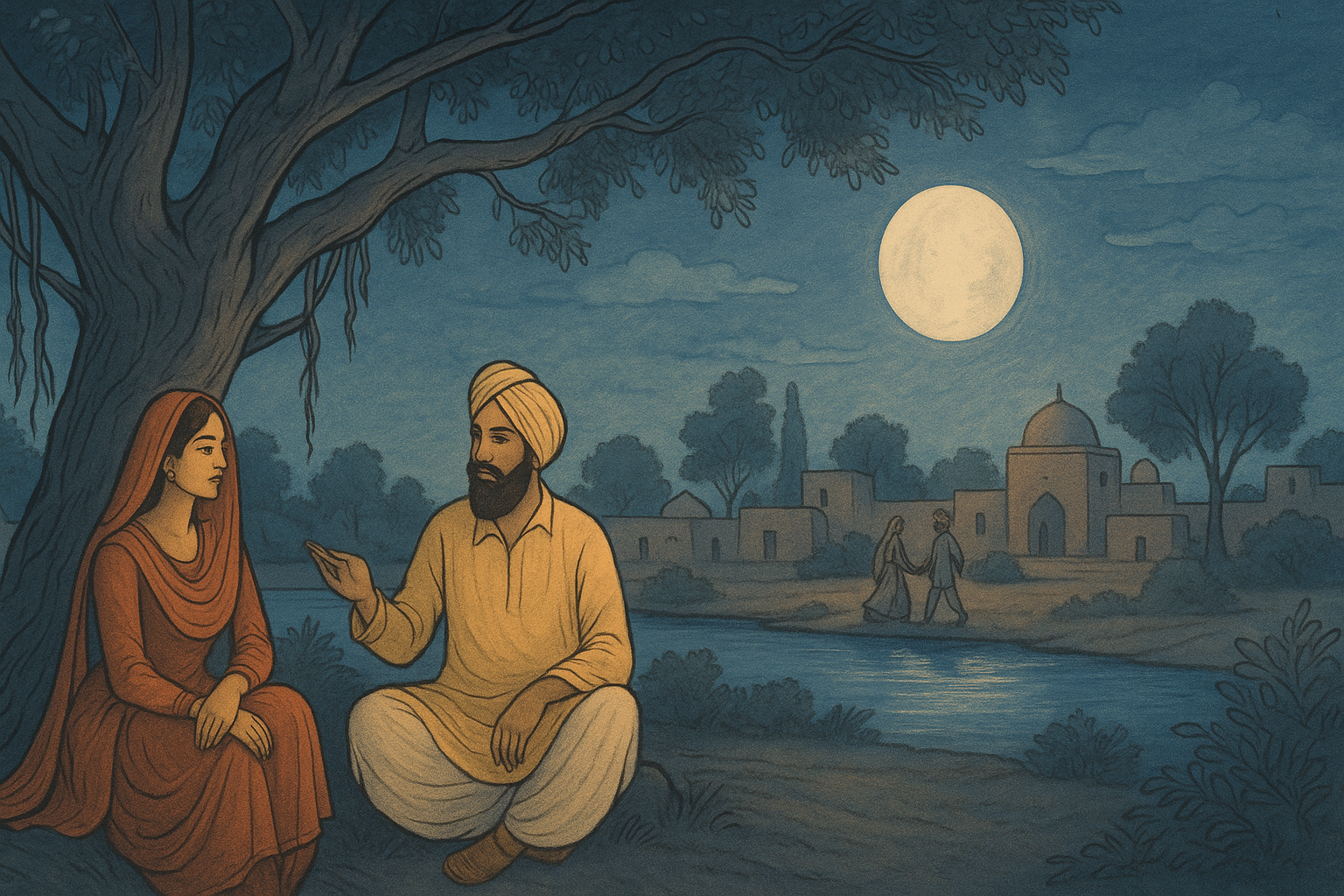
If you want to find the soul of a people, don’t look in their monuments.
Look in their rituals – the small, ordinary gestures that shape their days.
In Punjab, that soul still glows quietly in the mustard oil lamps lit at dusk, in the thread tied around a wrist for protection, and in the songs sung during harvest and birth alike.
These gestures, half-prayer and half-habit, are fragments of an ancient worldview that predates kingdoms and scriptures. They belong to folklore – the living kind that breathes between faith and everyday life.
Faith in Every Breath
In my parents-in-law home, there was a small plate kept on the kitchen shelf. Before a new batch of flour was milled, a pinch of it was sprinkled on that plate as an offering to Annapurna, the goddess of nourishment. My wife’s grandmother would murmur, “First for her, then for us.”
She was not following a ritual from a book. She was repeating something she had seen her mother do, and her mother before that – a lineage of reverence, unrecorded but unbroken.
That’s how Punjabi folklore survives: not by being taught, but by being imitated – like breathing.
Religion in Punjab has always been porous. Sikh, Hindu, and Muslim traditions intertwine so naturally that many customs flow effortlessly across faith lines. A pir’s shrine might be visited by a Hindu woman seeking a blessing, and a Sikh farmer might light incense for a local saint whose name belongs to no single religion. The sacred doesn’t sit only in temples or gurdwaras; it walks among the people, wearing a dozen different names and attires.
I remember this vividly from my childhood. My father often took me to one of the oldest soda shops in Amritsar, “Amin Chand Soda Water Waale,” just outside the Golden Temple (Harimandir Saahib, or Darbar Saahib, as it is known locally). We’d sit on the wooden bench, sipping cold rose milk soda, and I would watch the world pass by. Every cyclist, rickshaw puller, scooter rider, or moped driver would instinctively slow down as they approached the temple entrance. Some would stop; others would simply slow down, and bow their heads before moving on. They came from Hindu, Sikh, and Muslim families alike. Nobody asked who believed what. The act itself was enough – a quiet gesture of reverence toward something larger than all of us.
Even as a child, I understood that moment: when the brakes were pressed on their ride, it wasn’t out of obligation but respect for the almighty. A shared sacredness lived in the air, in the dust, in the rhythm of everyday life. And that, more than any scripture, was Punjab’s true religion. And this small ritual still carries on.
Saints, Spirits, and Everyday Gods
Walk through any Punjabi village, and you’ll find a mosaic of sacred sites – tiny shrines under peepal trees, roadside samadhs of wandering saints, and ancient wells said to have healing powers.
Names like Baba Farid, Gugga Pir, Mai Bhago, and Sakhi Sarwar echo through centuries of devotion. These figures, part legend and part memory, inhabit the space between religion and folklore.
To the people, they are not remote gods but companions – listeners of everyday worries, guardians of crops, protectors of travelers.
Offerings are simple: a handful of jaggery, a garland of marigolds, a whispered promise. And in return, people feel blessed – not because miracles always happen, but because they’ve shared their fears with someone who understands.
Rituals that Shape Life
Punjab’s folklore expresses itself most beautifully through the rituals that accompany life’s milestones – birth, marriage, and death.

- Birth:
When a child is born, a red thread is tied to the mother’s wrist and a nazar battu, a small black charm, is pinned near the baby to ward off the evil eye. The first lullaby the infant hears is often a tappa or a boli, those rhythmic, affectionate, ancient songs that women have sung for generations. These are not just melodies; they are protective circles woven from memory and love. Infants, it is believed, can be startled in their dreams and wake up crying from fears they cannot name. To protect them, mothers often place a piece of iron – scissors, an old knife, even just a metal key, under the pillow or the bed. Iron, in Punjabi tradition, absorbs or deflects bad spirits the way a dreamcatcher filters nightmares. Another version of this practice comes from Sikhi: the karra, the iron bangle, worn as one of the articles of faith. Even for infants, wearing a small piece of iron is believed to keep away harm and guide them toward righteousness.
My own story folds into this tradition. When I was four days old, I fell ill. I am told that my grandfather decided to get me a silver bangle, not iron, and that he sat by my side, praying quietly. After a day of waiting and watching, he slipped the silver karraa onto my tiny right wrist. As I grew older, I often rode on his shoulders to the local market, where he’d buy me clay toys, kuku cheechiyaan, as I called them. I still remember tugging his beard gently and asking, “Bapu ji, eh karraa kyon paya main?” (Why am I wearing this bangle?)
His voice comes back to me in fragments. He would tell me stories from Sikh history, the saakhis of the Gurus, and the heritage in which the karraa stands for protection, discipline, and integrity. Then he’d lower his voice a little, as if sharing a secret: the silver would keep me healthy, and the karraa would guard me from evil, keep me righteous, keep me selfless. There was no scientific explanation; just a beautiful weave of ritual, faith, and folklore.
As I grew, the bangle grew with me. My mother would take me to the goldsmith, who would cut the old karraa, melt and add fresh silver, and shape a slightly larger one for my wrist. The cycle repeated through the years, each new bangle carrying the memory of the last.
I am still wearing that silver karraa as I type this – the latest link in a chain of belief, love, and tradition that began long before I even knew my name. - Marriage:
Weddings in Punjab are layered with folklore so old that even the elders can’t always trace the origins, yet the body remembers them instinctively. The vatna ceremony, where a paste of turmeric, mustard oil, and flour is rubbed onto the bride and groom, is not just for purity or glow; it is believed to soften one’s fate, to smooth away hardships before stepping into a new life. Women sit around in bright phulkari duppattas, laughing as they apply the paste, each gesture a blessing whispered through hands rather than words.
Then comes the mehndi, where intricate henna patterns bloom on the bride’s palms. The deeper the color, the stronger the love, or so folklore says. Hidden initials are woven into the designs, teasing clues for the groom to find later. The air is filled with songs, most of them playful or mischievous, sung by the women of the family. In giddha, they clap and dance while reciting folk verses that lightly mock the groom’s family, celebrate the bride’s beauty, or offer tongue-in-cheek advice about marriage and in-laws.
“Sass te nanad ne taan maar mukkayi,
Par main vi Punjab di, kehdi ghabraayi?”
(“Let the mother-in-law and sister-in-law throw their jabs,
I’m a daughter of Punjab, why should I fear?”)
These songs, passed down for generations, aren’t merely entertainment. They are social cues dressed in humor; a gentle way of preparing the bride for the joys and challenges ahead. The rituals teach patience, generosity, the art of laughter during stress, and the value of community.
Even the phere, the sacred rounds around the fire, are folklore embodied. The fire witnesses the vows, but the women’s songs and elders’ blessings carry the emotional truth of what marriage really means in Punjabi culture: two families weaving themselves together, not just two individuals. - Death:
Even in mourning, folklore steadies the heart in ways that doctrine rarely can. After a death in the family, a small clay or brass lamp is kept burning continuously for days. Its flame is believed to guide the soul as it transitions – a soft light in the darkness, a reminder that the journey continues beyond what we can see. The lamp’s glow fills the night with a quiet hum of presence, as if the departed sits just beyond the threshold, listening to the prayers whispered in the stillness.
Food, too, carries meaning. Simple dishes like kheer or boiled rice are offered to ancestors, set aside in small bowls or fed to the poor in their memory. These acts are not superstitions; they are bridges. They keep the living connected to the departed through gestures of continuity. Sharing food becomes a way of saying, “We remember you. Your story doesn’t end here.”
In many Punjabi homes, mirrors are covered, loud music is silenced, and bright colors are avoided for a time, not as prohibitions, but as a slowing of life to honor the absence. One of my earliest memories is my grandfather’s passing. For a full year after, every festival and ceremony in our home felt gentler, softer. It was in his remembrance and family’s way of honoring him. Relatives and neighbors gather, bringing tea, food, and quiet companionship. Stories of the departed are shared in hushed tones, filled with equal parts grief and gratitude.
The rituals around death are less about the afterlife and more about the living learning how to carry on. They create space for memory, healing, and reflection. They remind us that grief is a thread woven into the same fabric as joy and that the people we lose remain with us through rituals, through stories, and through the small daily acts shaped by their love.
Charms, Omens & the Unseen World
Punjabi villages are full of quiet negotiations with the unseen.
When a crow caws on a rooftop, someone jokes, “Guests are coming.” If milk boils over unexpectedly, it’s a sign of good fortune. A sudden hiccup means someone is thinking of you.

These beliefs might sound whimsical, but they reveal something profound: a worldview in which everything – birds, rivers, shadows participates in human life. Nothing is random; everything speaks.
Even protection has its language. Red chili and lemon garlands hang above doorways to repel envy. Mustard oil lamps burn at crossroads to appease wandering spirits. Old women chant verses to cure headaches or heartaches. Outside homes, you still see nazar battu hung to ward off the evil eye.
Many of these beliefs still shape everyday life – small rituals, certain numbers considered inauspicious, and old religious stories woven into habit.
My grandmother, for example, believed the number three was unlucky. “Tinn kaane hunde ne,” she would say. I remember that my father always ate exactly three rotis, so she would pinch off a tiny piece from the third one to break the omen.
And during thunderstorms, she would insist I never sit in the same room as my maternal uncle. According to old lore, lightning sought out mama–bhanja pairs – a superstition rooted in the myth of Krishna, his siblings, and the fearsome figure of Kans, Krishna’s evil maternal uncle.
My mother believed that cutting the air with scissors or trimming nails at night would disturb the household’s peace. In Punjabi households, sharp objects are often linked with energy and intention; slicing the air was seen as symbolically “cutting” harmony or good fortune – associated with negative energy. It’s the same logic behind not handing someone a knife blade first. Handing a knife with the blade first can be dangerous, but within folklore, these small rituals meant to keep conflict, misfortune, and unseen forces at bay.
She also warned us never to cut nails or hair after dark, saying it attracted bhoot-pret and negative energies. In many Punjabi and Hindu traditions, nighttime is associated with tamasic energy, so grooming or cutting the body is avoided as a matter of spiritual hygiene rather than habit.
These are small acts of power – folklore’s way of giving people control over uncertainty.
The Seasonal Soul of Punjab
No discussion of Punjabi folklore is complete without stepping into the rhythm of its festivals. Each celebration is a reminder of how deeply the people of Punjab remain tied to the land – its seasons, its moods, its generosity. These festivals are not just dates on a calendar; they are the eternal dialogue between humans and nature, a way of honoring planting and harvesting, rest and renewal, faith and gratitude.
- Lohri: Celebrated in the cold of January, Lohri marks the turning of winter; a symbolic return of warmth and light. Families gather around blazing bonfires, tossing popcorn, sesame sweets, puffed rice, and peanuts into the flames as offerings. Children still go door to door singing “Sundar mundriye ho!”, the folk song that immortalizes Dulla Bhatti, the rebel-hero who rescued young girls from abduction and arranged their marriages with dignity. The night crackles with laughter, the beat of the dhol, and the belief that fire purifies and protects.
- Basant Panchami: Spring’s first whisper arrives with Basant. Fields of mustard bloom in vibrant yellow, and the sky fills with kites – each tug of the string a salute to the changing season. People wear shades of yellow, symbolizing joy, warmth, and the renewal of the earth. For poets and musicians, Basant has always been a muse; for farmers, it is the promise of hope.
- Baisakhi: Both a harvest festival and a sacred cornerstone of Sikh identity, Baisakhi carries multiple layers of meaning. It is a day of gratitude to the soil that sustains life, and a solemn remembrance of 1699, when Guru Gobind Singh created the Khalsa, forging a community rooted in courage and equality. Gurdwaras overflow with hymns, farmers celebrate a successful crop, and the land feels alive with purpose and memory.
- Teej & Karva Chauth: These festivals celebrate feminine devotion, resilience, and emotional endurance. Teej arrives with monsoon winds – women swing on decorated swings, adorn themselves in green, and sing songs of longing and love. Karva Chauth, observed through a day-long fast, becomes a ritual of devotion, storytelling, and community. Women gather, dressed in vibrant reds, sharing folk tales passed from mother to daughter, stitching folklore and faith into the fabric of marriage.
Each festival renews the rhythm of life – a reminder that time itself is cyclical, not linear. Seasons change, but faith returns like a familiar melody.
When Faith and Folklore Meet
What fascinates me most is how effortlessly Punjab blends the sacred with the mundane. A farmer might recite a pauri (stanza) from the Guru Granth Sahib (Sikh Holy Book) while oiling his tractor. A bride might quote a folk proverb right before taking her wedding vows.
There is no separation – life and faith are braided together like a plait of hair.
That is why folklore continues to thrive here. It does not belong to scholars or priests; it belongs to the people who live it daily, often without knowing they’re carrying something ancient.
The Unbroken Chain
When I once asked my grandmother why she lit a lamp every evening at the doorstep, she smiled and said, “So that people and our ancestors may find their way home.” I never found that line in any scripture, but it remains the most profound prayer I’ve ever heard.
That lamp, that gesture – that’s folklore! It connects generations across silence and centuries. It is the memory of a civilization that refused to forget itself, even when empires rose and fell.
Closing Reflection
Folklore is not a museum piece; it’s a living rhythm. It changes accent and form but never disappears.
In Punjab, faith is not confined to temples or texts – it is whispered in lullabies, hidden in rituals, and carried in every act of kindness or gratitude.
As I light a small candle on winter nights, I often think of that brass plate from my childhood – the one that held the first handful of flour.
It wasn’t just an offering. It was a reminder that every meal, every day, every life is part of a story much older than us – one that began with reverence and continues through memory.
That, perhaps, is the quietest miracle of all.
Links to the essays in the series:
- Echoes of the Five Rivers: A Journey Through Punjabi Folklore
- Echoes of the Five Rivers, Part 1: The Soul of Punjab and Its Stories
- Echoes of the Five Rivers, Part 2: Themes, Motifs & the Soul of Punjabi Storytelling
- Echoes of the Five Rivers, Part 3: Folk Beliefs, Rituals & the Living Spirit of Punjab
- Echoes of the Five Rivers, Part 4: Folk Music, Songs & the Voice of the Land
- Echoes of the Five Rivers, Part 5: The Qissas – Love, Rebellion, and the Eternal River
- Echoes of the Five Rivers, Part 6: Saints, Seekers & the Soul of Punjab
- Echoes of the Five Rivers, Part 7: Legends of Valor, Justice & the Everyday Hero
- Echoes of the Five Rivers, Part 8: Folklore & Modernity – The Stories That Refuse to Die
- Echoes of the Five Rivers, Part 9: Reflections, Continuity & the River That Remembers
👁️ 487 views
2 Comments on “Echoes of the Five Rivers, Part 3: Folk Beliefs, Rituals & the Living Spirit of Punjab”
Beautifully described, brought back memories, and glad to see that inspite of being far away from your motherland you cherish those memories so much.Balle Balle burraaaah
Thanks, Doc. Glad you enjoyed it.
I could capture only few things. These are memories of childhood, and a few already passed on to my kids.