

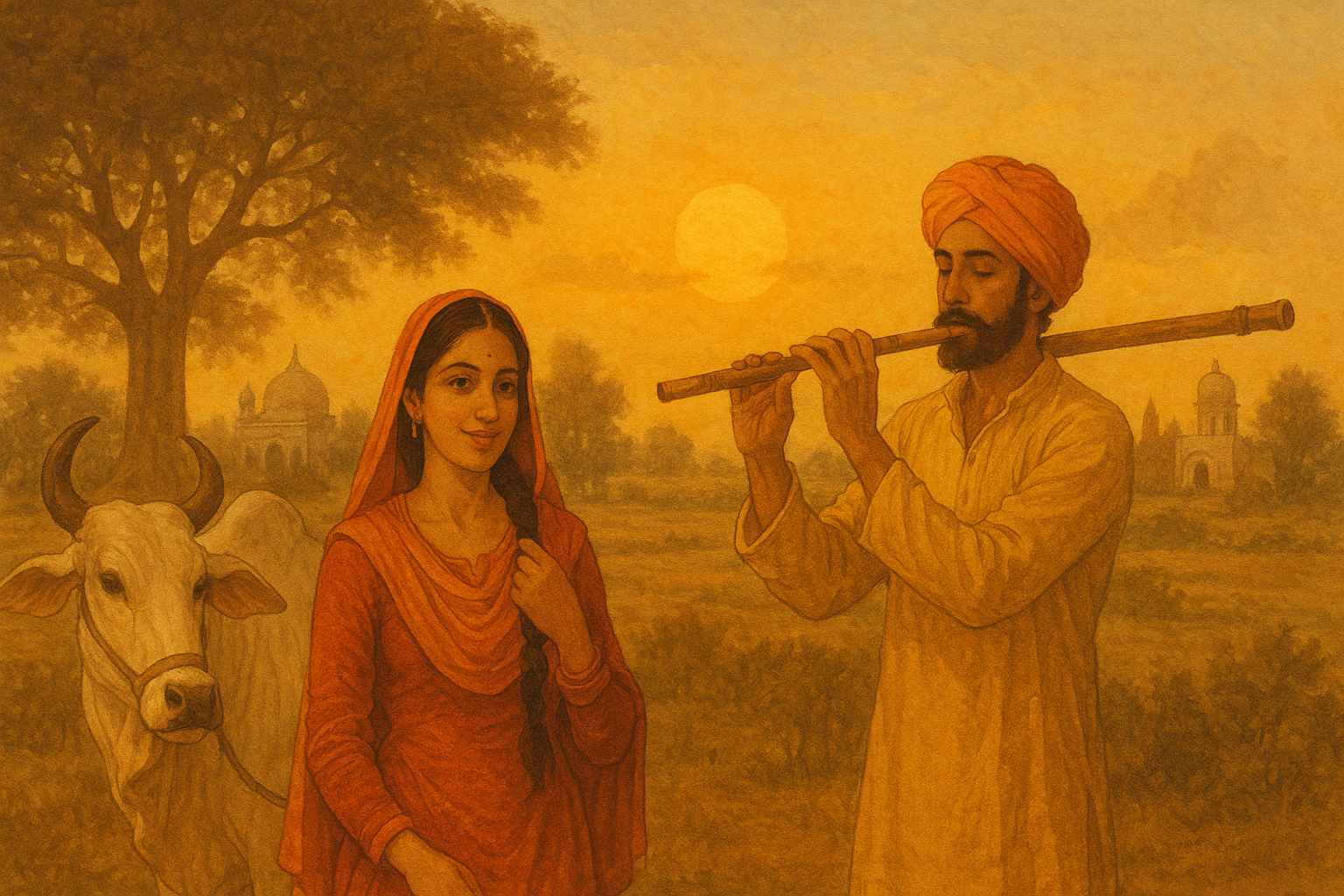
It begins not with a book, but with a voice.
I still remember summer nights in Amritsar when the power would go out, and the world would suddenly become quiet except for the creak of the hand fan and the distant hum of cicadas. My mother, sitting cross-legged on a woven cot, would start telling a story – sometimes about Heer and Ranjha, sometimes about a clever sparrow outwitting a cat. The glow from the kerosene lamp trembled on her face, and her voice carried a rhythm older than written words. At other times, it was riding my grandfather’s shoulders, listening to saakhis, learning wisdom and moral lessons. It was in these moments that I first encountered what I now recognize as the living spirit of Punjabi folklore.
Folklore in Punjab is not a relic of the past. It is breath and heartbeat – woven into songs sung at weddings, proverbs whispered in fields, and tales exchanged over cups of ‘chaa (chai). It has survived invasions, partitions, and displacements. Even when the borders of Punjab were divided, its stories refused to be split. They flowed, like its rivers, across boundaries – between India and Pakistan, from villages to cities, from hearths to digital screens.
What is Folklore, Really?
The word “folklore” often conjures images of old tales or myths frozen in time, but in truth, it is something more fluid. It is the voice of the common people – lok kahaniyan, stories carried not by kings or scribes but by mothers, farmers, artisans, and dhaadis (bards). In the Punjabi context, folklore includes qissas (epic love ballads), boliyan (folk couplets), tappay (rhymed exchanges), riddles, idioms, rituals, beliefs, social consciousness, and even the patterns embroidered on a phulkari shawl.
Each of these carries fragments of a shared memory – whispers of who the Punjabi people were, and what they dreamed of being.
The Land That Shapes the Story
To understand Punjabi folklore, you must first understand Punjab itself – the land of five rivers.
Ravi, Beas, Sutlej, Chenab, and Jhelum: their waters nourished not just the crops but the imagination of the people who lived by them. This is a land where the soil remembers – where Alexander’s armies once marched, where saints sang poetry in marketplaces, where love stories unfolded under mango groves.
The geography itself seems to encourage storytelling. Rivers create journeys, fields create rhythms, and harvest seasons bring together communities that celebrate with song and dance. Even today, festivals like Lohri or Baisakhi carry echoes of ancient fertility rites and agrarian prayers – rituals transformed into cultural celebrations.
Partition in 1947 tore Punjab into two nations, but not two souls. On both sides of the border, grandmothers still tell the same tales, the same songs are sung at weddings, and the same metaphors for love and loss are shared. Folklore, in that sense, has been Punjab’s truest refugee – wandering but never lost.
The Many Faces of Punjabi Folklore
Folklore in Punjab is not just about qissas of tragic lovers. It’s a complete ecosystem of human experience:
- Songs and Music: The beating heart of Punjab. The dhol and tumbi speak as much as words do. Heer, jugni, and dhadi vaar (ballads of valor) all narrate not just emotions but ethics.
- Oral Tales: Trickster stories, animal fables, and moral parables – often used to teach values to children.
- Proverbs and Idioms: Compact wisdom – “Jithon da dana, uththon da rahan” (You belong where you find your bread).
- Rituals and Beliefs: The tying of a red thread for protection, the lighting of a lamp before leaving home, or the offering of mustard oil to ancestors – all speak a folklore language older than organized religion.
- Secular philisophy: Punjab is blessed by the likes of Bulleh Shah, Guru Nanak, Valmiki, and other saints who turned Punjab’s folklore into a living philosophy of love, unity, and conscience.
- Art and Craft: Every phulkari (embroidered shawl) tells a story through thread and color – often representing emotions that words cannot.
When woven together, these elements form the great tapestry of Punjabi identity. Each thread connects a person not only to their past but also to their community – to the collective “we.”
The Oral Tradition: Memory as Heritage
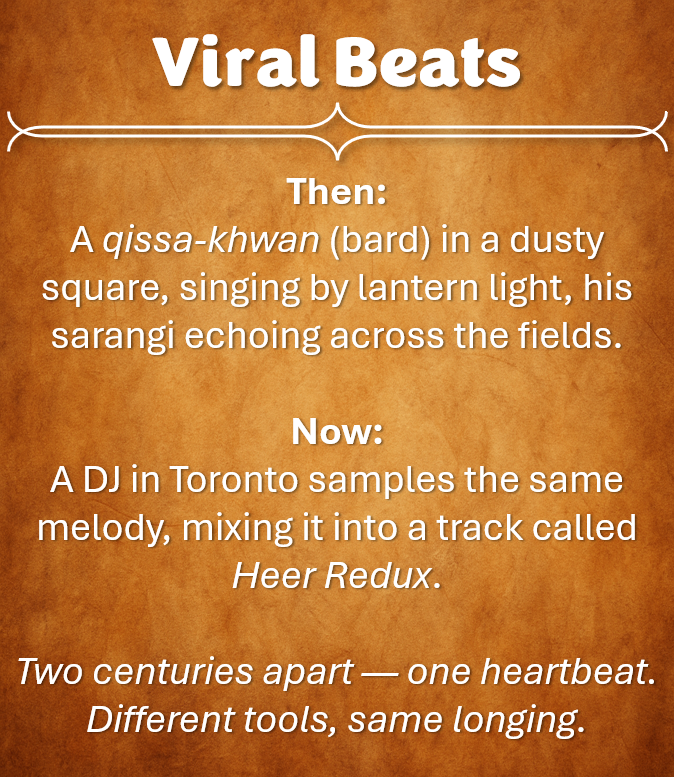
Before there were printing presses or podcasts, there were voices. The Punjabi oral tradition was carried by qissa-khwans – storytellers who would travel from village to village, singing the tales of Heer, Sohni, or Dulla Bhatti. Their performances were part entertainment, part moral education, part spiritual reflection.
What fascinates me is how oral storytelling functions like a living organism. Every time a tale is told, it changes – shaped by the storyteller’s tone, the listener’s reaction, the moment in history. No two versions of Heer Ranjha are identical, and that is the beauty of it. The story grows, breathes, and adapts.
When Waris Shah wrote his definitive version of Heer Ranjha in the 18th century, he was not creating something new – he was giving written form to a song that already existed in the hearts of the people. And yet, his version, infused with Sufi metaphors and poetic mastery, turned the folk story into an epic – a tale of divine love disguised as human passion.
Mehta family’s rendition of Waaris Shah’s Heer
Artists: Mohinder Lal Mehta (91 Years), Mukesh Mehta (62 Years), Vipul Mehta (29 Years)
Why Folklore Still Matters
In an age of streaming content and instant reels, one might ask – why do old stories matter? Because folklore does what algorithms cannot: it reminds us who we are.
Folklore carries the emotional DNA of people. It tells us what we fear, what we celebrate, and what we aspire to be. When a mother sings Sohni Mahiwal to her child, she’s not just narrating tragedy; she’s teaching the endurance of love, the courage of defiance, and the rhythm of the river that flows through every Punjabi heart.
For me, rediscovering these stories as an adult feels like returning home – not to a place, but to a voice. The same one that trembled in the lantern light decades ago.
Looking Ahead
This series, Echoes of the Five Rivers, will wander through the valleys and verses of Punjabi folklore. In the coming parts, we’ll explore recurring themes and motifs, the beliefs that shape everyday life, the musical pulse of folk songs, and the legendary lovers whose names are still sung under the stars.
But before we get to heroes and heartbreak, it’s important to pause – to understand that behind every story are people trying to make sense of life, love, loss, and laughter.
That’s what makes Punjabi folklore timeless. It belongs to everyone who listens.
Closing Reflection
Stories are how we remember. But in Punjab, they’re also how we live.
The folk tale doesn’t end when the storyteller stops – it lingers in a song, a proverb, a shared laugh over ‘chaa (chai, or tea).
Perhaps that’s the secret of Punjabi folklore – it isn’t bound by time. It flows, like the rivers that named the land, carrying with it everything the people have ever loved, lost, or dreamed.
Links to the essays in the series:
- Echoes of the Five Rivers: A Journey Through Punjabi Folklore
- Echoes of the Five Rivers, Part 1: The Soul of Punjab and Its Stories
- Echoes of the Five Rivers, Part 2: Themes, Motifs & the Soul of Punjabi Storytelling
- Echoes of the Five Rivers, Part 3: Folk Beliefs, Rituals & the Living Spirit of Punjab
- Echoes of the Five Rivers, Part 4: Folk Music, Songs & the Voice of the Land
- Echoes of the Five Rivers, Part 5: The Qissas – Love, Rebellion, and the Eternal River
- Echoes of the Five Rivers, Part 6: Saints, Seekers & the Soul of Punjab
- Echoes of the Five Rivers, Part 7: Legends of Valor, Justice & the Everyday Hero
- Echoes of the Five Rivers, Part 8: Folklore & Modernity – The Stories That Refuse to Die
- Echoes of the Five Rivers, Part 9: Reflections, Continuity & the River That Remembers
👁️ 502 views
2 Comments on “Echoes of the Five Rivers, Part 1: The Soul of Punjab and Its Stories”
Fabulous! I look forward to the coming posts in this series. The transport to an earlier time feels real, the exposition absorbing, and the impact of the grounding in today’s reality while re-living the past is profound.
Thank you. I’m glad the writing carried you back to those older rhythms. I should say, “that’s exactly what I hoped this series would do”.
The inspiration comes from the proverbs we still use, the idioms we grew up hearing, and the stories that quietly shaped us. Going back, remembering where I first heard them, and reconnecting with that world has been its own journey. I’m excited to share the upcoming parts over the next few weeks — there’s so much more to explore.