
Dragons, Part 1: When Chaos Had Scales, or Dragons of the Ancient World

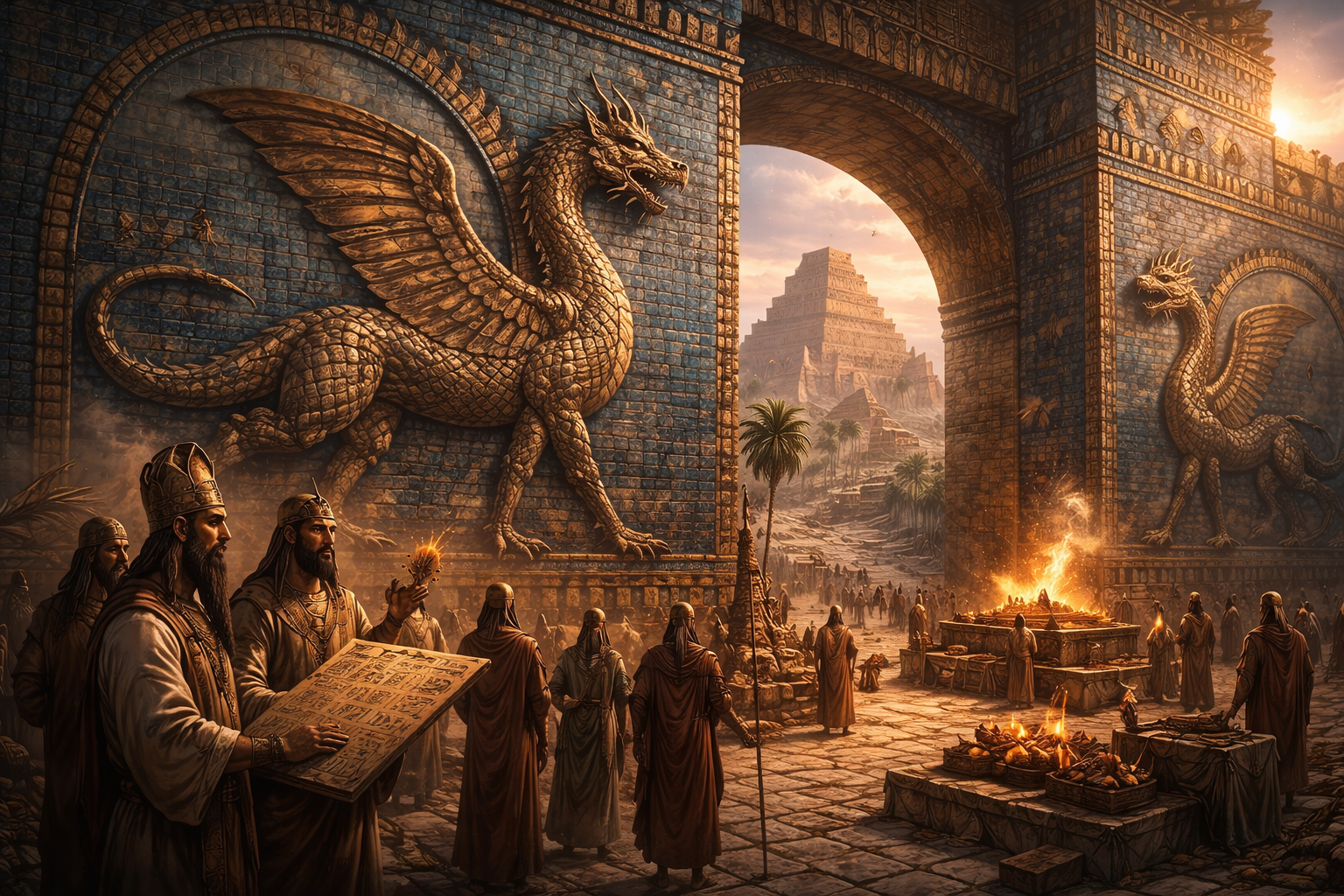
Before dragons became enemies, they were explanations.
In the ancient world, people did not invent dragons to frighten children or to give heroes something impressive to kill. Dragons emerged because early societies needed a way to talk about forces that were real, overwhelming, and indifferent to human intention. Floods, droughts, storms, disease, famine, the slow violence of time itself. These were not abstract problems. They were lived realities. The dragon was a way to give those realities a body.
To understand ancient dragons, we have to set aside the modern instinct to treat them as characters. Early dragons were not personalities. They were conditions.
In Mesopotamia, among the earliest urban civilizations, dragons and serpent-beasts appear at the foundation of myth itself. These cultures lived at the mercy of rivers that could nurture or annihilate entire cities depending on the season. Chaos was not theoretical. It was hydrological. The dragon here is not a creature that disrupts order; it is disorder. It coils through creation myths as something that must be confronted so that the world can be shaped at all. The victory over the dragon is not moral. It is cosmological. Order does not triumph because it is good, but because it is necessary.
What is striking is that these early dragons are not portrayed as petty or malicious. They are vast. Impersonal. Almost tragic in their inevitability. Killing or subduing such a dragon is less like defeating an enemy and more like damming a river. It solves a problem while introducing new risks.
That pattern repeats.
In the Greek world, the drakon was not yet the winged fire-breather of later imagination. The word itself is tied to seeing, to watching. A drakon is a guardian, a sentinel, a being whose defining trait is vigilance. Greek dragons coil around springs, groves, sacred trees. They guard thresholds rather than hoards. Their presence signals that you are crossing from the ordinary into the charged. If you encounter a drakon, you have already gone too far to pretend innocence.
Here again, the dragon is not evil by default. It is doing a job. It enforces boundaries that matter to the gods, to nature, or to the structure of the world itself. Slaying such a dragon is rarely consequence-free. Heroes who kill drakons are often cursed, exiled, or burdened with obligations they did not anticipate. The dragon’s death resolves one tension and creates another.
Ancient stories understood something we often forget: removing a guardian does not remove the danger. It relocates it.
Further east, in the Indo-Iranian mythic sphere, the serpent-dragon appears as blockage. Vritra, the great serpent, does not merely threaten life. He withholds it. He traps the waters, hoards the rains, compresses abundance into stagnation. The battle against him is not about revenge or honor. It is about release. When the serpent is struck down, rivers flow, fertility returns, the world breathes again.
This is an important distinction. The dragon is not a predator feeding on people. It is a choke point in the system. It represents accumulation without circulation. Hoarding before hoards were counted in gold.
That idea of the dragon as hoarder appears far earlier than medieval treasure caves. It begins as a natural metaphor. Water that does not move becomes deadly. Wealth that does not circulate corrupts. Power that is not checked calcifies. The dragon embodies all three.
Even in ancient Hebrew texts, where the serpent becomes morally charged in later interpretation, the older imagery is more complex. Serpents and sea monsters appear as embodiments of primordial chaos, adversaries of divine order rather than tempters of individual souls. They represent forces that predate law, covenant, and instruction. Their defeat is about establishing a habitable cosmos, not enforcing obedience.
What changes over time is not the dragon itself, but what humans need the dragon to explain.
The Roman world inherits many of these ideas and repurposes them pragmatically. The draco becomes a military symbol, a standard carried into battle. The dragon here is no longer a cosmic problem but a sign of disciplined violence. It does not threaten the empire; it represents it. This is a critical shift. Power that was once external and terrifying is now claimed, displayed, and institutionalized.
Yet even then, the dragon remains double-edged. A symbol of dominance always carries the memory of the chaos it once represented. To march under a dragon banner is to announce both strength and danger, authority and warning.
Across these cultures, a pattern emerges. Ancient dragons are rarely solitary inventions. They appear where humans confront forces that feel too large, too old, or too systemically embedded to be reduced to simple enemies. They are stories about limits. About what happens when natural order breaks down or becomes inaccessible.
This is why early dragons are often associated with water, storms, darkness, and the edges of maps. They inhabit places humans cannot fully control. Rivers in flood. Seas without shorelines. Mountains without paths. Caves that swallow sound. These are not arbitrary settings. They are reminders that civilization exists on borrowed stability.
What is absent from these early dragon stories is just as revealing as what is present. There is little emphasis on greed in the moral sense. Little fixation on cruelty for its own sake. The dragon does not torment villagers for amusement. It simply exists, and its existence creates pressure. It forces response.
Heroes emerge not because they are virtuous, but because the situation demands intervention. The dragon creates the conditions for heroism without caring who answers the call.
This is a very different relationship than the one modern fantasy often presents. We are accustomed to dragons as antagonists with personalities, grudges, and plans. Ancient dragons rarely plan. They endure. They wait. They obstruct. They persist longer than generations.
And that persistence is key.
In societies where life expectancy was short and environmental threats were constant, the dragon functioned as a narrative compression of time. It represented dangers that outlasted individual lives. You could not simply wait them out. You had to deal with them, or your descendants would.
Seen this way, the dragon is not a monster but a warning system.
As civilizations grew more complex, so did the dragon’s symbolic load. It became a way to talk about surplus and scarcity, authority and rebellion, divine order and natural resistance. It absorbed whatever anxieties a culture could not resolve through law or ritual alone.
That adaptability explains why dragons appear independently across civilizations that had little direct contact. The human problems they address are universal. How do you live in a world that can undo you without intent? How do you explain disasters that do not care about morality? How do you justify power that claims to tame chaos while benefiting from it?
Dragons provided a language for those questions long before philosophy formalized them.
By the time later traditions begin to moralize the dragon more sharply, something important has already happened. Chaos has been personalized. Danger has been given intention. The dragon starts to shift from being a feature of the world to being a fault in it.
But that comes later.
In the ancient world, dragons were still part of the natural order, however terrifying that order might be. They were not intruders. They belonged. Their defeat was never simple, and their absence was never guaranteed.
That worldview carries a humility that modern interpretations often lose. Ancient stories did not promise permanent victory over chaos. They promised temporary balance. The dragon could be pushed back, redirected, appeased, or bound. Rarely was it erased completely.
And perhaps that is why these stories still resonate. They acknowledge a truth that remains uncomfortable: some problems cannot be solved once and for all. They can only be managed, negotiated with, or held at bay.
The dragon, in its earliest form, understood this.
Before it learned to speak, before it learned to hoard gold, before it learned to tempt saints or terrorize villages, the dragon taught humanity a hard lesson. The world is not built for our convenience. It is older than us, stronger than us, and largely indifferent to our intentions.
Giving that truth a body was not an act of fear.
It was an act of clarity.
👁️ 2 views