

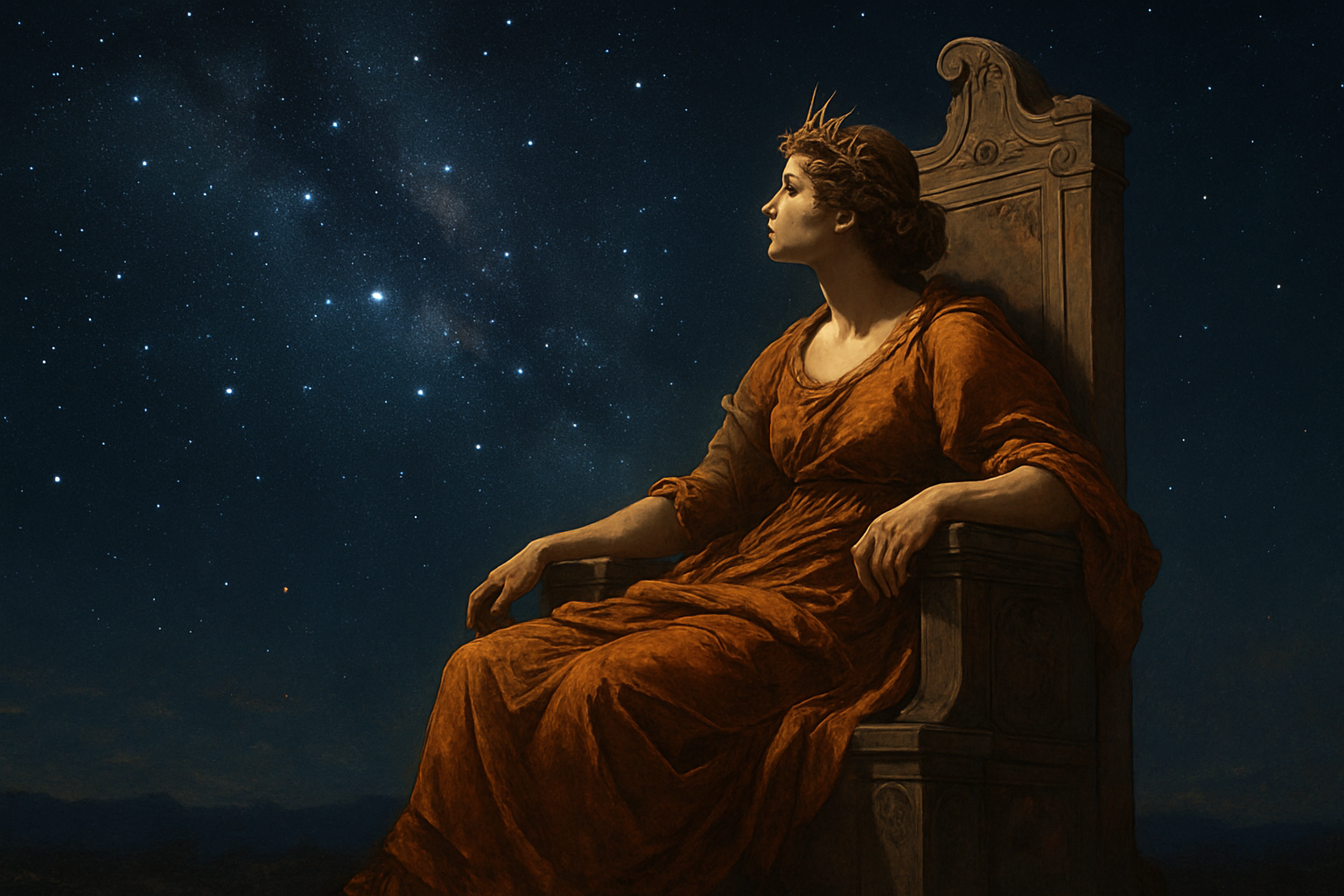
It was on the way back from a late evening ice-cream run that the conversation turned to constellations. The kids, pointed out stars and asked about the brightest ones in the night sky. When we reached home, we all stepped out of the car for a better look. Facing north, the Big Dipper came into view almost immediately, its familiar shape guiding my gaze upward. Just beyond, near the steadfast glow of the Pole Star, I spotted the crooked pattern of Cassiopeia. She wasn’t upright that night; instead, her throne seemed to tilt awkwardly, as if caught mid-turn. And in that moment, I was reminded of the Greek myth of Queen Cassiopeia – her vanity, her punishment, and her eternal seat among the stars.
A Queen’s Pride and Punishment
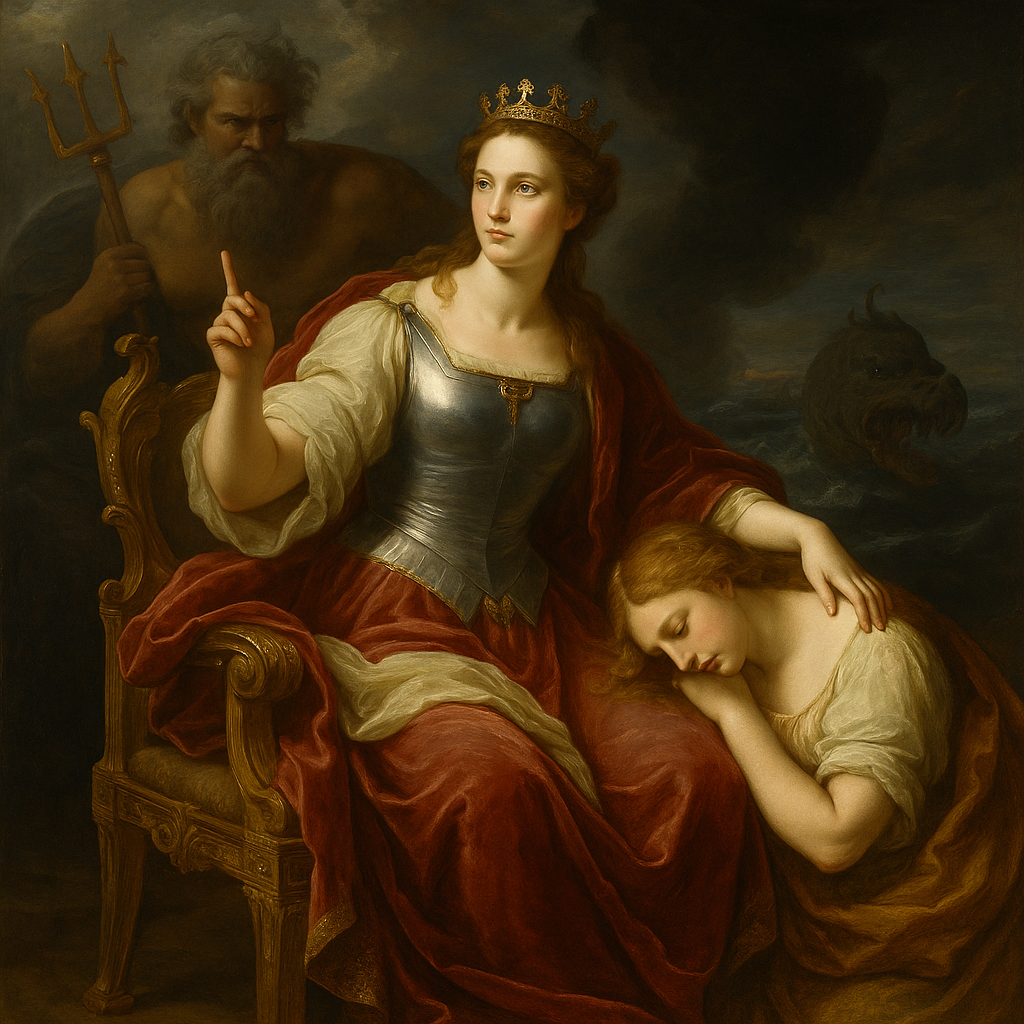
Greek mythology is filled with kings and queens whose pride often outshone their wisdom, and few stories illustrate this better than that of Cassiopeia. She was the queen of Aethiopia, married to King Cepheus, and mother to the beautiful Andromeda. Cassiopeia’s fatal flaw was her vanity. She was so enamored with her own beauty, and that of her daughter, that she claimed they surpassed even the sea nymphs, the Nereids, in loveliness.
Such arrogance did not go unnoticed. The Nereids, insulted, complained to their father, Poseidon, the god of the sea. Enraged, Poseidon decided to punish Cassiopeia and her family. He sent a monstrous sea creature (often described as a giant serpent or whale, the Cetus) to ravage their kingdom’s shores. To appease the gods’ wrath, Cepheus and Cassiopeia were forced to chain their daughter Andromeda to a rock as a sacrifice.
It was only through the hero Perseus, fresh from slaying Medusa, that Andromeda was saved, cementing one of the most dramatic tales of rescue in Greek mythology. But Cassiopeia, the queen whose vanity had started the chain of events, did not escape unscathed. The gods decreed that she should be placed in the sky as a constellation, seated forever on her throne, circling the heavens. Her punishment was fitting: in the course of her eternal rotation, she is forced to sit upright for half the night, and upside down for the other half – a cosmic reminder of her vanity and humiliation.
The Throne in the Sky
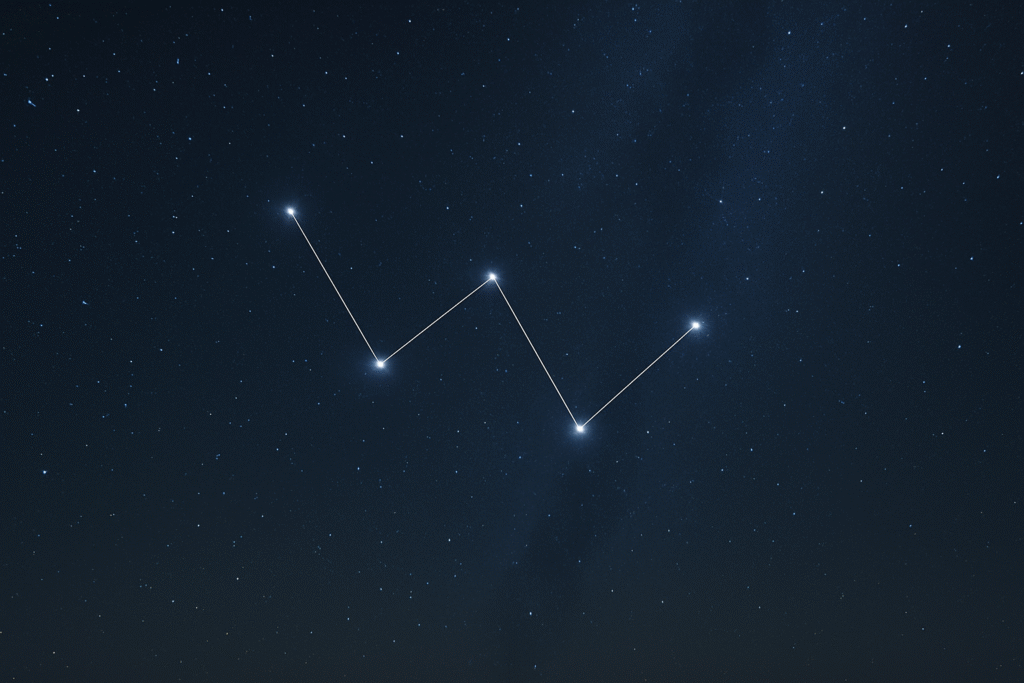
Astronomers and stargazers know Cassiopeia not for her pride, but for her unmistakable shape in the night sky. The constellation Cassiopeia is one of the easiest to spot in the northern hemisphere. Its five brightest stars form a distinct “W” shape, though depending on the season and time of night, that “W” can appear as an “M,” a zig-zag, or even lying on its side.
This shifting appearance ties beautifully to her mythological punishment. Just as the story tells of Cassiopeia’s vanity being turned into humiliation, the constellation appears to tumble through the night, sometimes upright, sometimes inverted. Unlike constellations that remain consistently oriented in the sky, Cassiopeia seems to “fall off her throne” as she circles the celestial pole.
In fact, her perpetual circling is a direct result of her position in the sky. Cassiopeia is a circumpolar constellation for much of the northern hemisphere – meaning it never fully sets below the horizon. Instead, it rotates around Polaris, the North Star, in a constant cosmic loop. Night after night, Cassiopeia’s stars tell the story of her eternal punishment.
Cassiopeia’s Celestial Court
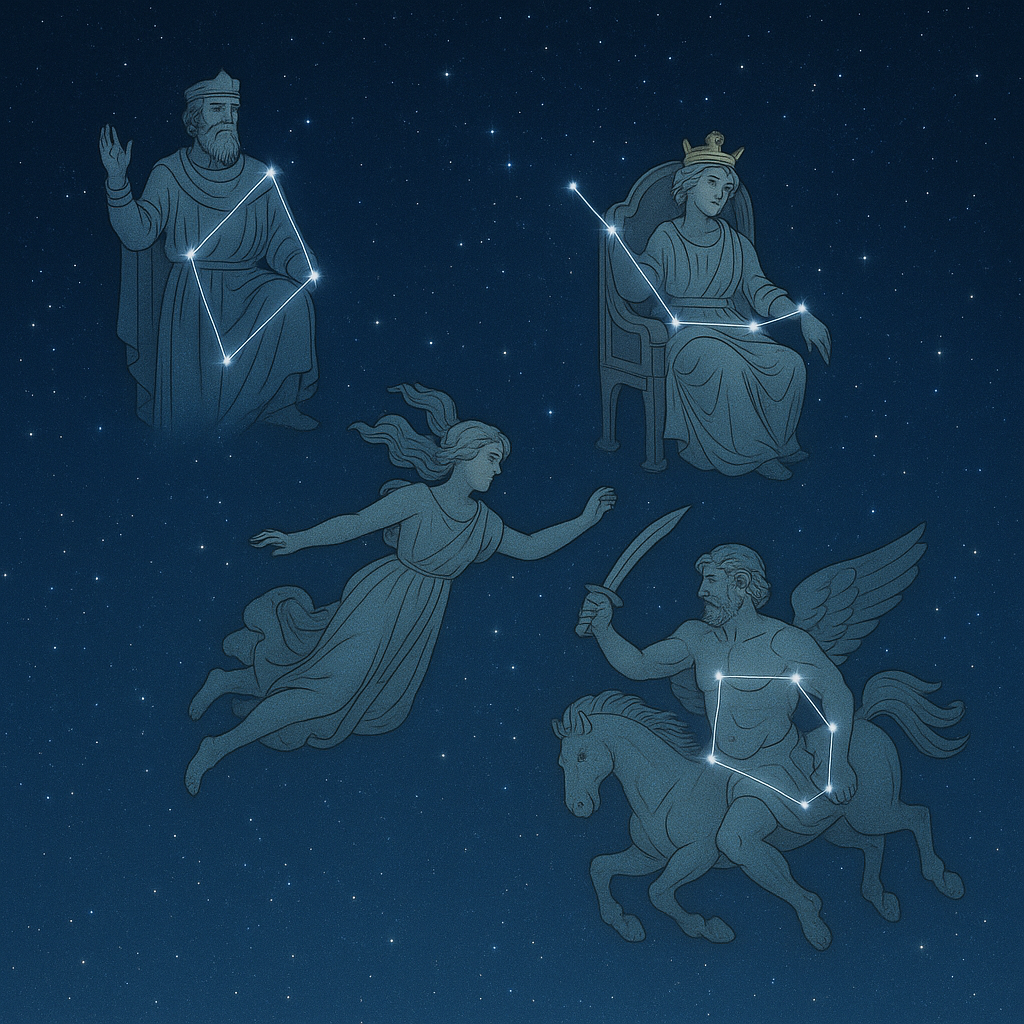
Cassiopeia doesn’t sit alone in the heavens. Her story is spread across the sky in a kind of cosmic theater:
- Cepheus, her husband, occupies the sky nearby, depicted as a king wearing a crown.
- Andromeda, her daughter, stretches out in a long constellation connected to Pegasus, the winged horse Perseus rode.
- Perseus, the hero, is there too, with stars marking his triumph over Medusa.
- Even Cetus, the sea monster, lurks further south in the sky.
Together, these constellations form one of the richest mythological “family portraits” in the heavens, each character frozen in starlight, replaying their drama every night.
The Science Behind the Stars
While mythology gives Cassiopeia its story, astronomy provides the detail. The constellation lies in the Milky Way’s rich star fields, making it home to numerous star clusters and nebulae. Amateur astronomers often use Cassiopeia as a starting point for sky tours because it’s so easy to find and points the way to the North Star.
- Cassiopeia A (Cas A): One of the strongest sources of radio waves in the sky, this is the remnant of a supernova that exploded about 11,000 years ago. It’s one of the most studied supernova remnants, offering clues about the life cycles of stars.
- The Heart and Soul Nebulae (IC 1805 and IC 1848): Massive star-forming regions near Cassiopeia that glow beautifully in astrophotography. Their poetic names fit well with a constellation tied to love, beauty, and vanity.
- Open Star Clusters: Cassiopeia is littered with them, including the famous “Owl Cluster” (NGC 457), where the arrangement of stars looks like a tiny owl or even the character E.T. raising his arms.
In this way, Cassiopeia is both a mythological reminder and a treasure trove for astronomers. Her throne may be a punishment in myth, but in science, it’s a window into the universe.
Vanity in the Stars
What makes Cassiopeia’s story so captivating is how neatly the myth aligns with the science. Unlike some constellations where the myth feels imposed on the stars, Cassiopeia’s constant rotation and her “upside-down throne” perfectly mirror the story of her cosmic humiliation.
There’s also a kind of timeless irony. Ancient Greeks used stories like Cassiopeia’s to caution against vanity and hubris. Today, the constellation still reminds us of those themes, but also of the beauty of human imagination. After all, we no longer look at Cassiopeia as merely a vain queen – we see her as a guiding pattern in the sky, a constellation that helps us navigate both practically (to Polaris) and symbolically (toward stories of consequence and redemption).
Cassiopeia in Culture and Legacy
The image of Cassiopeia as the vain queen has endured beyond Greek mythology. She appears in art, literature, and modern retellings of the Andromeda myth. Astronomers, too, have kept her story alive through naming conventions: not only the constellation itself, but also objects like Cassiopeia A carry her name.
Interestingly, in some interpretations, Cassiopeia is not only punished but also serves as a reminder of the interconnectedness of myth and cosmos. She’s visible year-round in much of the northern hemisphere, meaning ancient storytellers could always point to her as a moral lesson in the sky. Her immortality is not in beauty but in narrative.
Myth and Astronomy: A Shared Throne
Cassiopeia is more than just a starry “W” in the sky. She is a reminder of how mythology and astronomy intertwine. The Greeks looked up and saw a queen punished for vanity. Modern astronomers look up and see stellar nurseries, exploding stars, and cosmic structures billions of years old. Both views are true, and both enrich our understanding of the universe.
So next time you’re out on a clear night, look north and find the crooked throne of Cassiopeia. Remember her story: a queen who boasted too much, punished to spin forever in the heavens. And marvel at how a tale from thousands of years ago still lives among the stars, whispering lessons about pride, beauty, and the eternal dance of the cosmos.
The vain queen still sits on her throne, spinning endlessly in the sky – sometimes upright, sometimes upside down.
Check other stories in this series by clicking here.
👁️ 474 views