
Satluj: A Film That Does Not Wound the Body, It Wounds the Soul

Some films are watched. Some are endured. And then there are films like Satluj, which do something more dangerous. They enter the room quietly, sit next to you, and begin removing the lies one by one.
Originally known as Punjab 95, Honey Trehan’s film arrives with the weight of a history that many people remember, many people avoid, and many people have never been allowed to fully understand. The film is inspired by the life of Jaswant Singh Khalra, the human rights activist who investigated illegal cremations and disappearances in Punjab during the militancy years. The film itself was reportedly trapped for years in a certification battle, with demands for extensive cuts before it finally surfaced on streaming under the new title Satluj. Director Honey Trehan and Diljit Dosanjh have both maintained that the released version is uncut, with only the title changed.
That history matters because Satluj is not merely a film about violence. It is a film about the machinery that hides violence. It is about the neatness of official records, the silence of institutions, the fear inside ordinary homes, and the terror of a society where a person can disappear and the world can be instructed to move on.
The story begins with Jaswant Singh Khalra, played by Diljit Dosanjh, searching for a missing relative. It is an ordinary human beginning. A family is worried. A man starts asking questions. But the questions do not remain small for long. One missing person leads to another. One body leads to another. One record leads to a pit of darkness. Soon, the search is no longer about one person. It becomes about Punjab itself.
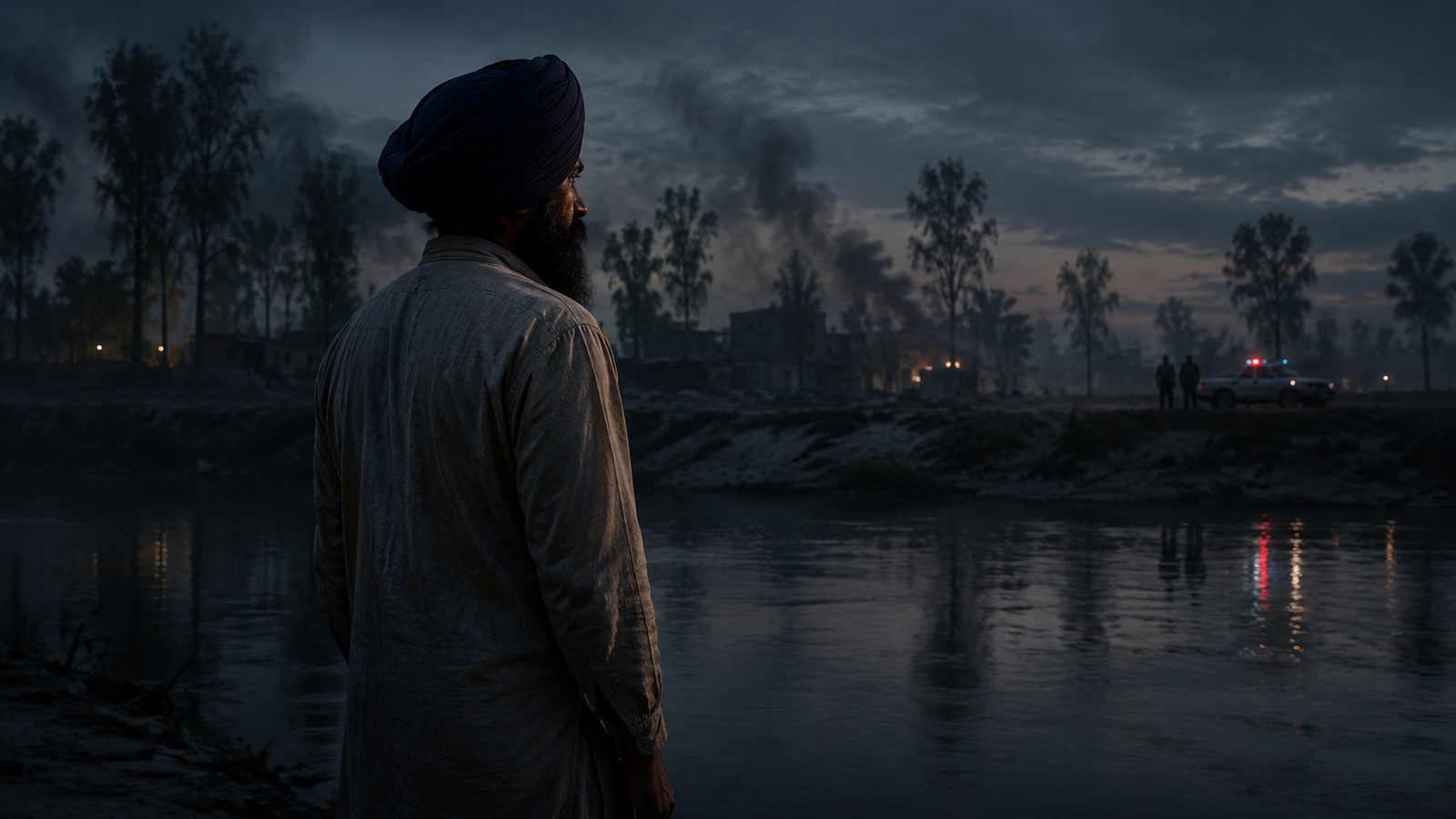
This is where the title Satluj becomes more than geographical. A river carries memory. It carries soil, ash, prayer, blood, and history. In this film, the river is not scenic. It is witness. It becomes the place where the dead are hidden, where evidence is drowned, where a state tries to wash its hands and discovers that water remembers.
What makes Satluj so unsettling is that it does not rely on conventional cinematic brutality. It is not constantly loud. It does not need bullets in every frame. The violence here is colder. It is bureaucratic, procedural, almost casual. That is more frightening because cruelty becomes routine. The film suggests that when violence is absorbed into paperwork, uniforms, and chain of command, it becomes harder to see and easier to deny.
There is a line in the Hindi review that stayed with me: this film wounds you without touching you. That is the right way to describe it. Satluj does not simply show pain. It makes you sit inside helplessness.
The film’s visual language understands this. Much of it appears to live in darkness, not merely as a stylistic choice but as moral architecture. Punjab is not shown as a bright postcard of mustard fields, folk songs, and nostalgia. This is a Punjab where the light has retreated into corners. Darkness is not just absence of light. It is a condition. It is what happens when truth has been buried too long.
And yet, this is not a simplistic film about good people and bad people. That would have been easier and perhaps more comforting. The horror here is that the violence happens within the same society, among people who share language, geography, faith, memory, and blood. There are no easy outsiders to hate. In Vicky Kaushal’s Sardar Udham, the British empire gives the viewer a clear object of moral outrage. In Satluj, the wound is internal, and the enemy is within. That makes it harder to process.
Human Rights Watch has documented how counterinsurgency laws, incentives, and police powers during that period contributed to disappearances and extrajudicial executions, and specifically notes Khalra’s investigation into secret cremations before his own arrest, torture, and killing by police officials. It also records the Indian government’s admission of 2,097 illegal cremations in Amritsar. Human Rights Watch Amnesty International had earlier raised concerns around Khalra’s disappearance, intimidation of witnesses, delays, and attempts to undermine the judicial process.
This is why Satluj matters. It is not inventing darkness for dramatic effect. It is dramatizing a darkness that already existed.
Diljit Dosanjh carries the film with remarkable restraint. He does not play Khalra like a cinematic hero designed for applause. He plays him like a man who begins with concern and slowly becomes unable to look away. That transformation is important. Courage is often misrepresented in cinema as aggression. Here, courage looks like persistence. It looks like a man continuing to ask questions after every sensible instinct tells him to stop.
There are moments where Diljit’s face does more work than dialogue. The best actors do not always need to announce emotion. They allow the audience to discover it. After Chamkila and now Satluj, it is becoming increasingly difficult to call Diljit merely a singer who acts. That label is now outdated. He is one of the most compelling screen presences in Indian cinema because he brings moral simplicity without making it feel simplistic. He can appear ordinary and monumental in the same scene.
Arjun Rampal’s entry gives the film a different rhythm. Before him, Satluj feels almost suffocating, as if the viewer is trapped in the same atmosphere as the victims and their families. With Rampal, the film takes on the shape of an investigation thriller. The police versus CBI angle does not dilute the emotional weight. It gives the story structure. It reminds us that truth is not just felt. It must also be pursued, documented, assembled, and defended.
Rampal has often been underused in Hindi cinema. Here, his stillness works. He does not need to overpower the frame. His character brings a colder intelligence into the film, and that is necessary. In a story full of fear, grief, and moral collapse, he represents the methodical side of justice. Not justice as slogan. Justice as evidence.
The negative characters are terrifying because they are not written as cartoon villains. They are ordinary men who have discovered that power gives them permission to become monstrous. That is the most frightening kind of evil. It does not arrive wearing horns. It arrives wearing a uniform, carrying a file, speaking in familiar accents, and behaving as if accountability is something that happens to other people.
The family scenes are where the film becomes almost unbearable. Political violence is often discussed in numbers. Twenty-five thousand. Two thousand. Hundreds. Thousands. But families do not grieve in statistics. A missing person is not a data point. He is someone’s son, husband, father, brother, neighbour. Satluj understands this. It slows down enough to show the domestic cost of terror. The waiting. The uncertainty. The humiliation of asking for answers from the very system that may be responsible for the disappearance.
That heaviness will not work for everyone. This is not entertainment in the casual sense. It is not a Friday night watch. It is not background cinema. It demands attention and emotional stamina. There are films one recommends easily. Satluj is not one of them. This is a film one recommends with a warning.
But that does not make it less necessary. In fact, that may be precisely why it is necessary.
The controversy around the film’s release only adds another layer to the story. A film about suppressed truth becoming difficult to release is almost too on the nose. Reports indicate that after its streaming release, Satluj was removed from ZEE5 in India, with security concerns cited. (The Times of India) Whatever one’s politics, the larger question remains uncomfortable: if a society cannot look at its own wounds, does the wound disappear, or does it simply become infected?
That is the question Satluj leaves behind.
It is not a perfect film because a film like this probably cannot be perfect. It is carrying too much grief, too much history, and too much moral burden. But it is powerful, sincere, and deeply unsettling. It does not flatter the viewer. It does not provide easy catharsis. It does not allow us to say, “That was the past,” and walk away clean.
For Punjab, memory has always been complicated. We remember through songs, through food, through migration, through family stories, through silence. Sometimes what is not said becomes louder than what is said. Satluj enters that silence and refuses to behave politely.
That is why the film works.
It does not shout. It does not sermonize. It does not beg for sympathy. It simply shows what happens when a man follows the dead until the living are forced to answer.
Satluj is heavy cinema. It is brave cinema. It is not for everyone. But some films are not made for comfort. Some are made because history has been waiting too long outside the door.
And when history finally enters, it rarely comes softly.
Final thoughts:
One of the toughest films to watch. I watched it in 3 sittings. Everytime I would stop, I was scared to go back to it.
Not for the faint of heart (like me).
Read this:
- Punjab 1984 – Ballewood Arrives !!!
- The Enterprise of Evil Operates on the Illusion of Invincibility
👁️ 97 views