


On June 18, I complete 30 years in the workforce, spanning government institutions, large corporations, and private companies. Over three decades, I have had the privilege of working with many talented people and observing many different leadership and management styles.
This essay is inspired by those observations and experiences. The patterns described here are my own interpretations and reflections. Most of us display one or two of these behaviors from time to time. We are human, after all. Then there are a few individuals who seem to devote remarkable amounts of energy to practicing nearly all of them.
The challenge is not recognizing these behaviors in others. It is recognizing them in ourselves.
Most career advice assumes that if you work hard, deliver results, and help the organization succeed, opportunities will naturally follow.
Most of the time, that is true.
But every so often, you encounter a different reality. The better you perform, the more resistance you seem to face. Meetings become harder to get into. Information arrives later than it should. Your ideas are repeated by someone else. Promotions are delayed. Visibility shrinks.
At first, it feels like coincidence.
Then you begin noticing patterns.
The uncomfortable truth is that organizations are made of people, and people are not always driven solely by logic, performance metrics, or corporate values. They are also influenced by ambition, insecurity, politics, status, and self-preservation.
This does not necessarily mean someone sees you as a threat. In fact, that phrase is often overused on social media. Sometimes there are legitimate reasons for difficult relationships. Sometimes managers are overwhelmed, distracted, or simply ineffective.
Yet there are situations where a high-performing employee creates anxiety for someone higher up the chain. When that happens, certain behaviors tend to appear repeatedly.
Recognizing them is important, not for becoming cynical, but for understanding the environment around you.
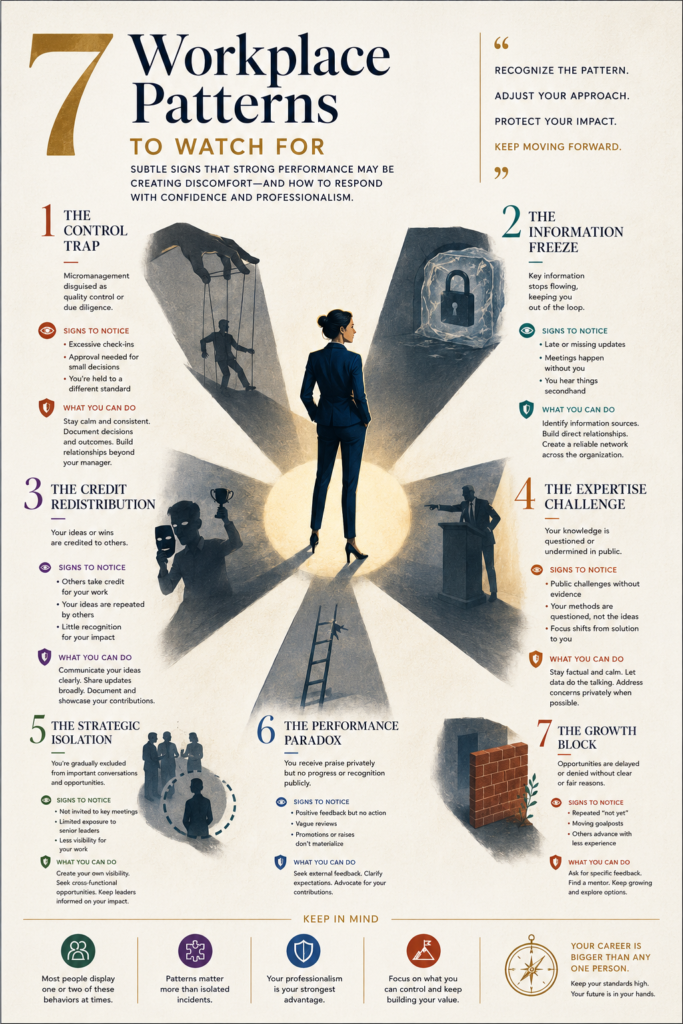
CLICK HERE TO DOWNLOAD THE INFOGRAPHIC FOR THIS POST

The Control Trap
One of the earliest signs is selective micromanagement.
You notice that colleagues receive broad objectives and freedom to execute. You, on the other hand, are required to provide detailed updates, seek approval for minor decisions, and justify every action.
The stated reason is usually quality control or consistency.
The real reason may be something else.
Highly capable employees often create discomfort because they operate independently. Independence reduces someone’s ability to control the narrative, influence outcomes, or claim ownership.
Ironically, the more competent you become, the tighter the oversight can become.
The mistake many people make is fighting the control directly. That usually escalates the situation.
A more effective response is to broaden your professional relationships. Build connections with stakeholders, peers, and leaders across the organization. When your credibility is established through multiple channels, excessive control becomes harder to maintain.

The Information Freeze
Information is power in every organization.
When key information suddenly stops flowing, pay attention.
Perhaps you used to be included in planning discussions but are now informed only after decisions are made. Perhaps critical meetings occur without your involvement. Maybe everyone seems to know something before you do.
This often creates confusion because it is difficult to prove. Every individual exclusion can be explained away as an oversight.
Yet repeated oversights form a pattern.
Information isolation weakens influence. It limits your ability to contribute and makes your performance appear less impactful.
The solution is not confrontation. Instead, identify where information originates and develop direct relationships with those sources. The strongest professionals rarely rely on a single communication channel.
They build networks.
A strong network often succeeds where organizational charts fail.

The Credit Redistribution Program
Most professionals have experienced this at least once.
You present an idea. The room remains quiet.
Ten minutes later, someone else presents essentially the same idea, and suddenly everyone loves it.
Or perhaps a project succeeds, but your contribution receives little recognition while others become the visible face of the effort.
Not every instance is malicious. Good ideas frequently emerge from collaborative environments.
The problem arises when the pattern becomes consistent.
Organizations tend to reward visibility as much as contribution. If your work remains hidden while others communicate outcomes, they often receive the recognition.
This is why experienced professionals document achievements, communicate progress, and share results broadly with relevant stakeholders.
Many people assume that good work speaks for itself.
It does not.
Good work usually needs a spokesperson.

The Expertise Challenge
There is a particular type of meeting that many professionals recognize immediately.
You explain a recommendation supported by data, experience, and analysis.
Someone interrupts.
They challenge the recommendation, not by presenting stronger evidence, but by creating doubt.
The discussion shifts from the quality of the idea to defending your credibility.
Sometimes this is healthy debate. Healthy organizations should encourage disagreement.
The difference lies in intent.
Constructive disagreement focuses on finding the best answer.
Defensive disagreement focuses on weakening the person presenting the answer.
When expertise is repeatedly challenged in public but rarely discussed privately, it often signals something deeper than intellectual curiosity.
The best response is remarkably simple.
Stay calm.
Stay factual.
Stay professional.
Data is rarely emotional. Let evidence carry the argument instead of ego.
Over time, credibility compounds.

The Strategic Isolation
Career growth is heavily influenced by exposure.
People cannot advocate for your work if they never see it.
One common pattern is gradual separation from influential conversations. Invitations disappear. Executive reviews happen without you. Customer meetings are assigned elsewhere.
Again, each event seems minor in isolation.
Together, they create a wall.
This is particularly dangerous because career progression often depends less on the work being performed and more on who understands the value of that work.
Many professionals assume visibility will arrive automatically.
It rarely does.
Successful careers are built through intentional exposure. Volunteer for presentations. Participate in cross-functional initiatives. Share updates. Create opportunities to engage with senior leadership.
Visibility should never depend entirely on a single person’s permission.

The Performance Paradox
This is perhaps the most confusing sign of all.
Privately, you hear positive things.
“You are doing great.”
“We really value your contribution.”
“Everyone appreciates your work.”
Yet when promotion discussions occur, nothing happens.
When recognition opportunities appear, your name is absent.
When performance reviews arrive, feedback becomes vague.
The result is a strange contradiction. You receive enough praise to remain motivated but not enough support to advance.
This often leaves employees questioning themselves.
Maybe I am not as effective as I thought.
Maybe I need to work harder.
Maybe next year will be different.
Sometimes those things are true.
Sometimes they are not.
A useful reality check is external validation. Seek feedback from customers, peers, partners, and stakeholders. Broader perspectives often reveal whether the problem lies with performance or perception.
Objective feedback is far more valuable than ambiguous praise.
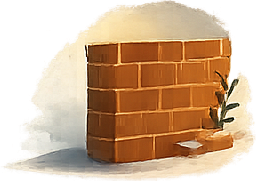
The Growth Block
Most careers include periods of waiting.
Not every delay indicates a problem.
However, repeated delays deserve scrutiny.
You hear phrases such as:
“Not yet.”
“The timing isn’t right.”
“Let’s revisit this next year.”
“We need more evidence.”
Then next year arrives and the answer remains unchanged.
Meanwhile, others advance with less experience, less impact, or fewer accomplishments.
Career growth depends on opportunity as much as merit. When opportunities are systematically withheld, even exceptional performers can stagnate.
This is why mentors are so important.
A mentor provides perspective beyond the immediate reporting structure. They can help identify whether the obstacle is temporary, organizational, or structural.
Most importantly, they remind you that your career belongs to you, not to any single manager, executive, or company.
A Final Thought
Social media often portrays workplace dynamics as a simple story of heroes and villains.
Reality is usually more complicated.
Not every difficult manager is insecure.
Not every overlooked employee is exceptional.
Not every setback is evidence of politics.
Sometimes performance genuinely needs improvement. Sometimes communication needs work. Sometimes organizational priorities shift.
Before assuming the worst, examine your situation honestly.
Seek feedback.
Look for patterns rather than isolated incidents.
Gather evidence instead of relying on emotions.
And remember one important principle.
Your career is bigger than any individual relationship.
The most successful professionals I have met did not spend years trying to win every political battle. They focused on building expertise, delivering value, creating strong networks, and maintaining their reputation.
Organizations change.
Managers come and go.
Strategies are rewritten.
But your credibility travels with you.
In the long run, that is the asset that matters most.
👁️ 124 views
4 Comments on “Seven Workplace Patterns to Watch Out For”
Spot on and I love the info graphics.
Thanks, Suraj.
Painfully accurate – thanks for the blog!
Thanks for the comment Sheri. Glad that this resonated with you. We have all gone through it. This was my way of getting it out of my system.