


Every ecosystem has its life forms.
The savannah has lions. The ocean has whales. The corporate world has buzzwords.
Scientists have studied stars, black holes, and the origins of the universe. Yet few mysteries are as fascinating as how a simple phrase can go from obscure conference presentation to appearing in every executive slide deck on Earth within eighteen months.
Today, let us examine the natural life cycle of a corporate buzzword.
Like all living things, buzzwords are born, grow, multiply, dominate their environment, and eventually collapse under the weight of their own success. Then, in a remarkable display of corporate evolution, they return wearing a slightly different name tag and begin the cycle all over again.
The Buzzword
I have been watching one particular buzzword for much longer than most.
In 1992, during my first semester studying Electronics Engineering at Punjab Engineering College in Chandigarh, one of my programming assignments was to write a program that could solve quadratic equations. The challenge was not simply to calculate the answer. The program needed to accept different coefficients, determine the nature of the roots, solve the equation correctly, and explain the steps to the user.
At the time, I remember thinking that I was making the computer “intelligent.” After all, instead of solving one specific problem, it could solve any quadratic equation a user entered. It could guide the user through the process. It could make decisions based on the inputs.
Looking back, there was nothing intelligent about it. It was simply a collection of rules written by a student who was still figuring out how programming worked.
Yet that experience taught me something important. Humans have always been eager to attribute intelligence to machines. The moment a computer appears to make decisions, we start describing it with words that sound far grander than what is actually happening.
Over the following decades, I encountered “artificial intelligence” many times.
There was always some breakthrough just around the corner.
An expert system here.
A neural network there.
A famous chess match where a machine defeated a grandmaster.
A computer winning a quiz show.
Each achievement was impressive. Yet most of these systems remained highly specialized. They solved narrow classes of problems using increasingly sophisticated algorithms. The technology advanced, but it never quite escaped the laboratory, research paper, or carefully controlled demonstration.
Then machine learning matured.
Data became abundant.
Compute became cheap.
Cloud infrastructure scaled.
And suddenly the old buzzword returned.
Artificial Intelligence. Or, as it is more commonly known today, AI. The rest is corporate history.
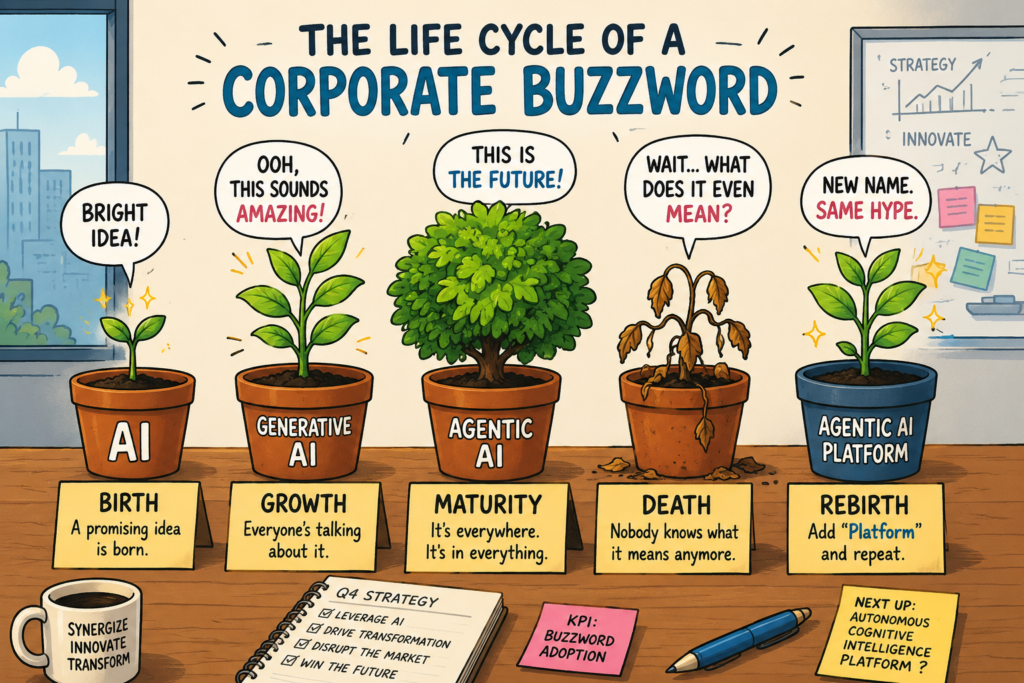
Stage 1: Birth
Every buzzword begins life as a legitimate idea.
Contrary to popular belief, buzzwords are not invented by consultants in conference rooms. They usually start with researchers, engineers, or practitioners trying to solve real problems.
AI was no exception.
For decades, it referred to a broad field of study involving machine learning, neural networks, pattern recognition, search algorithms, and decision-making systems.
People could reasonably explain what it meant.
This was a dangerous situation because clarity rarely survives success.
Stage 2: Growth
Once the technology began producing visible results, adoption accelerated.
Suddenly everything was AI.
Your phone had AI.
Your car had AI.
Your camera had AI.
Your refrigerator apparently had AI.
Some products genuinely benefited from machine learning. Others appeared to benefit mainly from marketing departments.
Then came the next evolutionary mutation.
Generative AI.
The original buzzword had become too common. A new one was required.
Now every presentation, keynote, investor call, and strategy document featured Generative AI.
The conference ecosystem adapted immediately.
Every conference suddenly contained eighteen sessions on Generative AI.
The startup ecosystem adapted even faster.
Hundreds of companies appeared overnight.
Many had little more than a website, a funding round, and a promise to revolutionize humanity.
Investors applauded.
Analysts published reports.
Consultants produced frameworks.
The buzzword entered its expansion phase.
Stage 3: Maturity
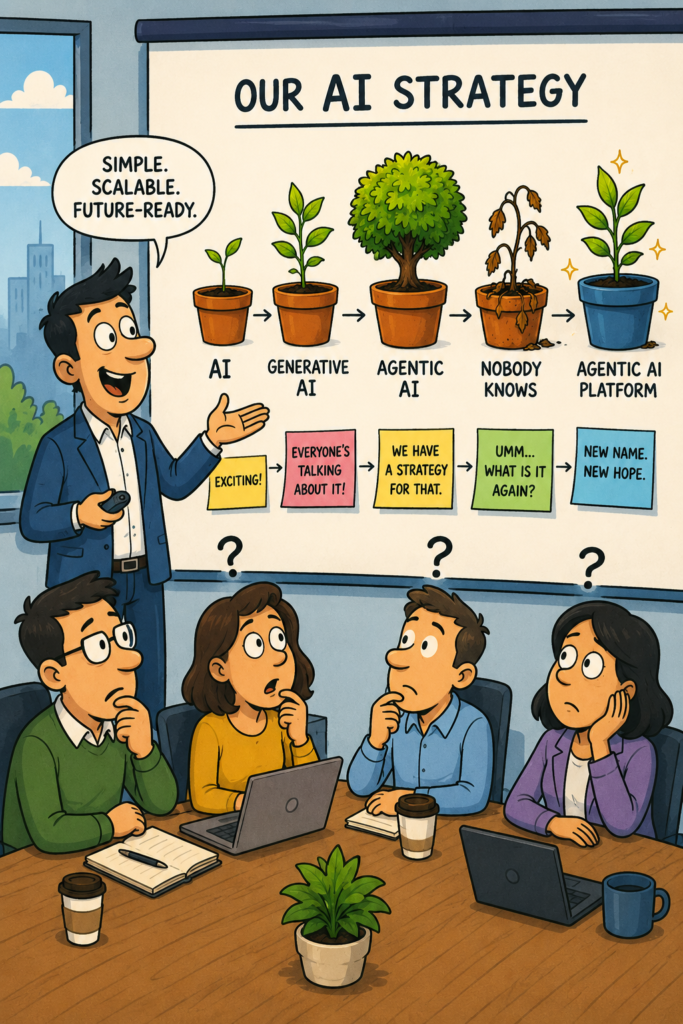
Then came Agentic AI.
Not AI.
Not Generative AI.
Agentic AI.
The corporate ecosystem had reached a point where ordinary AI was no longer exciting enough.
The new term spread rapidly through boardrooms and strategy meetings.
Executives began asking whether products supported Agentic AI.
Product managers updated roadmaps.
Marketing teams rewrote websites.
Sales teams replaced old slides with new slides.
Remarkably little changed in the underlying products.
Thousands of PowerPoint slides, however, achieved digital enlightenment.
Stage 4: Peak Saturation
This is where buzzwords reach maximum density.
Every strategic initiative includes the term.
Every presentation includes the term.
Every executive update includes the term.
Soon people begin speaking sentences such as:
“We are leveraging an Agentic AI-driven transformation strategy to create scalable enterprise value.”
The fascinating thing about such statements is that everyone nods.
Nobody wishes to be the person who asks what the sentence actually means.
Corporate survival often depends on appearing to understand things slightly before everyone else.
Stage 5: Semantic Collapse
Eventually the buzzword becomes too successful.
It has been applied to so many products, services, initiatives, and business models that its meaning begins to dissolve.
Ask five people to define Agentic AI.
You will receive six definitions.
Ask ten people.
You will receive fourteen definitions and three invitations to webinars.
The term now exists in a peculiar state.
Everyone uses it.
Nobody agrees on what it means.
The buzzword has effectively died.
Stage 6: Rebirth
Fortunately, corporate evolution has a solution.
Add another word.
Historically, one word has demonstrated extraordinary resurrection powers – Platform.
This word can revive almost anything.
AI becomes an AI Platform.
Analytics becomes an Analytics Platform.
Digital Transformation becomes a Digital Transformation Platform.
Agentic AI becomes an Agentic AI Platform.
The product remains largely unchanged.
The website gains new graphics.
The slide deck receives fresh colors.
The analyst community discovers renewed enthusiasm.
The cycle begins again.
Final Thoughts
The funny thing about buzzwords is that most of them start with something real.
The quadratic equation program I wrote in 1992 was not intelligent. Yet it reflected a very human desire to build machines that could reason, assist, and solve problems.
That desire never disappeared.
The technology improved.
The algorithms improved.
The compute improved.
The results improved.
What also improved was our ability to wrap those advances in increasingly elaborate terminology.
Buzzwords are not the problem.
They are often shorthand for genuine innovation.
The problem arises when the buzzword becomes more important than the idea itself.
A useful term begins by clarifying.
A successful term gains momentum.
A famous term becomes overused.
An overused term loses meaning.
And then, just when everyone is ready to move on, someone adds “Platform” to the end and launches another billion-dollar strategy around it.
Somewhere right now, a consultant is inventing the next great buzzword.
Somewhere else, a marketing team is preparing a keynote about it.
And somewhere in a conference room, an executive is asking:
“What is our strategy around this?”
The life cycle continues.
As nature intended.
Post Script:
Today is first day of June. 30 years ago, in June 1996, I stepped into the corporate world at Siemens – as a Marketing Executive at Power Plant Automation division. That was my first job after graduation. So, you can say that I have seen my fair share of corporate buzzwords.
This is a satirical piece viewed and experienced the strange and entertaining lens my journey. It is written entirely in humor and good spirit. If some of the situations, meetings, acronyms, reorganizations, or slide decks feel painfully familiar … well, that is (not) purely coincidental and absolutely not based on any real corporate experiences whatsoever.
Other pieces in this series:
👁️ 152 views