

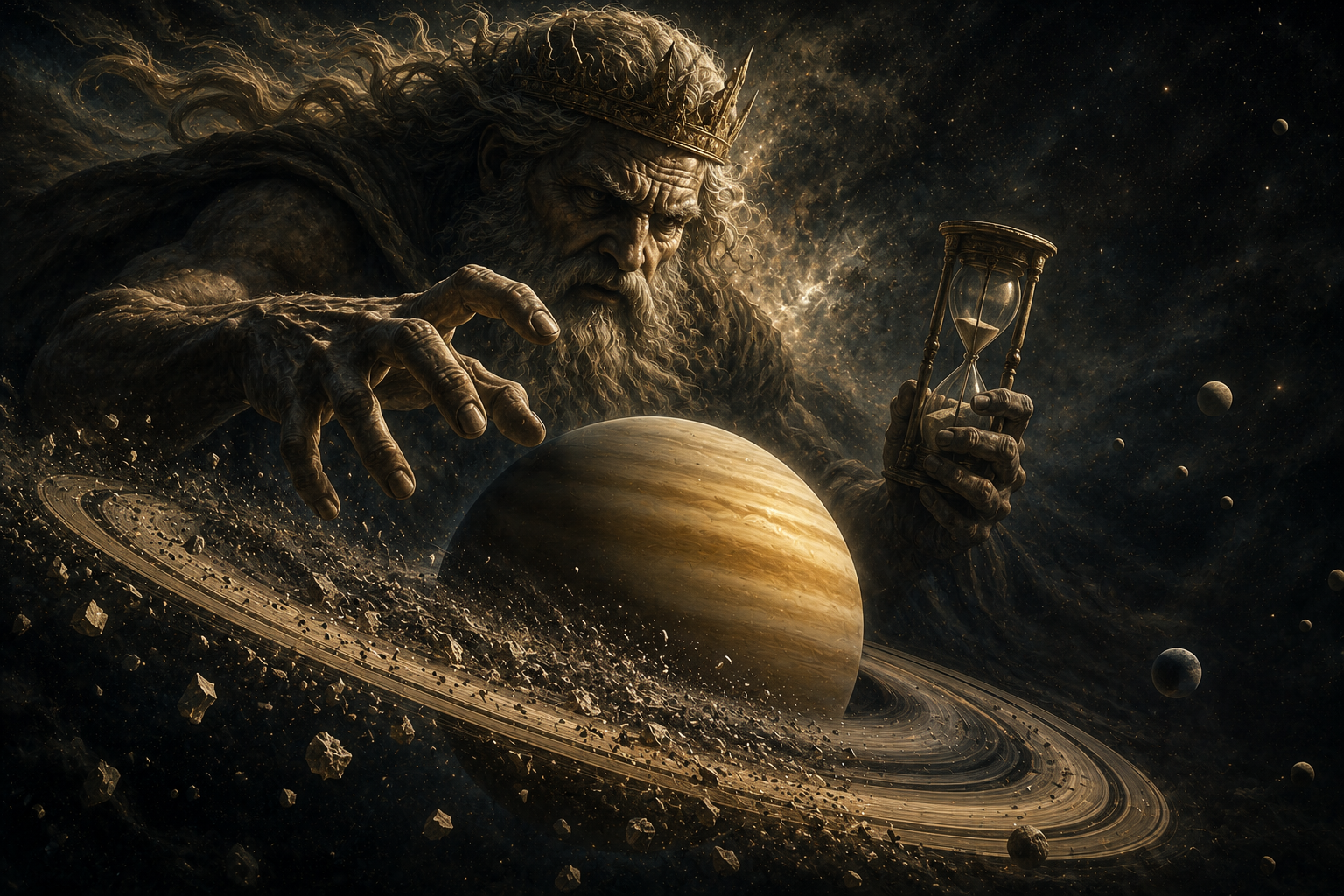
The god who devoured his children still echoes in the planet slowly consuming its own rings.
There are few sights in astronomy as mesmerizing as Saturn. Suspended in darkness, circled by luminous rings that seem too delicate to exist, Saturn appears almost unreal. Even through a small telescope, it does not look like a planet so much as a carefully crafted symbol placed in the heavens by an artist with impossible patience.
For centuries, Saturn has inspired awe. Ancient astronomers saw it moving slowly across the night sky, distant and cold, wandering farther from the Sun than any other planet visible to the naked eye. The Romans named it after Saturn, their equivalent of the Greek Titan Cronus, one of the oldest and most unsettling figures in mythology.
It was an appropriate choice.
Because beneath Saturn’s beauty lies a story about time, fear, decay, and consumption.
And beneath the beauty of the planet itself lies a similar truth.
The Titan Who Feared the Future
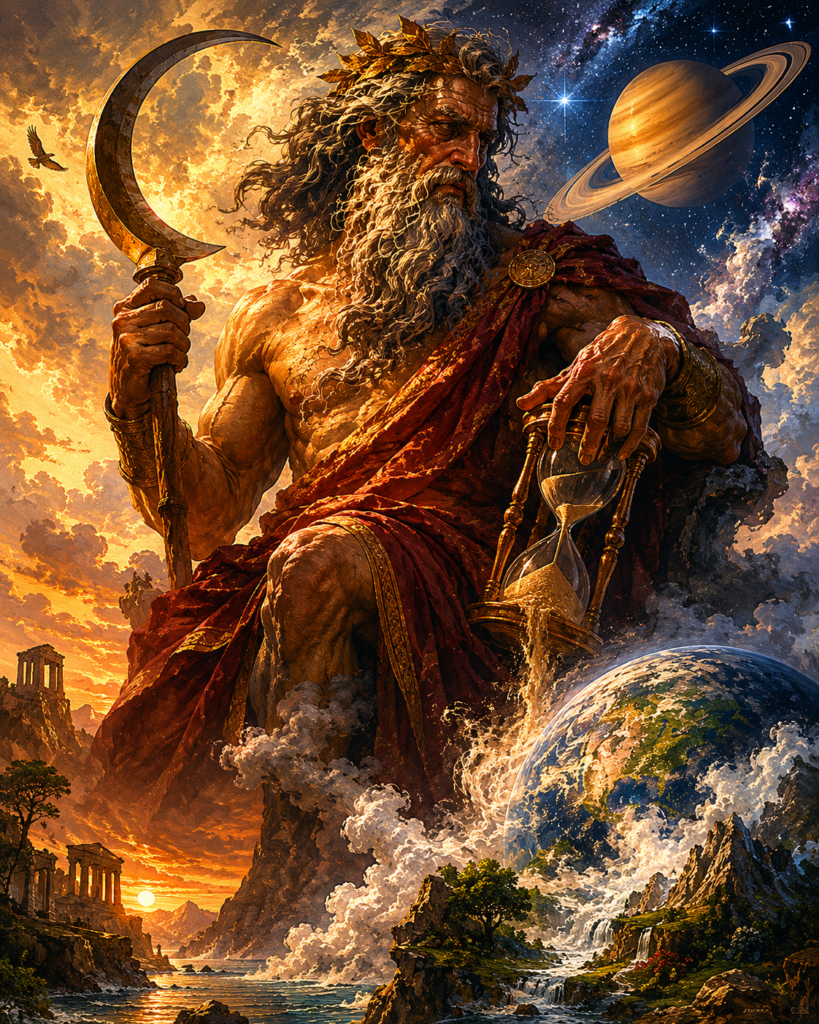
In Greek mythology, Cronus was the youngest of the Titans, born of Uranus, the sky, and Gaia, the earth. His rise to power came through violence. Guided by Gaia, Cronus overthrew his father Uranus with a sickle, severing the heavens from the earth and claiming dominion over the cosmos.
But power gained through fear rarely produces peace.
Cronus learned of a prophecy that one of his own children would eventually overthrow him, just as he had overthrown his father. Terrified of losing power, he resorted to something monstrous. Each time his wife Rhea gave birth, Cronus swallowed the child whole.
- Hestia.
- Demeter.
- Hera.
- Hades.
- Poseidon.
One after another, the Titan devoured his own children in an attempt to stop time itself from moving forward.
It is one of the darkest images in mythology. A father consuming the future because he fears what the future will become.
But prophecies in Greek myth are rarely escaped.
When Zeus was born, Rhea deceived Cronus by wrapping a stone in swaddling cloth and giving it to him instead. Cronus swallowed the stone, believing it to be the child. Zeus survived in secret, grew to adulthood, and eventually fulfilled the prophecy, overthrowing his father and forcing Cronus to release the children he had consumed.
The cycle repeated.
A son replacing a father.
Time moving forward despite every attempt to stop it.
And thousands of years later, the planet named after Cronus reveals a strangely similar story unfolding in silence.
The Lord of the Rings
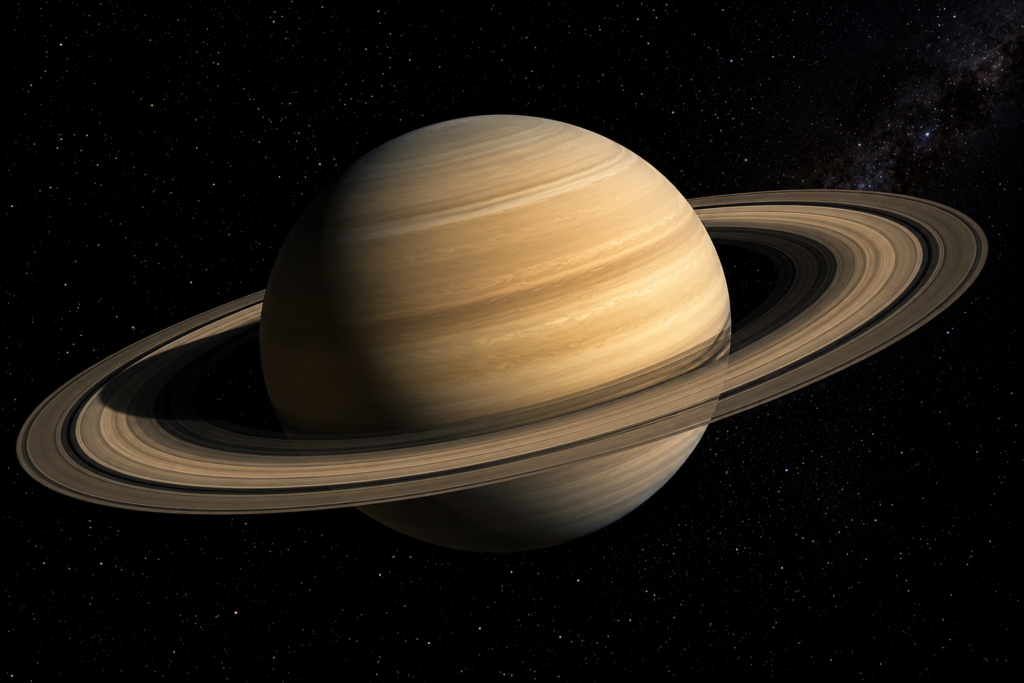
Saturn is the second largest planet in the solar system, a gas giant so immense that more than 760 Earths could fit inside it. Yet despite its size, Saturn is astonishingly light for a planet of its scale. Its average density is lower than water. If one could imagine an ocean large enough, Saturn would theoretically float.
But Saturn’s defining feature is, of course, its rings.
Stretching hundreds of thousands of kilometers across space, the rings are composed mostly of ice, rock, and dust. They shine brilliantly because sunlight reflects from countless particles orbiting in formation around the planet.
From a distance, they appear eternal.
But they are not.
Modern astronomy has revealed that Saturn’s rings are surprisingly fragile and temporary. They are constantly changing, shaped by collisions, gravitational interactions, and erosion. Tiny particles spiral inward toward Saturn in what scientists call ring rain, slowly falling into the planet under the influence of gravity and magnetic forces.
Saturn is consuming its own rings.
Not violently. Not suddenly. But steadily.
The process is slow enough that it unfolds over millions of years, yet fast enough that astronomers believe the rings may disappear entirely one day. Saturn may once have possessed far larger rings, perhaps formed from shattered moons or icy bodies torn apart by gravitational forces.
The planet is reclaiming what once orbited it.
And suddenly, the myth feels less distant.
Time as the Great Devourer
Cronus eventually became associated not only with Saturn, but with time itself. The similarity between the Greek word Chronos and Cronus blurred over centuries, and the Titan evolved into a symbolic figure representing time’s unstoppable nature.
This transformation makes profound sense.
Time consumes everything.
Youth fades.
Empires collapse.
Stars burn out.
Even mountains erode into dust.
Saturn’s rings embody this idea beautifully. They seem permanent because human lives are brief. But on cosmic timescales, the rings are temporary structures already in decline. What appears eternal is simply moving too slowly for us to notice its disappearance.
The devourer is still feeding.
Not on children now, but on ice and stone suspended in orbit.
Beauty That Cannot Last
Part of Saturn’s power lies in its contradiction.
It is perhaps the most beautiful planet in the solar system, yet its beauty is temporary. The rings that define Saturn may be among the youngest structures in the solar system. Some estimates suggest they formed only a few hundred million years ago, relatively recent in cosmic terms.
And they may vanish in another hundred million years.
This gives Saturn a strange melancholy. We happen to exist during the era in which its rings are visible in all their grandeur. Dinosaurs never saw Saturn this way. Future civilizations may not either.
We are witnessing a temporary masterpiece.
There is something deeply human about this realization. The things we find most beautiful are often the things least able to endure unchanged. Flowers bloom briefly. Sunsets vanish within minutes. Music exists only while it is being played.
Saturn’s rings belong to that same category.
A magnificent structure already in the process of disappearing.
The Shepherds of the Rings
The rings themselves are not static. Embedded within them are small moons known as shepherd moons, whose gravity shapes and maintains the ring structure. Moons like Prometheus and Pandora tug gently at the edges of rings, creating gaps, waves, and spiraling patterns.
These moons simultaneously preserve and destabilize the rings. Gravity keeps the structure organized, but gravity also slowly destroys it.
Again, Saturn reflects its mythological counterpart.
Cronus tried to preserve his power through destruction. Saturn preserves its beauty through forces that also guarantee its eventual erosion.
The same gravity that creates the rings will ultimately consume them.
A Planet That Teaches Humility
Saturn reminds us how deceptive permanence can be.
Human beings often think in short spans of time. We imagine that mountains are eternal, oceans unchanging, and planets fixed forever in their present form. But astronomy reveals a universe in constant motion. Stars are born and die. Galaxies collide. Planets evolve.
Even Saturn’s iconic rings are merely passing phases in a much larger story.
The Greeks understood something similar through myth. Cronus believed he could stop change by swallowing his children. But the future cannot be consumed forever. Time itself defeats those who attempt to control it absolutely.
The Titan fell because he feared change.
Saturn’s rings fall because change is inevitable.
The Devourer Still Watches the Sky
On a clear night, Saturn appears calm. Golden. Silent. Through a telescope, its rings seem delicate enough to shatter with a touch.
Yet behind that beauty lies an invisible process unfolding continuously. Particles descend into the atmosphere. Ice disappears. Structures erode. The planet slowly reclaims what once circled around it.
Cronus, the devourer of his own children, survives in that image.
A father consuming what belongs to him.
A god trying to stop time.
A planet quietly dismantling its own beauty.
And perhaps that is why Saturn fascinates us so deeply.
Because beneath its elegance lies a truth we all recognize.
Nothing beautiful remains unchanged forever.
Other posts in the series
- Mars: Panic will leave and Fear will be destroyed
- Cassiopeia: The Queen Condemned to Spin Among the Stars
- When the sky fell, it never stood upright again
- The fastest messenger of Olympus still races through the heavens
- Venus shines with beauty, but burns with truth
- The sky remembers its hunter, and the stars remember how to begin
👁️ 164 views