


There are supposedly five stages of grief.
Denial. Anger. Bargaining. Depression. Acceptance.
After spending enough years in the technology industry, I have come to believe there are also five stages of joining a tech company. The emotional patterns are remarkably similar, except that in this case HR sends you a laptop, a backpack, and mandatory cybersecurity training.
Every new employee begins the journey with optimism and confidence. They believe they are joining a company that is about to redefine the future of humanity. A few months later, they are whispering phrases like “Let us take this offline” while staring dead-eyed into a fifth consecutive meeting about alignment.
The transformation is gradual. Almost beautiful, in a strange corporate sort of way.
Like all great journeys, it begins with hope.
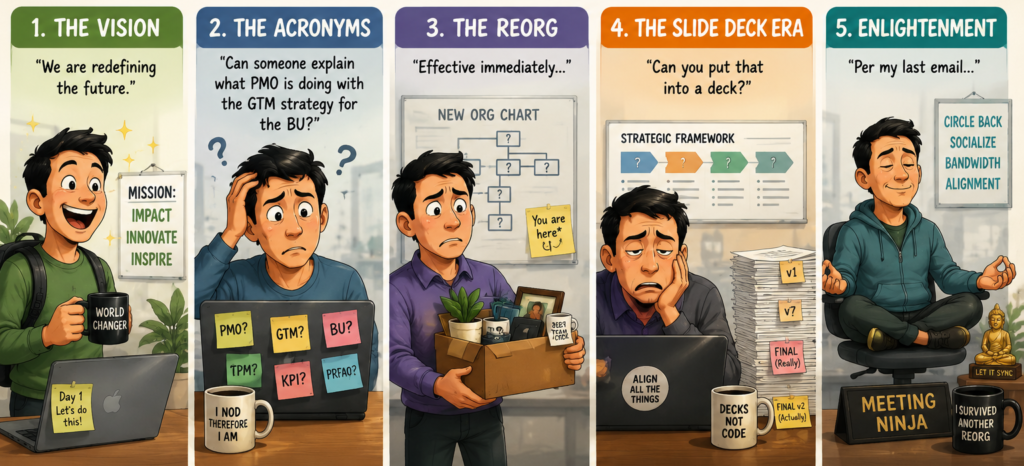
Stage 1: The Vision
This is the honeymoon phase.
The recruiter spoke passionately about innovation. The hiring manager talked about disruption. The CEO mentioned changing the world at least three times during the all-hands meeting.
You are inspired.
Your new laptop arrives in an elegant box that feels more luxurious than your first apartment. You carefully adjust your home office camera angle. You post on LinkedIn:
“Thrilled and humbled to begin this exciting journey with an amazing team!”
For the first few weeks, everything feels important.
You arrive early to meetings.
You take notes during introductions.
You actually read the onboarding material.
Most importantly, you still believe every meeting has a purpose.
At this stage, the company culture appears magical. Everyone seems intelligent. Every presentation contains phrases like “industry-leading,” “next-generation,” and “customer-centric innovation.” You have no idea what half the products do, but they all appear capable of revolutionizing civilization.
Then comes your first cross-functional meeting.
And the second stage begins.
Stage 2: The Acronyms
No one warns you about the acronyms.
Technology companies do not communicate in English. They communicate in encrypted corporate dialects that sound like military satellite transmissions.
Your first warning sign is a sentence like this:
“We need PMO alignment before the GTM review with the BU leadership ahead of QBR.”
You nod politely while understanding absolutely nothing.
Soon every conversation sounds like this.
“Legal has concerns with the PRFAQ.”
“The KPI ownership belongs to TPM.”
“We need a deeper dive before exec review.”
At some point, you stop trying to decode the language and simply begin repeating it back to other people like a corporate parrot.
The truly terrifying part is that nobody asks questions. Everyone is pretending to understand everyone else. Entire meetings proceed entirely on confidence and PowerPoint animations.
The acronyms spread quickly. Within a month, you are casually saying things like “I’ll sync with the PM” and “We need executive visibility” without realizing what you have become.
This is also the stage where you encounter the company’s internal systems.
You need access to a tool.
To request access, you must use another tool.
You do not have access to that tool either.
The onboarding wiki was apparently written during the Bronze Age and references software that no longer exists. You discover pages titled “NEW_FINAL_V2_UPDATED.”
You begin to sense that something is not entirely under control.
Then comes the first reorganization.
Stage 3: The Reorg
The email always begins the same way.
“Effective immediately…”
These two words have destroyed more emotional stability in the technology industry than market crashes.
Suddenly your manager changes.
Your project moves divisions.
Your team now reports into an organization you have never heard of before.
The vice president who hired you has vanished into another strategic initiative somewhere in the cloud.
Nobody knows who owns anything anymore.
This is explained to you as “realignment for operational focus.”
The most experienced employees react to reorganizations the way medieval farmers reacted to weather. Quiet acceptance mixed with spiritual exhaustion.
A new executive arrives from another famous tech company. Everyone updates their slide templates. New terminology appears overnight.
The strategy changes.
Again.
You realize that org charts in technology companies are less like structures and more like temporary weather patterns.
This is also the phase where you learn that meetings before meetings are often more important than the actual meetings.
People begin saying things like:
- “Can we pre-wire this?”
- “Have you socialized the idea?”
- “Let us align offline before the review.”
At first this sounds collaborative.
Later you understand it is mostly preventive diplomacy.
You are no longer new enough to be innocent.
But you are still idealistic enough to believe actual work matters most.
That belief disappears during Stage Four.
Stage 4: The Slide Deck Era
You once believed technology companies built technology.
This is adorable.
Technology companies primarily build slide decks.
The products are secondary.
One day someone asks:
“Can you put that into a deck?”
This sentence changes your life forever.
A simple idea that could have been explained in three minutes now requires:
- Executive summary
- Strategy slide
- Architecture slide
- Market slide
- Risk slide
- Timeline slide
- Backup slides
- A cleaner version for leadership
- Another version with less text
- Another version with more detail
Entire afternoons disappear while people debate the size of arrows.
You discover that there are employees who have not touched an actual product in years, yet possess legendary influence because they can align colored rectangles with terrifying precision.
A single slide generates six meetings.
Nobody agrees on font size.
The phrase “single source of truth” appears moments before version confusion destroys civilization again.
You spend more time aligning than building.
You begin speaking differently too.
You no longer “solve problems.”
You “drive frameworks.”
You no longer “talk.”
You “sync.”
You no longer “disagree.”
You “have concerns with the direction.”
The transformation is nearly complete.
Only one stage remains.
Stage 5: Enlightenment
Eventually, something changes inside you.
You stop fighting the system.
You understand it.
You can now detect executive panic purely from calendar invitations.
A meeting titled “Quick Chat” means trouble.
“Optional” meetings are mandatory.
A 7:00 PM meeting invite from leadership means somebody somewhere has made a terrible mistake.
You begin rejecting meetings while simultaneously proposing different meetings.
You instinctively mute yourself before sneezing.
You can identify experienced employees simply by how long they wait before speaking in large meetings.
Most importantly, you begin onboarding younger employees.
You see them arrive early to meetings with hopeful expressions and fresh notebooks.
You watch them ask thoughtful questions.
You hear them say:
“I think we can simplify this process.”
You smile gently, like an old soldier who has seen many winters.
Then one day, without warning, you hear yourself saying:
“The reorg actually makes sense if you look at the bigger picture.”
That is when you realize the transformation is complete.
You are now part of the machine.
And somewhere in another building, a recruiter is currently telling a new candidate that the company is about to change the world.
The cycle begins again.
Post Script:
The inspiration for this essay comes from the well-known concept of the “Five Stages of Grief.” This piece is simply a satirical adaptation of that framework, viewed through the strange and entertaining lens of joining a new technology company.
It is written entirely in humor and good spirit. If some of the situations, meetings, acronyms, reorganizations, or slide decks feel painfully familiar … well, that is (not) purely coincidental and absolutely not based on any real corporate experiences whatsoever.
👁️ 156 views
7 Comments on “The Onboarding Cycle at a Corporate Tech Company”
Coincidence my rear end. Reading this brought back my PTSD.
Slide deck changes almost killed me… I learned to say “yes!” then wait and show them the same deck (“per you inputs!”) and watch them say “yes! This is soooo much better now!”
Excellent blog!
Hahaha. It is a bit exagerrated and amplied view, and it has happened to all of us.
Thanks for your comment. Glad you enjoyed it.
Bingo. This can invoke PTSD in most of us.
Too funny, Suraj.
My intention was not to invke PTSD. 😉
Brilliant rendition of what happens in most organizations and companies. Sadly nostalgic.
It is sad and nostalgic. I have gone through multiple presentations skills trainings, and everyone brings their own wisdom to the presentations.
And invariably, it has turned into Stage 4 – the Slide Dek Era.
Stage 2: Lesrn corporate jargon/buzzwords – Synergies, alignment, holistic, leverage, take it offline, …
😉