


There are books we read, and then there are books that read us back.
A few days ago, while going through a pile of old books, I found a worn paperback copy of To Kill a Mockingbird by Harper Lee. The cover had softened with time. The pages carried that familiar scent of age, a quiet mix of dust and memory. It felt less like an object and more like a companion that had been waiting patiently.
I opened it without expectation.
And then I found something I did not expect at all.
A Date, A Place, A Version of Me
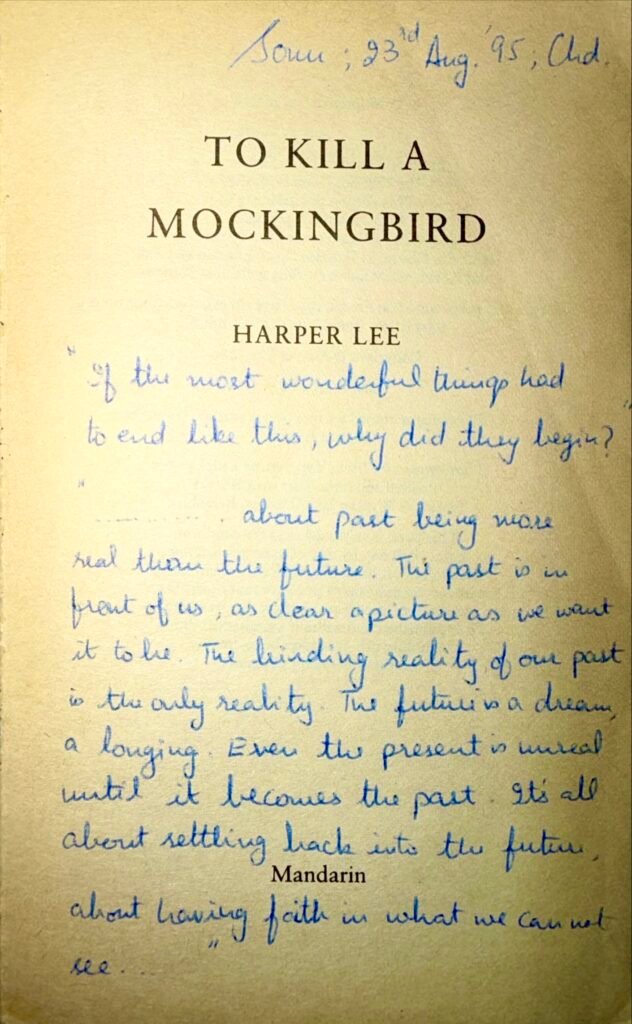
On the inside page, in my own handwriting, was a simple inscription:
“Sonu; 23rd Aug., ‘95, Chd.”
That alone was enough to stop me.
August 23rd. Just a few days after my birthday. Chandigarh. I can almost see it now. The neat geometry of Sector 17. The quiet pride of buying a book. If I had to guess, it was probably from Capital Book Shop, a place that felt like a treasure chest back then.
That line anchored me in time.
But it was the next lines that pulled me into something deeper.
A Question That Still Echoes
Below the date, I had written:
“If the most wonderful things has to end like this, why did they begin?”
I read it once. Then again. Then a third time.
And I realized something uncomfortable.
I have no memory of writing it.
I do not remember what I was going through. I do not remember who or what inspired that thought. There is no clear event tied to it. No heartbreak I can neatly label. No story I can reconstruct.
But the emotion is unmistakable.
It is the kind of question that only comes from intensity. From something that mattered deeply. Something that ended, or felt like it ended.
It is not a casual thought. It is a young man wrestling with meaning.
The Philosophy of a Younger Mind
Below that question, there was more. Fragmented, unfinished, but thoughtful in a way that surprised me.
“… about past being more real than the future. The past is in front of us, as clear a picture as we want it to be. Thing binding reality of our past is the only reality. The future is a dream, a longing. Even the present is unusual until it becomes the past. It’s all about settling back into the future, about having faith in what we cannot see …”
It reads like someone trying to make sense of time itself.
Not academically. Not philosophically in the formal sense.
But personally.
Urgently.
The Arrogance and Honesty of Youth
There is something both naive and profound in those lines.
Naive, because the past is not as clear as we want it to be. Memory edits. It softens edges. It sharpens certain moments and erases others. It tells stories that suit our current selves.
And yet, profound, because the feeling behind it is true.
At that age, the past feels solid. It feels like something you can hold on to. The future, on the other hand, is uncertain, abstract, almost unreal.
What struck me was not whether the thought was correct.
What struck me was that I was thinking this way at all.
At some point, a younger version of me sat down with a book, and instead of just reading it, he paused and tried to understand existence.
That matters.
The Memory That Refuses to Return
I tried, briefly, to reconstruct August 1995.
I thought about friends. School. Family. Events. Moments that might have triggered such writing.
Nothing.
It is as if the emotion survived, but the event did not.
And that raises an interesting question.
Do we remember experiences, or do we remember the feelings those experiences left behind?
Because clearly, something happened. Something that made me pick up a pen and write those words.
And yet, that “something” is gone.
Only the trace remains.
The Past as a Construct
Reading those lines today, I disagree with parts of it.
The past is not sitting in front of us as a clear picture. It is reconstructed every time we think about it. It is shaped by who we have become.
But here is the twist.
Even if the past is not perfectly real, it is still powerful.
It defines identity.
It influences decisions.
It creates emotional anchors.
So in a strange way, that younger version of me was not entirely wrong. He just did not yet have the language to express the complexity of it.
The Future We Cannot See
The last line stayed with me the longest.
“Having faith in what we cannot see.”That is not the voice of certainty.
That is the voice of someone trying to convince himself.
And that is where it becomes real.
Because even today, that is still the challenge.
We plan. We strategize. We forecast outcomes. We try to impose structure on what is fundamentally uncertain.
But at the core of it, we are still doing the same thing.
We are moving forward based on belief.
The Book as a Time Machine
That old copy of To Kill a Mockingbird did something no photograph or digital archive could do.
It did not just remind me of a moment.
It introduced me to a version of myself I had forgotten.
A version that was reflective. A little dramatic perhaps. But deeply engaged with questions that do not have easy answers.
There is something humbling about that.
We often think of growth as moving forward, becoming better, more refined, more informed.
But sometimes growth is also about recognizing that we once asked better questions than we do now.
What Remains
I closed the book and sat with it for a while.
Not trying to force a memory to return.
Not trying to decode the exact context.
Just accepting that this was a fragment of who I was.
And maybe that is enough.
We spend a lot of time trying to make sense of everything. To connect every dot. To build a clean narrative of our lives.
But life is not clean.
It is layered.
Messy.
Incomplete.
There are moments we forget but feelings we carry. Thoughts we abandon but questions that stay.
That inscription is one of those questions.
A Quiet Realization
If I had to answer that younger version of myself today, I would say this:
Wonderful things begin because they are meant to be experienced, not possessed.
They end because that is the nature of time.
And they matter because, even when they are gone, they leave behind something that shapes us.
Sometimes that “something” is not even a memory.
Sometimes it is just a sentence in an old book, waiting to be found.
Final Thought
There is a strange comfort in knowing that somewhere, in some forgotten corner of our past, we have already asked the questions we are still trying to answer.
And maybe that is enough.
Not to solve the mystery.
But to continue the journey.
👁️ 619 views
1 Comment on “A Forgotten Inscription, A Life Still Unfolding”
Oh my! This hit me in my chest. The same thing happened to me. I was given back some notebooks from school. There were short essays that I had written in a language much more richer than my current vocabulary!
Who is the person? This cannot be me. What has changed? Some topics were profound and others trivial. But each was treated with the same curiosity that showed a deeper understanding of the world that I would not have attributed to a person my age when it was written.
It was both shocking and a proud moment for me. I’m glad you found a hidden gem from your past!