
The sky remembers its hunter, and the stars remember how to begin

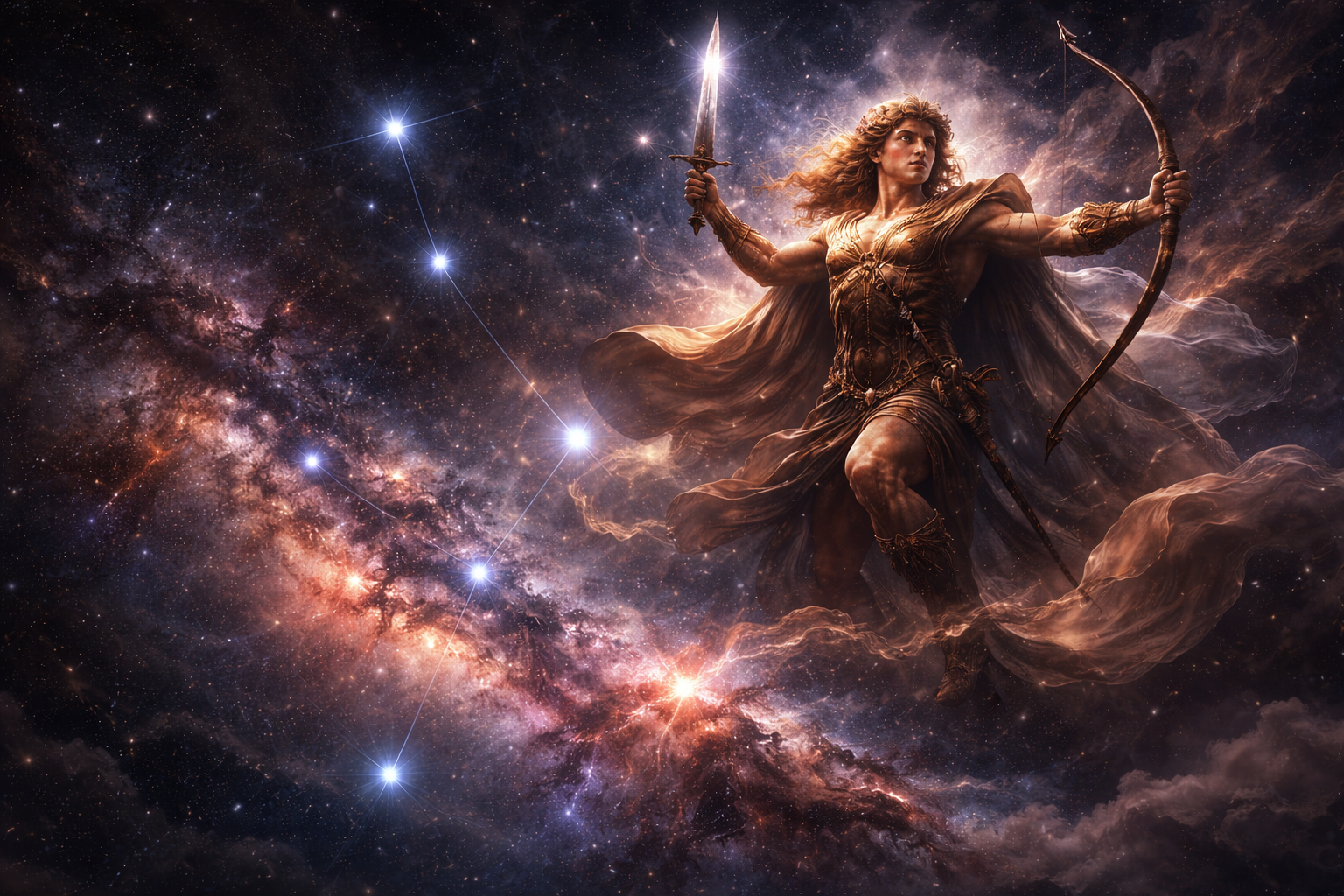
Orion, the hunter, still walks the night, and in his shadow, stars are born.
A Figure Too Large for the Earth
In the vast landscape of Greek mythology, few figures stand as boldly as Orion, the great hunter. He was not a king, nor a god, but something in between. A mortal of immense strength and skill, often described as a giant, Orion moved through the world with confidence that bordered on arrogance.
Stories about Orion vary, as they often do in ancient myth, but they share a common theme. He was unmatched in the hunt. No beast could outrun him. No wilderness could conceal its prey from his sight. In some tales, Orion boasted that he could kill every animal on Earth. In others, he pursued love with the same intensity he brought to the hunt, sometimes with tragic consequences.
Such pride rarely goes unanswered in Greek mythology.
In one version, the Earth goddess Gaia, angered by his boast, sent a scorpion to strike him down. In another, Artemis, goddess of the hunt, either loved him or was tricked into killing him with a distant arrow. However the story ends, Orion falls. The great hunter meets his limit.
But death, in myth, is often not an end. It is a transformation.
Zeus placed Orion among the stars, where he would walk the heavens for eternity. And not far behind him, in the sky, the constellation of Scorpius rises, ensuring that the hunter and the scorpion are never visible at the same time. One sets as the other rises. A cosmic chase that never ends.
The Hunter in the Night Sky
Look up on a clear winter night, and Orion is impossible to miss.
Three bright stars in a straight line form his belt, one of the most recognizable patterns in the sky. Surrounding them is a larger figure that suggests a human form, broad-shouldered, poised, and ready.
At one shoulder burns Betelgeuse, a red supergiant star that glows with a deep, fiery hue. At the opposite foot shines Rigel, a brilliant blue-white star, one of the brightest in the night sky. Together, they anchor Orion’s form, giving him both warmth and brilliance, like a living figure caught in motion.
Ancient observers saw more than just stars. They saw a hunter, weapon raised, forever striding across the sky. In different cultures, Orion has been interpreted in various ways, but the image of a great figure moving across the heavens remains constant.
Unlike many constellations that require imagination to decipher, Orion feels immediate. Almost deliberate.
It is as if the sky itself wanted to tell this story.
A Belt That Holds Creation
Orion’s most famous feature is his belt, those three stars aligned with striking precision. But look more closely, and you will notice something else beneath it, a faint, misty patch of light.
This is the Orion Nebula, one of the most remarkable objects in the night sky.
To the naked eye, it appears as a soft blur. Through a telescope, it reveals itself as a vast cloud of gas and dust, glowing with subtle colors and complex structure. It is not just a cloud. It is a place where stars are being born.
The Orion Nebula is a stellar nursery, a region where gravity pulls matter together to form new stars. Deep within its glowing expanse, clusters of young stars are taking shape, igniting for the first time after millions of years of slow collapse.
This is one of the closest such regions to Earth, which makes it invaluable to astronomers. It allows us to observe the process of star formation in detail, to see how light emerges from darkness, how structure arises from chaos.
And all of this unfolds in the very heart of the hunter.
It is a striking contrast.
Orion, the destroyer of beasts, carries within his form the birthplace of stars.
Death and Renewal in the Same Sky
The mythology of Orion tells a story of strength, pride, and downfall. A hunter who believed himself unstoppable is brought down by forces he could not control. It is a familiar arc, one repeated across many cultures and stories.
But the astronomy of Orion adds another layer.
Within the same constellation that represents death, there is creation. Within the same figure that embodies the hunt, there is birth. The Orion Nebula is not a relic of the past. It is an active, evolving region, shaping the future of the galaxy.
This duality is not accidental.
The universe often pairs destruction with creation. Stars are born in clouds like the Orion Nebula, but they will eventually die, some in quiet fading, others in violent explosions. Those explosions scatter elements across space, seeding the next generation of stars and planets.
In this way, Orion becomes more than a hunter. He becomes a symbol of the cycle itself.
Life and death.
Creation and destruction.
Endings that are also beginnings.
The Hunter Who Never Stops
One of the most compelling aspects of Orion’s myth is the idea of the eternal hunt.
Placed among the stars, he does not rest. He does not fade. He moves across the sky night after night, season after season. In winter, he dominates the sky, standing tall and unmistakable. By summer, he disappears below the horizon, only to return again.
This rhythm creates a sense of motion, even though the stars themselves are fixed on human timescales. Orion rises, crosses the sky, and sets, giving the impression of a journey that never truly ends.
In mythology, he chases prey. In astronomy, he carries the seeds of new stars. In observation, he guides the eye across the sky, pointing to other constellations, to Sirius, to Taurus, to the vast structure of the Milky Way.
He is both a destination and a guide.
A Constellation That Teaches Us to Look
For many people, Orion is the first constellation they learn to recognize. It is easy to find, easy to remember, and rich with detail. Once you see it, the night sky becomes less random, more structured.
Orion becomes an entry point.
From his belt, you can trace a line downward to Sirius, the brightest star in the night sky. Follow the belt upward, and you reach Aldebaran in the constellation Taurus. Orion sits at a crossroads of the sky, connecting different regions and stories.
In this way, the hunter does what he always did. He leads. He reveals. He makes the unseen visible.
Myth Written in Light
The ancient Greeks looked at Orion and saw a story of pride and consequence. Modern astronomers look at the same stars and see nuclear fusion, stellar evolution, and gravitational collapse.
Both perspectives are valid.
Myth gives us meaning. Science gives us mechanism. Together, they give us depth.
Orion stands at that intersection.
He is a figure shaped by imagination and confirmed by observation. A hunter who exists both in story and in space. A reminder that when we look at the sky, we are not just seeing distant objects. We are seeing layers of human thought, history, and curiosity.
Closing Reflection
On a cold, clear night, when Orion rises above the horizon, take a moment to look at him closely.
See the belt that has guided countless observers across time. See the glow of Betelgeuse and the brilliance of Rigel. And then, if you can, look deeper. Find the faint light of the Orion Nebula, where new stars are forming even now.
The hunter is still there.
Not chasing beasts, but carrying creation within him.
A figure of the past, holding the future.
Other posts in the series
- Mars: Panic will leave and Fear will be destroyed
- Cassiopeia: The Queen Condemned to Spin Among the Stars
- When the sky fell, it never stood upright again
- The fastest messenger of Olympus still races through the heavens
- Venus shines with beauty, but burns with truth
- The sky remembers its hunter, and the stars remember how to begin
👁️ 187 views