

Every now and then, someone asks me a question that sounds simple on the surface: How did you write your novellas?
It is one of those questions that seems like it should have a clean answer. A structured process. A deliberate plan. But the truth is far less tidy. Like most creative work, it started somewhere small, almost accidental, and only later turned into something that felt intentional.
For me, that beginning was not a grand ambition to write fiction. It was a box of cards.
The Accidental Beginning
A few years ago, I picked up a “Deck of Stories” set. It was designed for role-playing games like Dungeons & Dragons. The idea behind it was straightforward. Each card gives you a fragment of a narrative. A setting. A conflict. A twist. You draw a few cards, and together they form the seed of an adventure.
At the time, I approached it exactly as intended. I used the cards to build RPG adventures. Structured scenarios that a group of players could experience together. I wrote encounters, puzzles, and branching possibilities. I treated it like a system design problem, which, in hindsight, makes sense given how I usually think.
There was only one issue.
No one played them.
It is almost funny now. I had spent time crafting these adventures, thinking about how they would unfold, how players might react, how the story might evolve in a live setting. And then… nothing. They just sat there.
At first, it felt like effort wasted. But that frustration turned out to be the pivot point.
When the Purpose Changes
When something does not work the way you intended, you have two choices. You either abandon it, or you ask a different question.
Instead of asking, “Why is no one playing these?”, I began asking, “What else can these become?”
That small shift changed everything.
These adventures were not just game frameworks. They were narrative skeletons. They had tension, conflict, mystery. They had the raw ingredients of story, even if they were originally designed for interaction rather than reading.
That was the moment the idea for the Darkspire Chronicles took shape. Not as a campaign setting, but as a collection of stories. Each one rooted in an adventure, but written as a narrative experience.
The structure remained. The intent changed.
The First Real Test
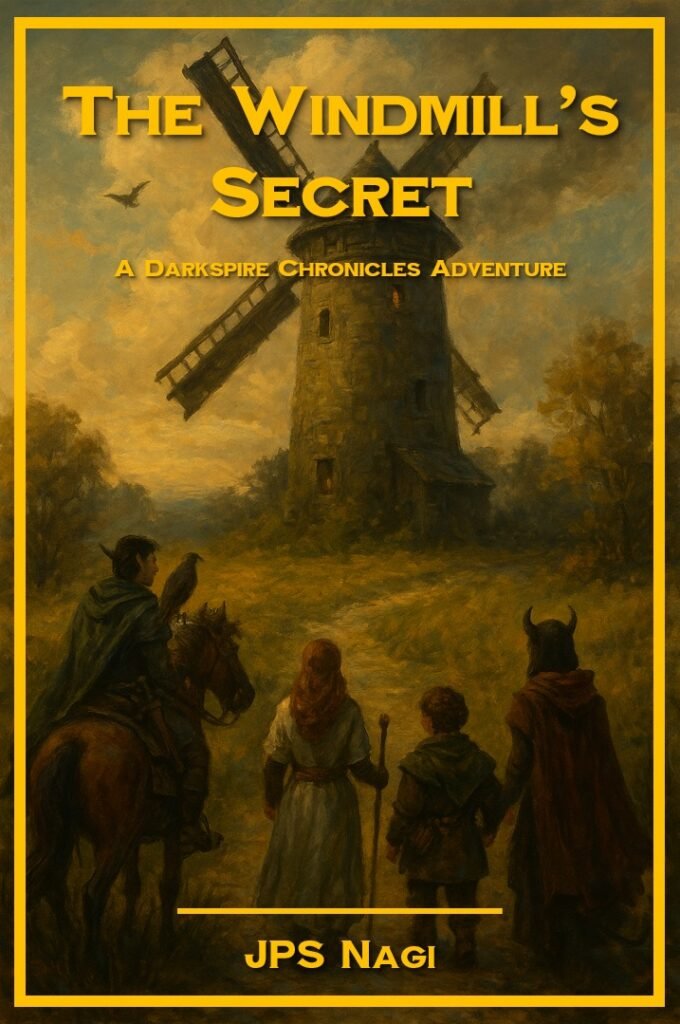
The first story I decided to build this way became The Windmill’s Secret. It was not chosen because it was the best idea. It was chosen because it was the next one in line. There was no grand strategy behind it.
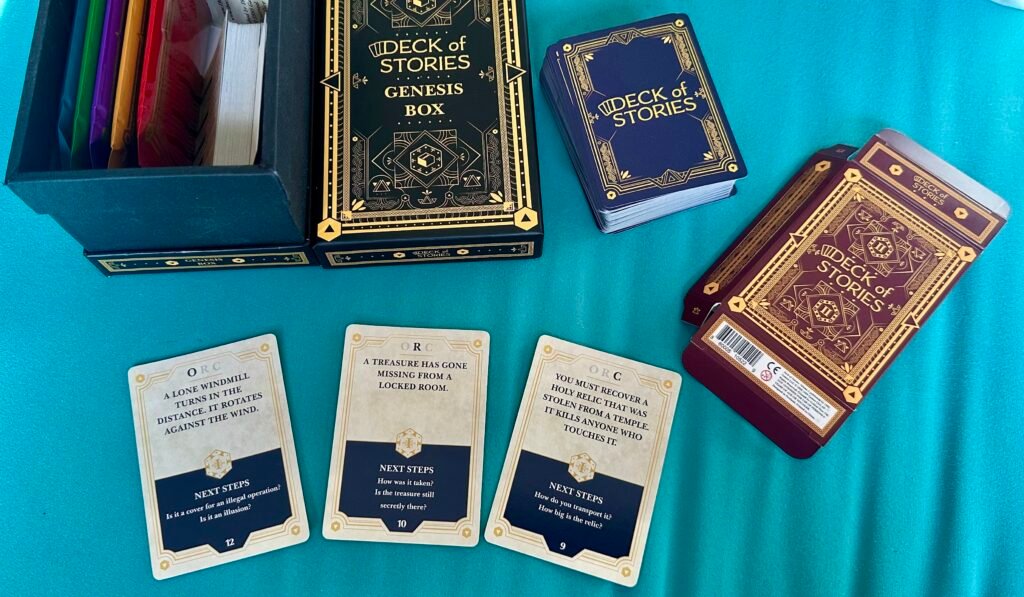
As with all the adventures, it began with three cards.
That constraint is important. Three ideas are just enough to create tension, but not enough to resolve it easily. You are forced to think. To connect. To interpret.
And sometimes, to struggle a little.
The Three Seeds of the Story
The first card was simple, but unsettling.
A LONE WINDMILL TURNS IN THE DISTANCE, ROTATING AGAINST THE WIND
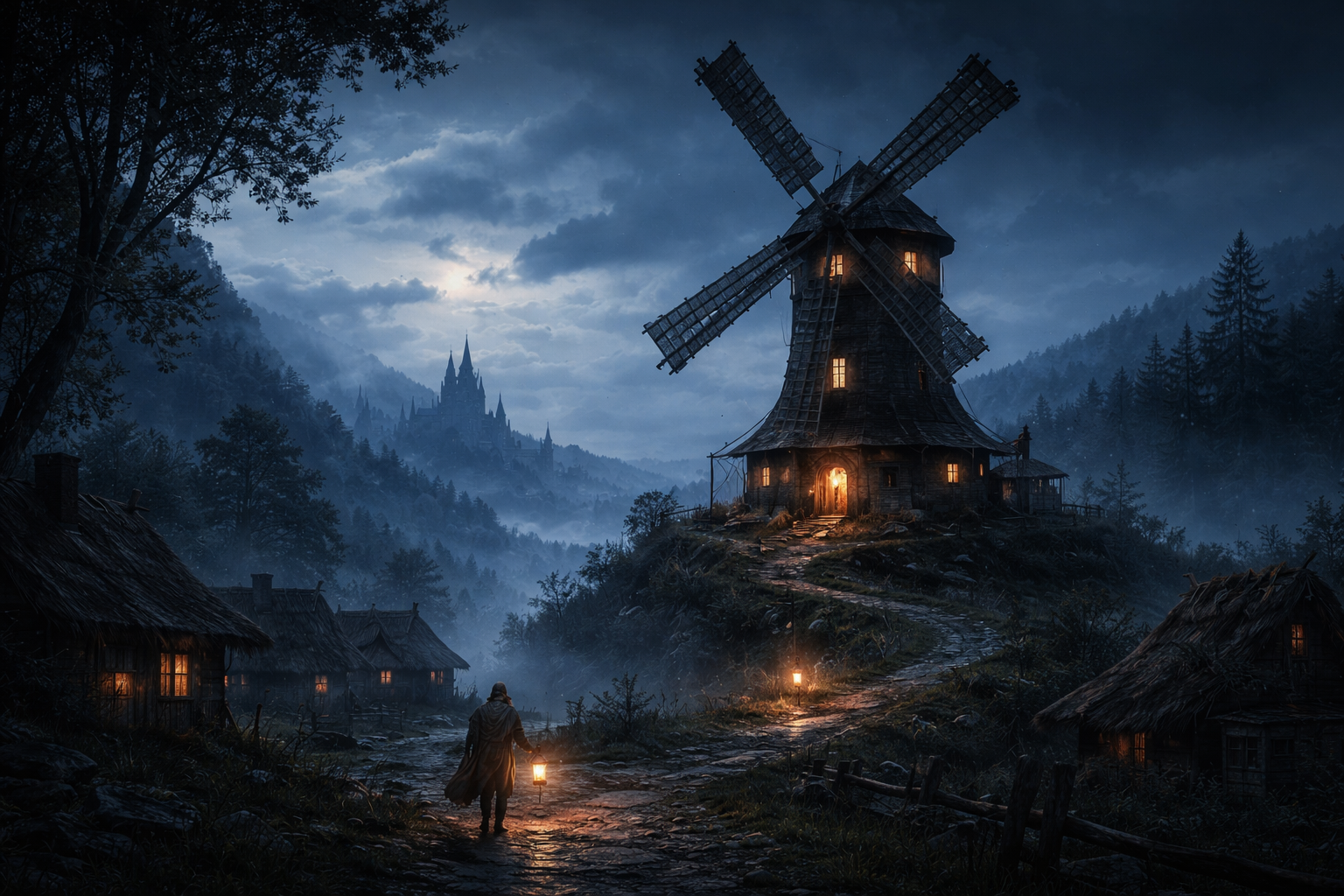
There is something inherently wrong about that image. Windmills are supposed to obey nature. They are passive machines. When one moves against the wind, it immediately raises a question. Something is interfering with the natural order.
At that point, the mind starts searching for explanations. Is it mechanical? Is it magical? Is it deception? Or is it something else entirely?
The second card introduced a very different kind of tension.
A TREASURE HAS GONE MISSING FROM A LOCKED ROOM.
This is a classic problem. The kind of puzzle that has existed in storytelling for centuries. It is logical. It invites analysis. It forces you to think about constraints. If the room was locked, then how did the theft occur? Was it truly locked? Was the treasure ever missing? Or is the entire premise misleading?
With just these two cards, there was already a story beginning to form. A strange location and an impossible event.
The third card changed the scale.
YOU MUST RECOVER A HOLY RELIC THAT WAS STOLEN FROM A TEMPLE. IT KILLS ANYONE WHO TOUCHES IT.
Now the story had weight. Not just mystery, but danger. Not just curiosity, but consequence.
The presence of the relic introduced new layers. It was not enough to find it. It had to be handled. Understood. Contained. It raised practical questions, but also moral ones. Why would something so dangerous exist? Why would anyone steal it? And what happens when power comes with a cost that cannot be ignored?
The Moment of Connection
This is the part that is difficult to describe, because it does not happen in a single step.
At first, the three ideas sit separately. The windmill. The locked room. The relic.
They do not naturally belong together. In fact, they resist each other. That resistance is important. It forces you to think beyond the obvious.
You begin asking questions, not to answer them immediately, but to see what possibilities emerge.
Could the windmill be hiding something? Could it be more than just a structure? Could the locked room theft be connected to something larger? Could the relic be the reason behind both?
There is a point where the questions start to overlap. Where one idea begins to explain another. That is when the story starts to take shape.
The windmill stops being just an image and becomes part of a system. The locked room is no longer an isolated puzzle but a symptom of a larger design. The relic becomes the central thread that ties everything together.
Nothing is forced. But nothing is accidental either.
Finding Structure in Chaos
Once the connections are in place, the next challenge is structure. Raw ideas are not enough. They need a shape.
For this, I relied on the Hero’s Journey framework, popularised by Joseph Campbell. Not because it is the only way to tell a story, but because it provides a reliable rhythm.
It allows you to pace the narrative. To move from curiosity to conflict to resolution in a way that feels natural.
As I mapped the story onto this framework, characters began to emerge. Motivations became clearer. The sequence of events started to feel inevitable rather than constructed.
The story moved from being a collection of ideas to something that had direction.
Shifting the Lens: From Game to Story
One of the most significant changes in this process was the shift in perspective.
When writing an RPG adventure, you think about players. About choices. About outcomes that can branch in multiple directions. You design for possibility.
When writing a novella, you think about the reader. About experience. About emotional continuity. You design for impact.
That shift required reworking almost everything.
Moments that would have been interactive became descriptive. Decisions that would have been made by players became part of the narrative arc. The focus moved from “what can happen” to “what should happen.”
The windmill was no longer just a clue to investigate. It became an atmosphere that lingered.
The locked room was no longer just a puzzle to solve. It became a source of tension that built over time.
The relic was no longer just an object to retrieve. It became a presence. Something that shaped the behavior of everyone around it.
The Story Beneath the Story
Without giving anything away, The Windmill’s Secret is ultimately about uncovering what is hidden in plain sight.
It is about the discomfort of realizing that something familiar is not what it seems. It is about the cost of pursuing truth when that truth is dangerous. And it is about the choices people make when faced with something they do not fully understand.
The external story is a mystery. The internal story is about consequence.
And that is where the transition from adventure to narrative really matters. Because a game can end when the objective is achieved. A story lingers because of what it leaves behind.
Building Beyond One Story
What started with The Windmill’s Secret did not end there.
In total, I created twelve such adventures using the same approach – the stories will unfold with time. Each one began with a handful of prompts. Each one required the same process of questioning, connecting, and shaping. Over time, the method became clearer. Not rigid, but repeatable. You start with constraints. You resist the urge to simplify too quickly. You allow the ideas to sit until they begin to connect. And then you impose structure without losing the original spark. It is a balance between discipline and curiosity.
What Stayed With Me
Looking back, the most important lesson from this process is that creativity does not always begin with inspiration. Sometimes it begins with structure. With limitations. With something as simple as three unrelated ideas. The magic is not in the cards themselves. It is in the questions they force you to ask. And perhaps more importantly, in the willingness to follow those questions even when the answers are not immediately clear. What started as a set of unused RPG adventures became the foundation for a narrative world. Not because the idea was perfect, but because it was explored.
Closing Thought
The Windmill’s Secret was not written in a straight line. It was discovered piece by piece.
Through contradiction. Through curiosity. Through the slow process of turning fragments into something coherent.
If there is one takeaway from this, it is this.
You do not need a complete idea to begin writing. You only need a place to start.
The rest reveals itself along the way.
Step into the world of Thaloria’s Darkspire Chronicles:
- The Windmill’s Secret: A Darkspire Chronicles Adventure Book One
- Echoes of Forsaken Paths: A Darkspire Chronicles Adventure Book Two
- Perilous Pursuit For Time: A Darkspire Chronicles Adventure Short Story
- Darkspire Chronicles on Amazon.
👁️ 294 views