
The fastest messenger of Olympus still races through the heavens

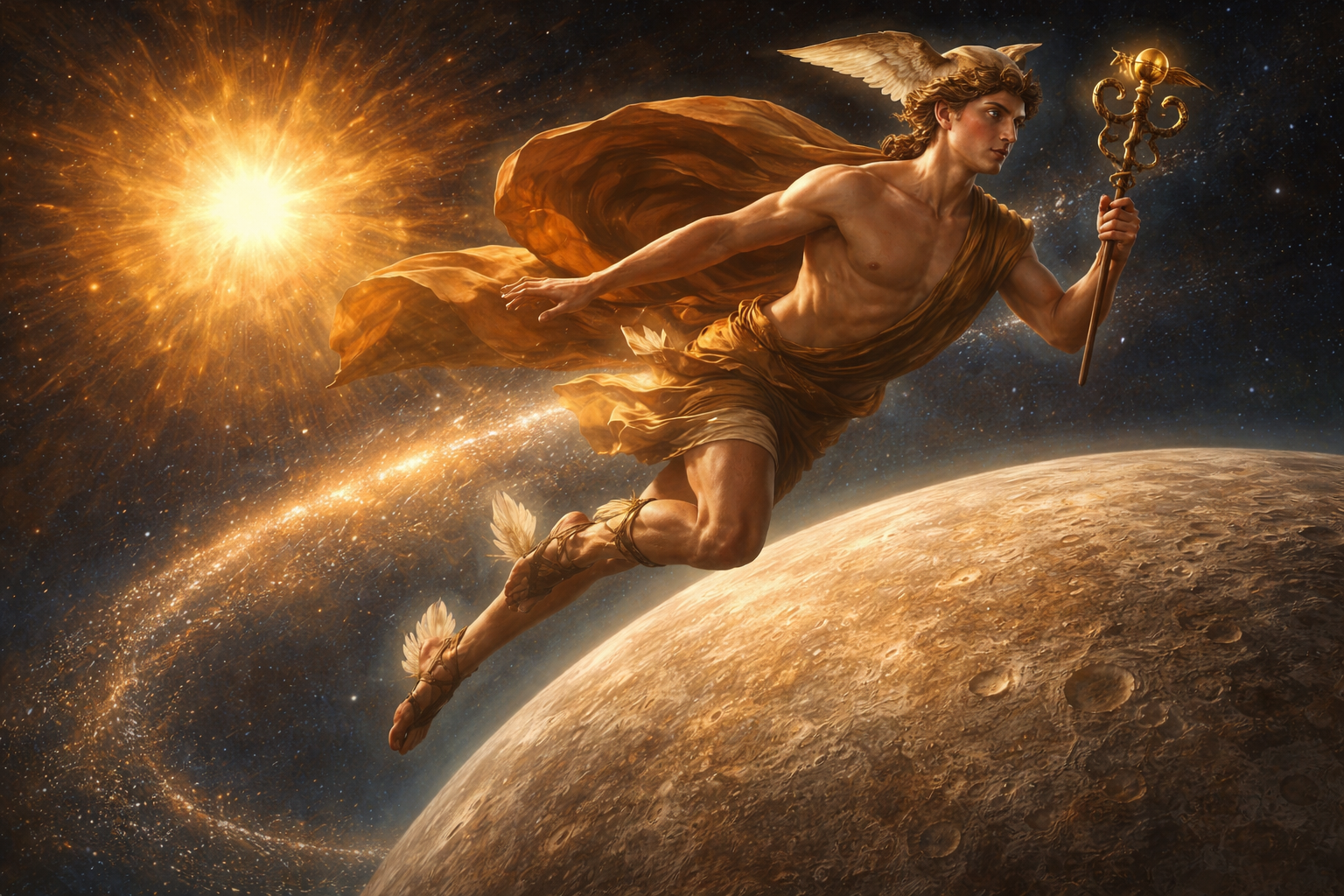
In Greek mythology, few gods moved as swiftly or as freely as Hermes. Son of Zeus and Maia, Hermes was the divine messenger of Olympus, a god of speed, travel, wit, and cunning. The Romans would later call him Mercury, and the name would eventually be given to the smallest and fastest planet in our solar system.
Hermes was rarely depicted standing still. Ancient poets imagined him with winged sandals, a winged helmet, and a staff called the caduceus, symbolizing his authority to move between worlds. He could travel effortlessly between the heavens, the earth, and even the underworld. Hermes carried messages for the gods, guided travelers, protected merchants, and escorted souls to the realm of Hades.
Speed defined him.
The myths often highlight his agility not just in motion but also in mind. As a newborn, Hermes already displayed his cleverness. In one famous story, he stole the cattle of Apollo, cleverly disguising their tracks so they could not be followed. When Apollo eventually discovered the theft and confronted him before Zeus, Hermes charmed everyone present with his wit and music, inventing the lyre and offering it to Apollo as compensation.
A trickster.
A traveler.
A messenger who could cross worlds faster than any god.
It is a fitting coincidence that the planet bearing his Roman name behaves in much the same way.
The Fastest Planet in the Solar System
Among the planets of our solar system, Mercury is the undisputed champion of speed.
Orbiting just 58 million kilometers (36 million miles) from the Sun, Mercury races around our star in only 88 Earth days. This means that Mercury completes more than four orbits for every single year on Earth. No other planet moves so quickly.
Its orbital speed reaches nearly 47 kilometers per second, about 170,000 kilometers per hour.
From the perspective of the solar system, Mercury is the celestial equivalent of Hermes sprinting across Olympus.
Ancient astronomers noticed this restless motion long before telescopes existed. Mercury appears close to the Sun in the sky and moves quickly from horizon to horizon, sometimes visible briefly at dawn or dusk before disappearing again. It never strays far from the Sun, making it a challenging planet to observe.
To early skywatchers, Mercury seemed elusive, fleeting, and constantly in motion – exactly like the messenger god whose name it carries.
A World Forged by Fire
If Hermes was the swift messenger of the gods, Mercury the planet is a world of extremes.
Because of its proximity to the Sun, Mercury experiences temperatures that swing dramatically. During the day, surface temperatures can reach 430°C (800°F), hot enough to melt lead. Yet at night, with no atmosphere to trap heat, temperatures plunge to −180°C (−290°F).
This enormous temperature difference makes Mercury one of the most extreme environments in the solar system.
Mercury’s surface itself resembles the Moon, covered in craters, cliffs, and ancient lava plains formed billions of years ago during the early formation of the solar system. One of its most striking features is the Caloris Basin, an enormous impact crater roughly 1,550 kilometers wide, created by a colossal collision long ago.
Despite its harsh environment, Mercury has fascinated astronomers for centuries. Because it lies so close to the Sun, studying it has always been difficult. Only a few spacecraft have visited it, including NASA’s MESSENGER mission, which orbited Mercury between 2011 and 2015 and revealed many of the planet’s secrets.
Among its discoveries was evidence that water ice may exist in permanently shadowed craters near Mercury’s poles, where sunlight never reaches.
Even on a world scorched by the Sun, the universe still finds ways to surprise us.
The Curious Rhythm of Mercury’s Day
Mercury’s motion through space is not just fast, it is also strangely complex.
For a long time, astronomers believed Mercury always kept the same face toward the Sun, much like the Moon does toward Earth. But in the 1960s, radar observations revealed something unexpected: Mercury rotates slowly, completing one full rotation every 59 Earth days.
This creates a unique rhythm between its rotation and orbit known as a 3:2 resonance.
In simple terms:
- Mercury rotates three times for every two orbits around the Sun.
This unusual gravitational dance gives Mercury one of the strangest calendars in the solar system. A single day on Mercury (sunrise to sunrise) lasts 176 Earth days, twice as long as its year.
On Mercury, a year passes faster than a day.
It is a world where time itself seems to run differently.
The Messenger Between Worlds
In mythology, Hermes served as a bridge between realms. He moved effortlessly between gods and mortals, between Olympus and the underworld.
Mercury the planet occupies a similar symbolic role in our solar system.
It sits at the inner edge of the planetary family, closest to the Sun. It experiences the strongest gravitational pull from our star and moves with unmatched speed. It is both a survivor of the solar system’s violent beginnings and a reminder of the immense forces that shaped the planets.
Mercury also played an important role in one of the greatest confirmations of modern physics. In the 19th century, astronomers noticed that Mercury’s orbit shifted slightly in ways that Newton’s laws could not fully explain. It wasn’t until Albert Einstein’s theory of general relativity that the mystery was solved. The curvature of spacetime near the Sun subtly altered Mercury’s orbit, and Einstein’s equations predicted the effect precisely.
In this way, Mercury helped confirm one of the most profound discoveries in science.
Even today, the swift planet continues to carry messages – this time not from gods, but from the laws of the universe itself.
Myth Written in Motion
Across cultures and centuries, humans have always searched the skies for stories. Sometimes the connection between myth and science feels poetic rather than literal.
Mercury offers one of the clearest examples.
A fleet-footed god who never stands still.
A planet that races around the Sun faster than any other.
The ancients named the wandering lights of the sky after their gods because those lights seemed alive with personality. Mercury’s rapid movement across the heavens must have reminded them of Hermes running across the world with divine messages.
Today, we understand the physics behind Mercury’s motion: gravity, orbital mechanics, and the immense pull of the Sun.
Yet the name still feels right.
Somewhere in the deep memory of humanity, the swift messenger still runs – circling the Sun every 88 days, racing through the darkness with winged sandals of fire.
Other posts in this series:
- Mars: Panic will leave and Fear will be destroyed
- Cassiopeia: The Queen Condemned to Spin Among the Stars
- When the sky fell, it never stood upright again
- The fastest messenger of Olympus still races through the heavens
- Venus shines with beauty, but burns with truth
- The sky remembers its hunter, and the stars remember how to begin
👁️ 182 views
Share this post :
Archives
| M | T | W | T | F | S | S |
|---|---|---|---|---|---|---|
| 1 | 2 | 3 | 4 | |||
| 5 | 6 | 7 | 8 | 9 | 10 | 11 |
| 12 | 13 | 14 | 15 | 16 | 17 | 18 |
| 19 | 20 | 21 | 22 | 23 | 24 | 25 |
| 26 | 27 | 28 | 29 | 30 | 31 | |
Categories
Missives from Planet Nagi
Sign up for our newsletter.
Get insightful stories, updates, and inspiration delivered straight to your inbox. Be the first to know what’s new and never miss a post!