

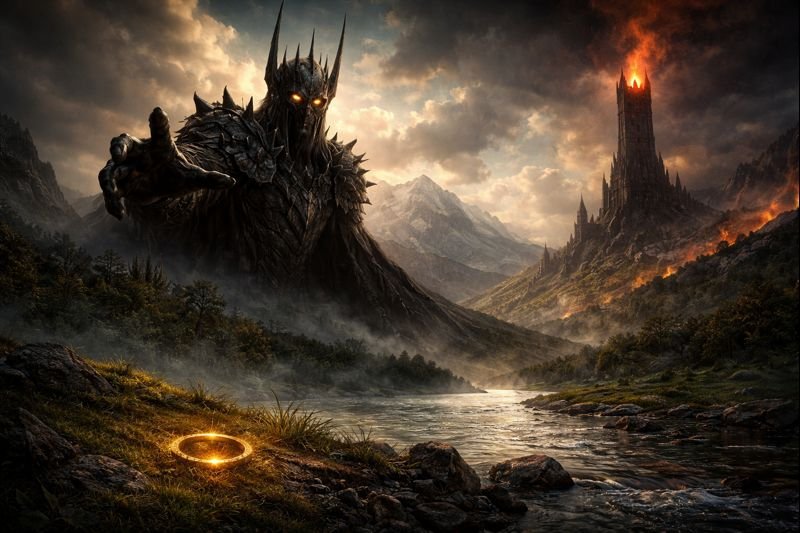
The Fellowship of the Ring completed twenty-five years recently, and the extended editions of all three films returned to theaters. We watched them the way many families did, spread across evenings, letting the long versions breathe as they were meant to. There is something quietly ceremonial about returning to these films after so many years. They feel less like movies and more like old stories we revisit to see what has changed in us.
One night, after we returned home, my daughter asked a question that stopped me mid-stride.
“So where was Sauron for 2500 years, while the One Ring was sitting dormant?”
It is a question that I have been asked before. Not a plot hole, but a conceptual one. The films show us Sauron as an ever-present Eye, searching, straining, raging. But the Ring lay lost for roughly twenty-five centuries, first in the Anduin, then in a cave beneath the Misty Mountains. If Sauron was so powerful, so watchful, so terrible, how did that happen?
The answer reveals something essential about Tolkien’s design. Sauron was never absent. He was simply working differently than we expect villains to work.
The Long Silence of the Ring
To understand the question, we need to frame the timeline. A Brief Timeline of Absence and Return
- Second Age, year 3441
Isildur cuts the One Ring from Sauron’s hand at the end of the War of the Last Alliance. Sauron’s physical form is destroyed. - Early Third Age
Isildur is ambushed at the Gladden Fields. The Ring is lost in the Anduin River. - Approximately 2500 years
The Ring lies hidden. First beneath the river, then in the depths of the mountains, after Déagol and Sméagol find it. - Third Age, year 2463
Sauron secretly returns, taking shape as the Necromancer in Dol Guldur. - Third Age, year 2951
Sauron openly returns to Mordor and reoccupies Barad-dûr. - Third Age, year 3018–3019
The War of the Ring unfolds.
That two and a half millennium gap is what makes the question feel unsettling. Surely a being of Sauron’s stature would not simply wait.
And he did not.
The Eye Misleads Us
Peter Jackson’s films gave us one of the most iconic visual metaphors in modern cinema: the Eye of Sauron, burning atop Barad-dûr. It is effective, memorable, and emotionally resonant. But it subtly distorts how Sauron operates in the books.
In Tolkien’s world, by the time of The Lord of the Rings, Sauron has taken physical form again. He is not a floating consciousness. He walks, commands, plans, and governs. The Eye is not a literal state of being. It is a symbol of attention, will, and domination.
That distinction matters.
Sauron’s strength is not constant surveillance. It is an influence applied at pressure points.
Rebuilding Without the Ring
When Sauron lost the Ring, he lost the ability to dominate absolutely. What he did not lose was memory, patience, or ambition.
For nearly two thousand years, he rebuilt himself quietly. He returned first as the Necromancer, testing the world, probing its defenses, and learning who remembered him and who had grown complacent. By the time he openly returned to Mordor, he no longer needed the Ring to move history.
Armies were raised without it. Alliances were forged without it. Fear spread without it.
The Ring amplified Sauron’s power, but it was never the source of his intelligence.

The Palantíri and the War of Minds
If there is one instrument that defines Sauron’s activity during the Ring’s absence, it is the palantíri.
The seeing stones were not tools of domination by force. They were tools of pressure. They did not lie, but they showed selectively. That distinction allowed Sauron to wage war without drawing a sword.
Denethor and the Cost of Knowledge
Denethor II, Steward of Gondor, turned to the palantír in grief and duty. He sought foresight to protect his people. What he found was truth without hope.
Sauron could not control Denethor. The Steward’s lineage and will were too strong. But control was not necessary. Sauron needed only to overwhelm him with visions of inevitable defeat. Over time, Denethor aged prematurely, not from sorcery, but from despair.
This is one of Tolkien’s quiet insights. Knowledge without context becomes poison.
Saruman and the Lie of Equality
Saruman’s fall is often misunderstood. He was not corrupted because he looked into the stone. He looked into the stone because he was already drifting toward pride.
Through the palantír of Orthanc, Sauron fed Saruman half-truths and strategic possibilities. He allowed Saruman to believe he was a rival rather than a servant. That illusion was enough to turn Isengard into a second dark power, fracturing the West before the war even began.
Sauron did not need loyalty. He needed a distraction.
Gollum and the Summons of Power
While kings and wizards struggled with knowledge, another creature felt Sauron’s pull more directly.
Gollum was bound to the Ring in ways even Sauron did not fully control. Yet the Ring marked him, and Sauron’s will bent all marked things toward Mordor. Gollum’s journey was not a coincidence. It was gravity.
When Sauron learned of hobbits and of the Shire through Gollum’s torment, the long dormancy ended. The Ring was no longer an abstract possibility. It had a geography.
From that moment on, the war accelerated.
The Nazgûl and the Hunt, Not the War
When the Nine Riders rode forth, they were not generals leading hosts. They were hunters.
Sauron masked their movement with diversions. Assaults on Osgiliath. Pressure on the Woodland Realm. Threats on multiple fronts. All of it served one purpose: to hide the true mission.
Retrieve the Ring.
This is another place where Sauron’s patience reveals itself. He did not rush armies north. He trusted secrecy, fear, and inevitability.
And for a time, it nearly worked.
The Fatal Blind Spot
Sauron’s great failure was not arrogance in the common sense. It was imagination.
He could not conceive of a mind that would seek to destroy the Ring rather than wield it. Every plan he made assumed possession. Even when Aragorn revealed himself through the palantír, bearing the reforged sword of Elendil, Sauron interpreted it as confirmation of his own assumptions.
Someone had claimed the Ring. The only question was who.
That belief shaped every decision that followed. The early assault on Gondor. The attacks in the north. The fixation on the Black Gate.
When Frodo and Sam crept through Mordor, they were invisible not because Sauron was blind, but because he was certain.
The End of a Distributed Will
When the Ring was destroyed, the collapse was immediate and total.
This reveals something crucial. Sauron was not merely commanding armies. He was sustaining them. His will acted as a binding force, keeping creatures of hatred and fear aligned toward a single purpose.
When that will was broken, the structure disintegrated. Orcs fled or slew themselves. The war did not end with negotiation. It ended with unraveling.
Tolkien compares it to the death of a hive mind. Without the central will, nothing holds.
So, Where Was Sauron?
He was waiting.
He was watching selectively, not universally. He was shaping outcomes rather than chasing artifacts. He was turning strength into inevitability.
For twenty-five hundred years, while the Ring lay forgotten, Sauron rebuilt the world into a shape where its return would be decisive.
That is what makes Tolkien’s villain so unsettling. Sauron does not dominate through spectacle. He dominates through systems. Through despair. Through patience.
When my daughter asked her question, she was really asking why evil was allowed so much time.
Tolkien’s answer, I think, is that evil is never idle. It is simply quiet until it believes the world is ready.
And sometimes, the smallest hands undo what centuries of careful planning could not.
Check out other essays on Tolkien and Middle-earth.
- The Pen of Middle-Earth Series
- The Pen of Middle-Earth: Tools that shaped J.R.R. Tolkien’s worlds
- The Pen of Middle-earth, Part I: Ink and Imagination – The Hand That Built Middle-earth
- The Pen of Middle-earth, Part II: The Instruments of Creation – Tolkien’s Pens, Nibs, and Inkwells
- The Pen of Middle-earth, Part III: The Script of Arda – How Tools Shaped Language
- The Pen of Middle-earth, Part IV: Recreating Tolkien – Modern Calligraphers and Fountain Pen Enthusiasts
- The Pen of Middle-earth, Part V: The Slowness of Creation – What Tolkien’s Pen Teaches Us
- History of Middle-Earth Series
- History of Middle-Earth, Part 1 – The Birth of a Legendarium
- History of Middle-Earth, Part 2 – The First Five Volumes: Early Myths & Lost Tales
- History of Middle-Earth, Part 3 – The Road to Númenor and the Shaping of History
- History of Middle-Earth, Part 4 – The Making of The Lord of the Rings
- History of Middle-Earth, Part 5 – The Later Silmarillion
- History of Middle-Earth, Part 6 – Peoples and the Nature of Middle-Earth
- Strider to High King: Aragorn’s Life After Sauron’s Fall
- LOTR’s Prologue: The Greatest Movie Opening Ever
- The Hidden Authors of Middle-earth: Tolkien’s Greatest Literary Illusion
- The Many Faces of Sauron: Understanding the Dark Lord’s Ten Forms in Middle-Earth
👁️ 238 views