


I first saw Ustad Puran Chand Wadali and Pyare Lal Wadali on Doordarshan Jalandhar. I was a child then, and Sufi music – slow, repetitive, unhurried – did not speak to me. At that age, it couldn’t. It asked for patience I didn’t yet possess, and stillness I hadn’t learned to value. It moved at a pace that felt alien to a young mind shaped by immediacy and novelty. I did not yet know that some music waits for you to grow into it.
I remember seeing him occasionally in Amritsar as well – riding a bicycle, handlebar moustache intact, unmistakable even in anonymity. There was something quietly striking about him, though I did not have the vocabulary for it then. He carried himself without urgency, without performance, with an innocent smile. At the time, he was simply a familiar face, a figure one noticed, remembered, and moved past. There was no sense yet of inheritance, of what he carried within him, of what traveled with him in silence.
Years later, that changed.
When I returned to Amritsar as a lecturer at Guru Nanak Dev University, I encountered the Wadali Brothers again – this time not through a television screen, but in person, during the university’s annual celebrations. As a member of the faculty, I was seated close to the stage. Proximity matters. It strips away illusion. It denies distance the chance to mythologize.

That evening, they did not simply perform. They sang their Sufi qawwalis, yes, but they also spoke. They spoke of their village, of their teachers, of their lineage. They spoke without drama, without self-conscious storytelling, without pretense. The music unfolded slowly, deliberately. There was no urgency to impress, no attempt to compress devotion into digestible minutes. What stayed with me was not virtuosity, but weight – the sense that every note had lived somewhere long before it reached us.
Their singing did not feel like an offering to the audience. It felt like a continuation of something already in motion.
After that night, I began seeking out every recording of theirs I could find. There were not many. The Wadali Brothers have always preferred the living moment over the archived one. Their art resists documentation because it is not meant to be preserved in pristine form. It is meant to be encountered. Their music belongs to the present tense, to breath and room and attention.
Certain compositions stayed with me and never quite left: “Ghooghat Chak O Sajna,” “Dama Dum Mast Qalandar,” “Ve Sone Diya Kangna,” “Charkha.” These are not songs one merely listens to. They linger. They repeat themselves inside you, slowly revealing layers you did not know were there. Each return uncovers something new – not because the music has changed, but because you have.
Guru Ki Wadali: Place Before Performance
To understand the Wadali Brothers, one must begin with place.
Guru ki Wadali is not incidental. It is essential. In Sufi traditions, geography is not merely a backdrop; it is a participant. The village, the dera, the soil itself becomes a silent collaborator in the music. Sound is shaped by where it is born. This is not art that migrates easily from its roots. It grows where it is planted.
Music here is not ambition. It is an inheritance.
The Wadalis did not leave Guru ki Wadali to become artists; they remained there to become vessels. That decision runs counter to the dominant narrative of success, which demands movement toward centers of power, visibility, and consumption. Even today, Ustad Puran Chand Wadali continues to live in his ancestral home, leading a life untouched by the excesses often associated with fame. That choice is not accidental. It is philosophical. It reflects a worldview in which the music is not something you extract from a place, but something you remain faithful to.
Lineage, Not Career
The Wadali lineage flows clearly and deliberately:
Ustad Thakur Das Ji → Ustad Gurmeet Bawa Ji → the Wadali Brothers.
This is not a résumé. It is a transmission.
The guru–shishya parampara here is not about technique alone. It is about discipline, restraint, and surrender. Music is not something you “do.” It is something you submit to. Learning is slow, often invisible, and deeply humbling. Progress is measured not in recognition but in readiness.
In this tradition, one does not decide to become a Sufi singer. One is allowed to carry the sound forward.
That distinction matters. It separates performance from devotion, ambition from service. The singer is not the center. The kalam is.
Sufi Thought in Their Singing
Sufi music operates on multiple planes simultaneously. On the surface, there is poetry of longing – separation, desire, waiting. Beneath it lies ishq-e-haqiqi, divine love, layered beneath ishq-e-majazi, worldly affection. The beloved in these compositions is never only human. The ambiguity is intentional. It allows the listener to enter from wherever they stand.
The Wadali Brothers understand this deeply. Their singing does not rush toward resolution. It circles, repeats, pauses. Silence between notes is not absence; it is meaning. Repetition is not redundancy – it is insistence. It is the act of returning, again and again, to what cannot be exhausted.
You are not meant to consume this music. You are meant to sit with it.
The Quiet Gravity of Puran Chand Wadali
Ustad Puran Chand Wadali himself always seemed less interested in being seen than in being present. There was a quiet gravity about him, whether on stage or in the village lanes of Guru ki Wadali, that made performance feel almost incidental.
He sings without haste, allowing the kalam to lead rather than his own voice. Even as the world around him grew louder and more hurried, he remained rooted, returning always to his ancestral home, to the same soil that had shaped his sound. In him, one sensed a deep refusal to separate life from music; both flowed from the same source, governed by patience, humility, and an unspoken understanding that devotion does not need adornment to endure.
The Voice of Pyare Lal Wadali
Ustad Pyare Lal Wadali’s voice was unmistakable – earthy, grounded, deliberately unpolished. There was no ornamentation for its own sake, no bravado disguised as devotion. His masculinity carried humility, not dominance. The power lay in restraint, in knowing when not to push, when to let the note breathe.
When he passed, it felt like losing more than a singer. It was the loss of a register of sincerity – something increasingly rare in a world that rewards projection over presence. After his passing, the music continued, as it must, but something intangible shifted. Not diminished, but changed. All living traditions change when one pillar is removed. The silence becomes part of the sound.
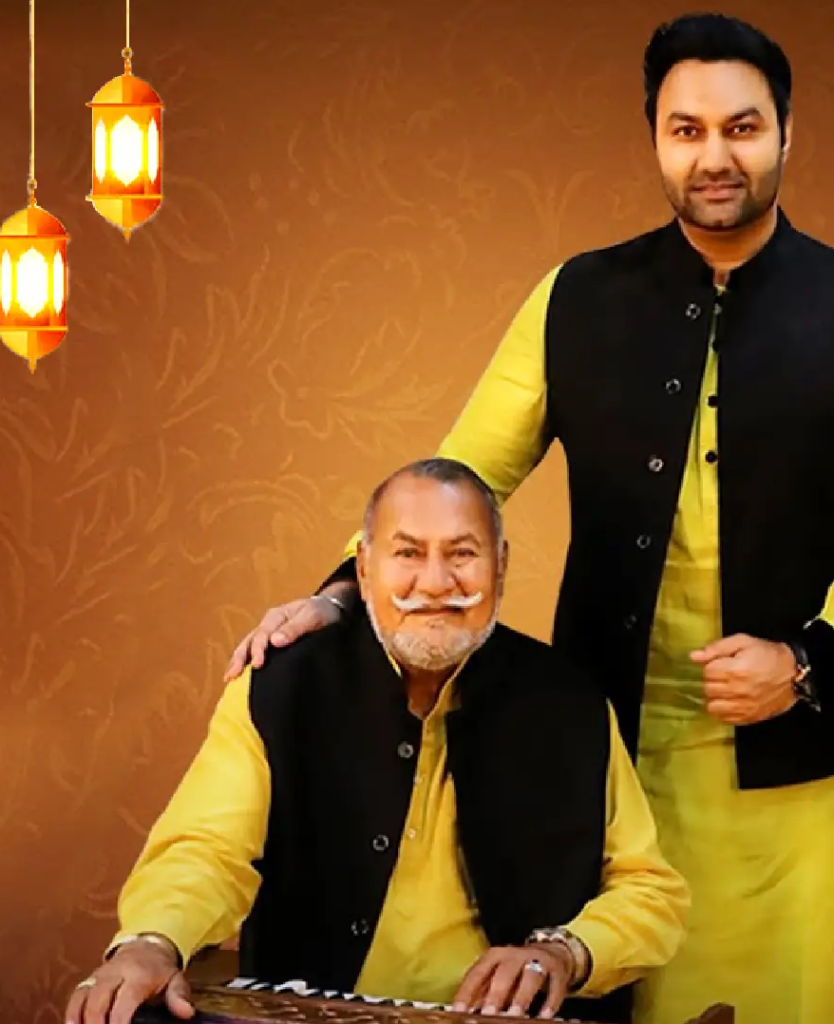
Now, Ustad Puran Chand’s son, Lakhwinder Wadali stepped up to the mantle to take his uncle’s place, and has continued the tradition of sufi singing. They perform as Wadalis now.
Why They Still Matter
We live in an age of speed, spectacle, and algorithms. Music is optimized for immediacy, trimmed for attention spans, shaped for virality. The Wadali Brothers ask for the opposite.
They ask for patience.
Their music does not reward casual listening. It demands humility. It gives back slowly, often long after the last note has faded. It resists being reduced to background noise. It insists on presence.
In doing so, it quietly challenges how we listen – not just to music, but to one another.
Listening as an Act of Humility
As a child, I never connected with Sufi music. In doing so, I missed something precious. Both my grandfathers were deeply rooted in these traditions – one through shabads, the other through Sufi qawwalis. I was close to both, yet I lacked the stillness required to truly listen. The classical alaaps never appealed to me then. They felt too slow, too demanding.
I wish they had.
Listening to the Wadali Brothers now feels like an act of quiet reconciliation – with age, with memory, with what I did not understand in time. It feels like standing still long enough for something older and wiser to catch up to you.
Sufism began as a reformist movement in Islam across Central Asia, its spirit extending into the Indian subcontinent. Its secular message – humanity above dogma – ran parallel to the Bhakti movement within Hinduism. Sikh thought emerged from the same soil of devotion and reform, shaped by Bhakti yet forming its own distinct path.
All of these traditions teach humility, equality, and humanity before the divine – whichever name one uses for it, or even if one uses none at all.
The Wadali Brothers embody this confluence. Sons of Guru ki Wadali – the birthplace of Guru Hargobind Sahib, the sixth Sikh Guru – they sing from soil steeped in Sufism, Bhakti, and Sikhi alike. They have sung shabads from the Guru Granth Sahib, the qawwalis of Sufi pirs like Baba Farid and Bulleh Shah, and the verses of Bhakt Kabir. Their music does not divide. It dissolves.
To listen to them is to lower oneself to accept that understanding does not come through intellect alone, but through surrender.
And that, perhaps, is their greatest gift.
If you enjoyed this, you may like,
- Echoes of the Divine: Hamds, Naats & Qawwalis in Sufism
- Echoes of the Five Rivers: A Journey Through Punjabi Folklore
- Echoes of the Five Rivers, Part 1: The Soul of Punjab and Its Stories
- Echoes of the Five Rivers, Part 2: Themes, Motifs & the Soul of Punjabi Storytelling
Here are a few of my favorites for you to enjoy,
👁️ 230 views