

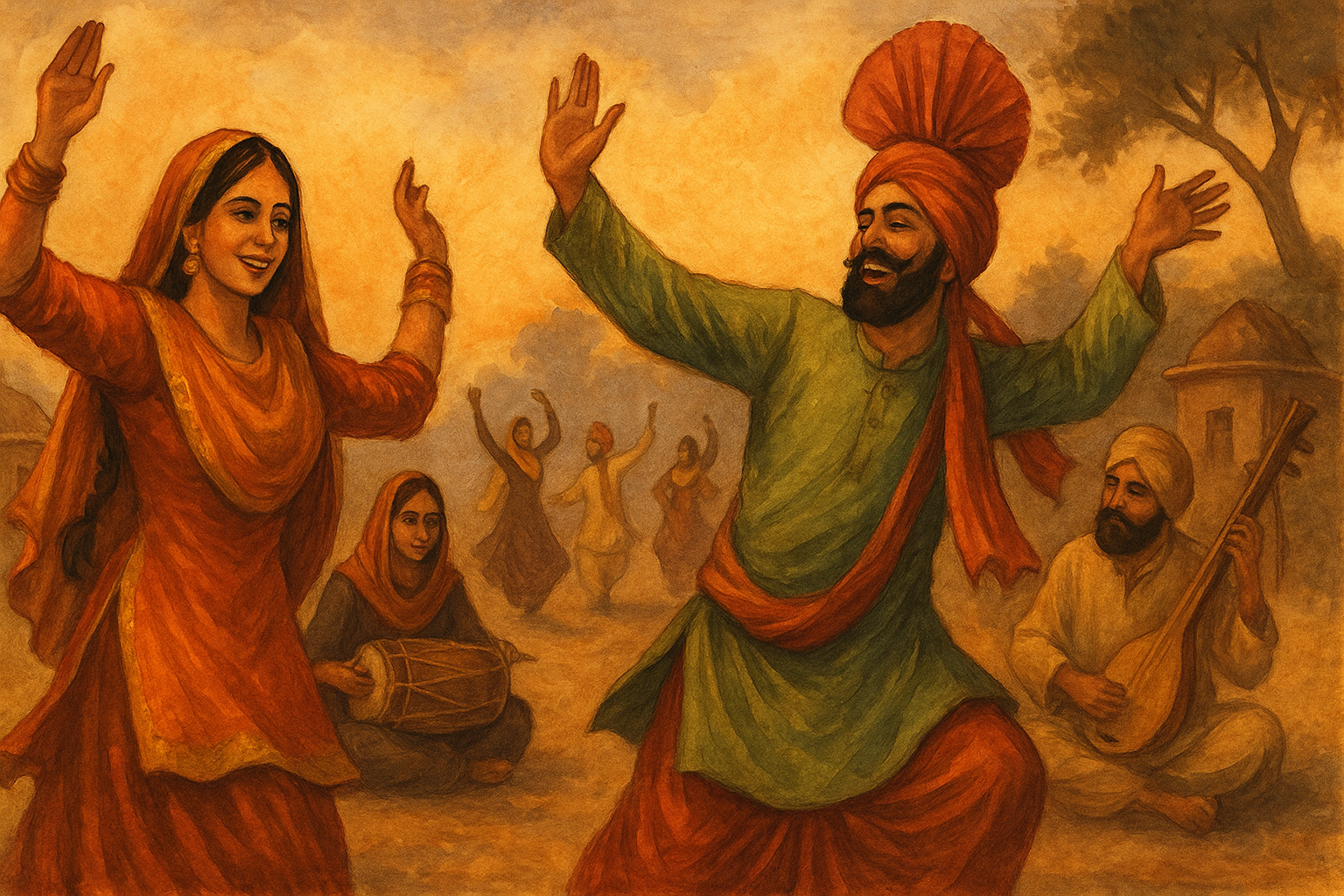
Not all of Punjab’s stories are about love.
Some are about courage – the kind that stands tall even when no one is watching.
Where Heer and Sohni whispered defiance in the name of love, figures like Raja Rasalu, Puran Bhagat, and Dulla Bhatti thundered their defiance in the name of justice.
If the qissa spoke to the heart, these legends spoke to the conscience.
They are the other pulse of Punjab’s folklore – reminders that heroism is not about power, but about moral strength.
Every Land Needs Its Heroes
The Punjab of folklore is not a land of kings and conquests; it’s a land of people who stood up for what was right, often with nothing but faith, wit, and will.
Their stories live in songs sung at melas, in verses carved on memory, and in laughter that carries more truth than sermons.
When I first heard about Dulla Bhatti, it was not from a book, but from a Lohri song – children going door to door, singing with glee:
“Sundar mundriye ho!
Tera kaun vichara? Dulla Bhatti wala!”
(O beautiful one, who protects you? It’s Dulla Bhatti!)
I didn’t understand the story then – only the rhythm. But later I learned that behind those playful lines was the story of a man who risked everything to protect the innocent.
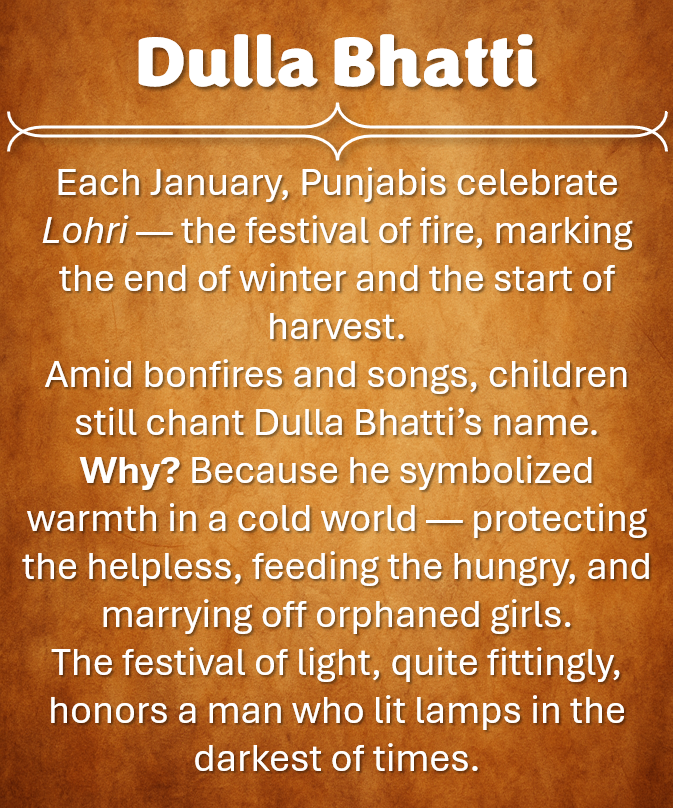
Dulla Bhatti: The Rebel with a Cause
Dulla Bhatti lived during Emperor Akbar’s time, in the 16th century.
Born into a Rajput family that resisted Mughal rule, he became a folk Robin Hood – stealing from the rich and powerful to help the poor. But his legend burns brightest in one act: rescuing girls who were being sold into slavery.
He would free them, arrange their marriages, and provide dowries – symbolic acts of defiance against tyranny and exploitation.
That is why, every Lohri, when children sing his name, they are unknowingly honoring a man who stood for dignity and justice.
In a land often celebrated for love stories, Dulla Bhatti’s tale reminds us that love for one’s people is also sacred.
Raja Rasalu: The Trickster King
If Dulla Bhatti represents rebellion, Raja Rasalu represents wit and wisdom.
He is Punjab’s wandering hero – part philosopher, part prankster, part saint.
His stories were told for centuries by qissa-khwans and village elders, blending humor and moral lessons in equal measure.
Rasalu’s adventures range from the absurd to the divine: he fights demons, outsmarts giants, converses with talking birds, and challenges destiny itself.
But beneath the fantasy lies something profound – the idea that cleverness and kindness are greater than strength.
He’s a king who laughs, a warrior who forgives, a hero who wins not by force, but by compassion.
That’s a very Punjabi kind of heroism – courageous, but never cruel.
Puran Bhagat: The Saint of Forgiveness
Some heroes fight the world. Others conquer themselves.
Puran Bhagat’s story belongs to the second kind.
He was the son of King Salwan of Sialkot, born after years of prayer. But his stepmother, enraged by his piety, falsely accused him of wrongdoing. The king, deceived, ordered Puran to be executed.
The executioner could not bring himself to kill the innocent boy – he cast him into a well instead, where Puran survived by divine grace and became a saint.
Years later, when the truth emerged, the king sought forgiveness. And Puran forgave him.
It is a tale of suffering turned into sanctity, cruelty answered with compassion – a parable of moral awakening.
Even today, Puran’s well near Sialkot is visited by pilgrims who drop coins and prayers, seeking blessings for healing and peace.
Raja Sálbán: The Builder of Sialkot
Long before Puran Bhagat, there was Raja Sálbán, another legendary figure tied to the same city.
He is said to have rebuilt Sialkot after its destruction, establishing it as a center of learning and trade.
His name survives not just in chronicles, but in the consciousness of the land – as the archetype of a wise and visionary ruler.
What’s fascinating is that both Sálbán and Puran, father and son in folklore, represent two sides of leadership – power and penitence.
Together, their stories remind us that true greatness is not inherited; it is earned through humility and justice.
Mai Bhago: The Warrior Saint
Though less often grouped with the old legends, Mai Bhago stands shoulder to shoulder with them.
A real historical figure from the early 18th century, she was a Sikh woman who rallied deserters back into battle during the Mughal wars and fought at Muktsar.
In her courage, one sees the evolution of folklore into living memory – the way myth becomes history, and history returns as legend.
Even today, her name is invoked by women as a symbol of strength – proof that heroism knows no gender.
The Moral Compass of Folklore
Each of these heroes stands for something larger than themselves:
- Dulla Bhatti: resistance and social justice.
- Raja Rasalu: wit and compassion.
- Puran Bhagat: faith and forgiveness.
- Raja Sálbán: vision and stewardship.
- Mai Bhago: courage and conscience.
Together, they form the moral framework of Punjab’s folklore – a reminder that heroism is not defined by victory, but by virtue.
They show that in a culture so often romanticized for its love stories, the deeper message has always been about integrity.
Folklore’s Idea of Justice
In Western myths, heroes often conquer kingdoms.
In Punjabi folklore, they redeem them.
Justice here is not about punishment – it’s about restoration. The wronged are heard. The guilty are forgiven. Balance is restored.
That’s what makes stories like Puran Bhagat’s so deeply moving – they redefine justice as healing, not revenge.
Even Raja Rasalu’s pranks serve a moral end: to humble the arrogant and protect the innocent.
It’s humor as justice – a concept as old as Punjab’s laughter itself.
Echoes in Modern Life
These heroes are not just memories – they’re archetypes that still shape Punjabi identity.
The farmer who shares his crop with a stranger, the teacher who stands up for a student, the woman who leads with quiet strength – they all carry echoes of these stories.
You’ll find Dulla Bhatti’s name on truck art, Mai Bhago’s face on murals, and Rasalu’s wit in the jokes told at roadside dhabas.
In every act of everyday bravery, folklore lives on – not as legend, but as legacy.
Closing Reflection
If Punjab’s love stories reveal its heart, its legends reveal its soul.
These heroes remind us that courage doesn’t always roar; sometimes it forgives, sometimes it laughs, sometimes it simply keeps a promise.
Their stories endure because they speak to the best in us – the part that refuses to surrender to cynicism, that still believes in fairness, loyalty, and light.
So when the dhol beats at Lohri or a child sings of Dulla Bhatti, it isn’t just folklore being remembered.
It’s Punjab whispering to itself:
Be brave. Be kind. Be just. And keep the fire burning.
Links to the essays in the series:
- Echoes of the Five Rivers: A Journey Through Punjabi Folklore
- Echoes of the Five Rivers, Part 1: The Soul of Punjab and Its Stories
- Echoes of the Five Rivers, Part 2: Themes, Motifs & the Soul of Punjabi Storytelling
- Echoes of the Five Rivers, Part 3: Folk Beliefs, Rituals & the Living Spirit of Punjab
- Echoes of the Five Rivers, Part 4: Folk Music, Songs & the Voice of the Land
- Echoes of the Five Rivers, Part 5: The Qissas – Love, Rebellion, and the Eternal River
- Echoes of the Five Rivers, Part 6: Saints, Seekers & the Soul of Punjab
- Echoes of the Five Rivers, Part 7: Legends of Valor, Justice & the Everyday Hero
- Echoes of the Five Rivers, Part 8: Folklore & Modernity – The Stories That Refuse to Die
- Echoes of the Five Rivers, Part 9: Reflections, Continuity & the River That Remembers
👁️ 922 views