

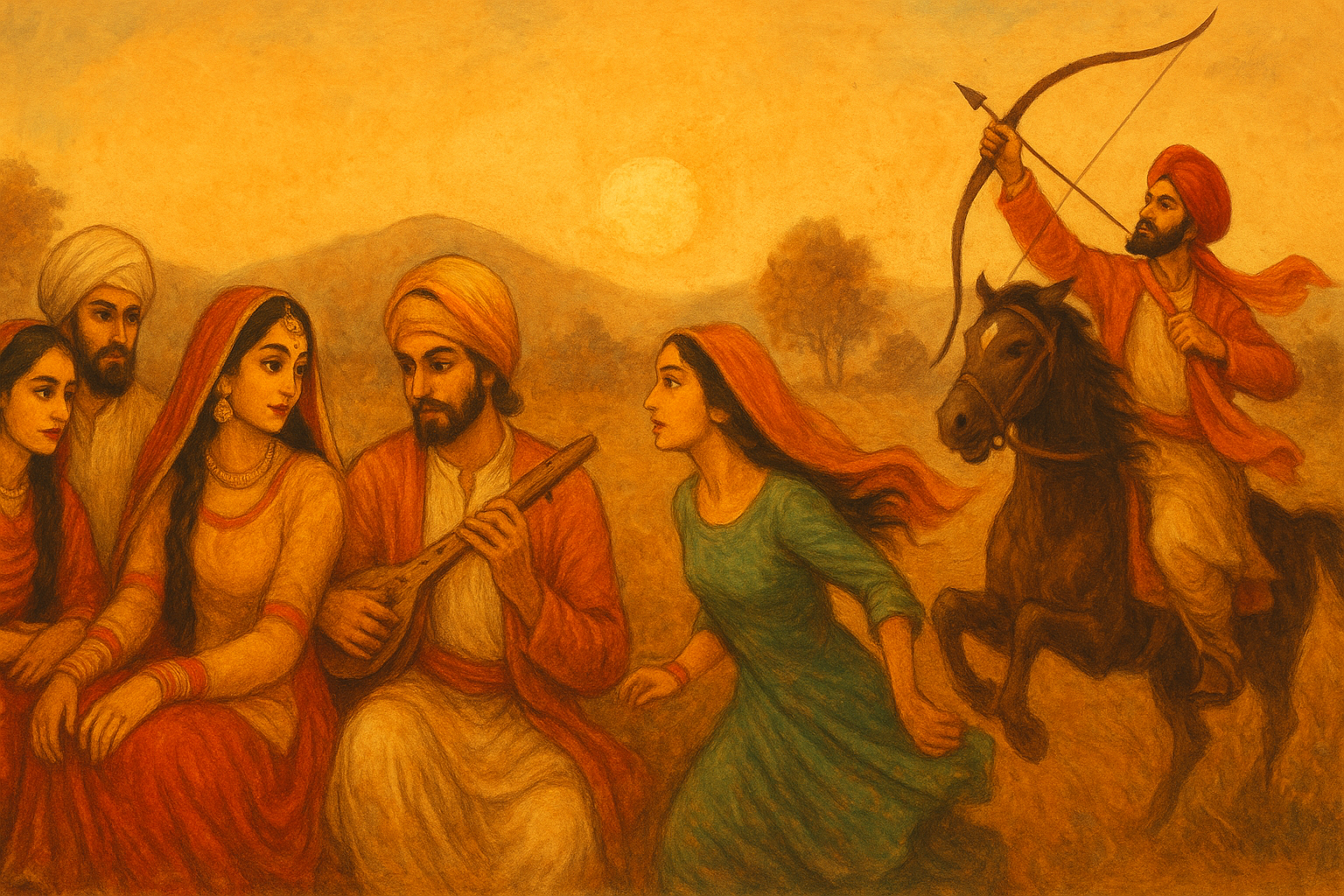
If Punjab had a heart, it would beat to the rhythm of a qissa.
These epic love stories – sung under the moonlight, recited in marketplaces, whispered by mothers to daughters – are not just romances. They are acts of defiance, songs of spiritual awakening, and mirrors to a society that has long wrestled with love, duty, and destiny.
Their names are legends now – Heer Ranjha, Sohni Mahiwal, Mirza Sahiban, Sassi Punnun.
Yet beneath every tragic ending lies the same unyielding truth: in Punjab’s imagination, love is never small. It is cosmic. It challenges everything – family, faith, even fate itself.
The Tradition of the Qissa
A qissa (from the Persian قصہ, meaning “story”) is more than a tale – it is a sung narrative, half poem and half prayer. In the villages of Punjab, professional storytellers called qissa-khwans would perform these long romances, often accompanied by the tumbi or sarangi.
The audience knew the stories by heart, yet they gathered again and again to hear them retold – because every singer gave them new life.
The qissa was not about surprise; it was about remembrance. It was a shared ritual of feeling.
These stories are the emotional epic of Punjab – the Iliad and Odyssey of its people, carried not in scrolls but in song.
Heer and Ranjha: The Song of Souls
Every love story begins somewhere – but in Punjab, they all seem to begin with Heer and Ranjha.
Heer, the fiercely intelligent daughter of a proud landowning family from Jhang, and Ranjha, a wandering flute player with little more than music and charm to his name, meet along the banks of the Chenab. The river listens as their love takes shape; quietly at first, then with a force that neither family nor custom can contain. Their union defies class, convention, and the rigid codes of honor that govern the world around them.
When that world inevitably turns against them, love does not retreat, it transforms. Ranjha abandons society and becomes a jogi, a wandering ascetic who renounces comfort, possession, and identity itself. Yet even in renunciation, he does not abandon Heer. His withdrawal from the world is not an escape, but a deeper commitment – proof that love, once awakened, cannot be undone.
Their eventual reunion feels like destiny correcting itself. But Punjab’s folklore does not grant easy victories. Betrayal seeps in, poisoning what little time they are given. Heer and Ranjha die just moments before their wedding, united not in life, but in transcendence. Their bodies perish, but their love escapes the boundaries that tried to contain it.
Waris Shah’s 18th-century retelling of Heer Ranjha is often praised as a pinnacle of Punjabi poetry and rightly so. Yet the story endures not simply because of its beauty, but because of its depth. Heer Ranjha is not merely a romance; it is philosophy sung as folklore. Through Heer’s defiance and Ranjha’s renunciation, Waris Shah weaves Sufi metaphysics into human longing. Heer becomes the restless soul, Ranjha the divine beloved, and their separation mirrors humanity’s eternal yearning for union with the Absolute.
In this telling, love is not possession – it is awakening. Separation is not punishment – it is instruction. Suffering sharpens perception, stripping away illusion until only truth remains.
To love, in this story, is to awaken. To suffer, is to understand.
“Heer di aakh suno Ranjha jogi,
Prem di raah na puch koi.”
Listen, O Ranjha the ascetic —
no one truly knows the road of love.
And perhaps that is why every Punjabi love story still begins here at the river’s edge, where the heart learns what it means to surrender.
Sohni and Mahiwal: Love Across the River
If Heer Ranjha is the song of the soul, Sohni Mahiwal is the cry of the heart – raw, urgent, and fearless.
Sohni, the daughter of a humble potter, falls in love with Mahiwal, a trader who arrives from across the river Chenab. Their love is immediate and absolute, unconcerned with class, consequence, or convention. But society, as it so often does in Punjabi folklore, stands in opposition. Sohni is married off against her will, and Mahiwal retreats to the far bank of the river, choosing exile over forgetting.
Yet love refuses to be contained by distance or decree. Night after night, under cover of darkness, Sohni steps into the cold waters of the Chenab, carrying nothing but her faith and an earthen pot baked hard by fire. The pot keeps her afloat as she swims toward her beloved. Each crossing is an act of defiance, against fear, against the river’s current, against the rules that insist love must submit.
Her secret cannot last forever. One night, her sister-in-law, suspicious and resentful, replaces Sohni’s baked pot with an unbaked one. When Sohni enters the river, the clay dissolves in her hands. The current overtakes her. And in that moment, the river claims her, not as punishment, but as witness. Sohni drowns, her name forever entwined with the waters she dared to cross.
This story is sung across Punjab and Sindh, retold in countless versions – each shaped by the singer, the region, the moment. Some call it a tragedy. Others call it devotion. But every telling circles the same haunting question: What does it mean to love completely, even when love demands everything?
Sohni’s crossing is not merely physical; it is spiritual. The river becomes the threshold between the worldly and the eternal. Each night’s swim is a prayer in motion, a surrender of the self to something larger than survival. In the end, love becomes the bridge that conquers fear, time, and mortality itself.
In Punjabi folklore, Sohni does not fail by drowning; she succeeds by refusing to turn back.
Mirza and Sahiban: The Arrow Unfired
The tale of Mirza Sahiban may be the most human of all Punjabi love stories; not because it is grand, but because it hesitates.
Mirza and Sahiban grow up together as childhood sweethearts, bound by affection long before they understand the weight of tribal rivalry and honor. Their love is quiet and familiar, shaped by shared glances and unspoken promises. But the world they inhabit has rules older than tenderness. When Sahiban’s family arranges her marriage to another man, love is no longer allowed the luxury of patience.
She chooses flight. Sahiban escapes on horseback with Mirza, riding toward freedom with urgency and hope intertwined. Yet even in escape, her heart remains torn – not between two men, but between love and consequence. When they stop to rest in the forest, she anticipates what is coming. Her brothers will pursue them. Blood will follow.
It is here that the story breaks its own heart.
Sahiban begs Mirza to put away his bow and arrows. She cannot bear the thought of violence – not even in defense of love. Her plea is not cowardice, but compassion. She believes, perhaps naively, that love might soften fate, that restraint might avert tragedy. Mirza agrees, trusting her instinct more than his weapons.
When her brothers arrive, Mirza stands unarmed. He fights bravely, but without his bow he is overpowered and killed. Sahiban, witnessing the irreversible cost of her choice, is consumed by grief and guilt. In despair, she takes her own life, joining Mirza not in victory, but in consequence.
This story lingers in Punjabi memory not merely because it ends in death, but because it ends in doubt. Sahiban’s decision, born from empathy, becomes the very act that seals their fate. It leaves behind a moral paradox that generations have wrestled with: was she foolish or wise, weak or courageous, selfish or pure?
Perhaps the power of this story lies precisely there. Sahiban is not a symbol or an ideal; she is human. She chooses mercy over force, hope over calculation, love over strategy and pays the price. In doing so, she reminds us that the most devastating tragedies are not always born of cruelty, but of compassion misplaced in a cruel world.
And that is why Mirza Sahiban endures – not as a warning, but as a mirror.
Sassi and Punnun: The Desert and the Divine
Where Heer Ranjha belongs to the rivers and Sohni to the flowing current, Sassi Punnun belongs to the desert – vast, unforgiving, and absolute. This is a love story stripped of ornament, unfolding against an endless horizon where there is nowhere to hide from truth or longing.
Sassi, the daughter of a humble washerman, falls in love with Punnun, a prince from Baluchistan. Their union defies social rank, geography, and expectation. Against all odds, they marry, a rare moment in Punjabi folklore where love briefly triumphs over convention. But destiny is not finished with them yet.
Punnun’s brothers, unable to accept the union, drug him and carry him away under cover of night. When Sassi wakes to find him gone, she does not pause to mourn or plead. She walks barefoot into the desert, calling his name into the emptiness. The journey is merciless. The sun scorches, the sands burn, and the horizon never seems to move. Yet she continues, driven not by hope of reunion alone, but by surrender to love itself.
Eventually, her body gives way. Some versions say the earth opens and takes her in; others say she collapses and disappears into the sand. In all tellings, the desert becomes her witness. Her devotion transforms her, not into a tragic lover, but into a saint. To this day, multiple tombs attributed to Sassi dot the landscapes of Sindh and Balochistan, each claimed as the place where love dissolved into eternity. The sands that swallowed her body became sacred ground.
This story is less about romance and more about renunciation. Sassi does not rage against fate; she submits to love so completely that the self vanishes. In her journey, desire is refined into devotion, longing into transcendence.
It is no surprise that Sufi poets like Shah Abdul Latif Bhittai saw in Sassi the perfect metaphor for the seeker’s path toward the Divine. Like the mystic, she abandons comfort, identity, and fear, walking alone into the unknown. In Sassi Punnun, love is not an emotion; it is a pilgrimage.
Beyond Tragedy
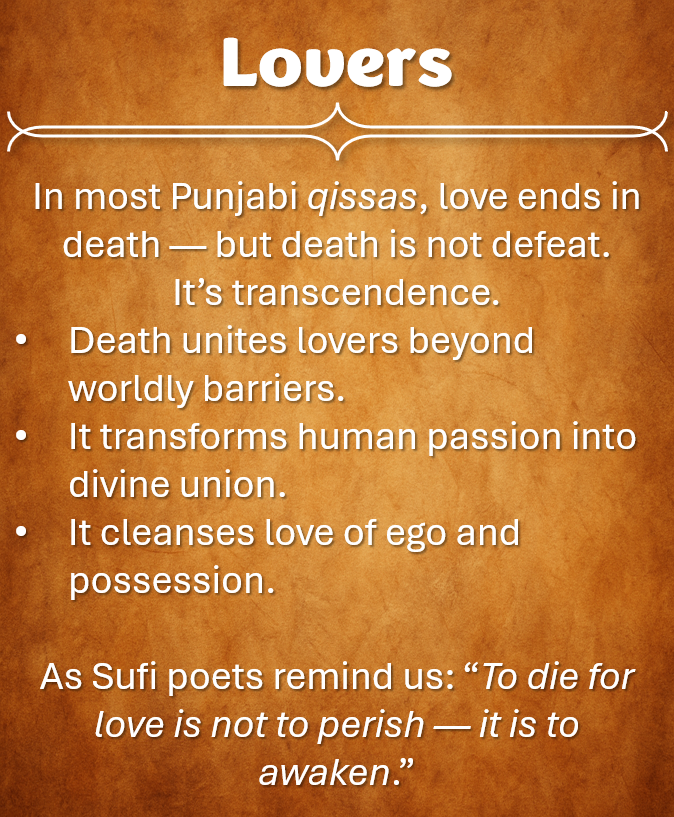
These stories are often labeled tragic, but that word is far too small for what they hold. Tragedy suggests an ending, a failure, a loss that closes the book. Punjabi qissas do something else entirely. Their conclusions are not about death; they are about transformation. What perishes is the body. What survives is meaning.
In each of these tales, love grows larger than the lovers themselves. It refuses to remain private or obedient. It exposes injustice, unsettles rigid hierarchies, mocks false honor, and quietly dissolves the boundary between the human and the divine. Love becomes a force that interrogates society rather than submitting to it.
Heer defies patriarchy, insisting on choice in a world built on control.
Sohni defies fear, stepping again and again into the dark current.
Sahiban defies violence, choosing mercy even when it costs her everything.
Sassi defies mortality, walking beyond the limits of the self altogether.
Each act of defiance carries consequence and yet, it is through these consequences that the stories endure. Their resistance is what gives them immortality. By refusing to conform, they refuse to disappear.
This is the quiet secret of the qissa: love is never defeated. It only sheds one form to take another, from flesh into song, from memory into myth, from story into philosophy. And as long as these tales are sung, love continues to live, untamed and undefeated.
Love as Resistance
In a society where hierarchy, lineage, and honor often dictated the course of a life, these love stories were acts of quiet rebellion. They did not shout or march; they whispered, sang, and endured. Yet in their softness lay their power. Through them, forbidden desires found voice, rigid boundaries were crossed, and obedience was gently but firmly refused.
These stories placed women at their moral center. Heer, Sohni, Sahiban, and Sassi were not passive figures waiting to be claimed; they chose, they acted, they endured consequence. Their loves crossed lines of class, tribe, and geography, insisting that the heart does not recognize social rank. In doing so, the qissas offered a radical idea: that love itself is a form of truth, even when it disrupts order.
Every time a heer singer stood in a village square, he was doing more than entertaining an audience. He was inviting them into a question – one that could not be asked openly in everyday life. As the story unfolded, listeners were forced to confront their own assumptions about duty, honor, and obedience. What if the heart knows something society does not? What if love reveals a deeper justice than law or custom?
That question did not end with the final verse. It lingered in the silence afterward, traveled home with the listeners, and quietly shaped how they saw the world. And it continues to echo today wherever these stories are still sung, and wherever love dares to speak back to power.
Across Time and Border
What is perhaps most remarkable about these qissas is not merely that they endured, but how they endured. When Partition tore Punjab in two in 1947, it fractured land, families, and memory. Borders were drawn with violence and haste, but the stories refused to obey them. Even as people crossed over in fear and grief, they carried these tales with them – not packed in trunks, but held in breath and song.
On one side of the border, Heer Ranjha continued to be sung in Lahore’s gatherings and shrines; on the other, Sohni Mahiwal appeared painted on truck tailgates rumbling through Amritsar and Ludhiana. Mirza Sahiban found new life in films, theater, and ballads produced in both nations – sometimes altered in detail, but never in spirit. Each retelling was a quiet act of preservation, a refusal to let division claim the heart.
In this way, the qissas became the shared inheritance of a divided people. They reminded Punjabis, on both sides, of a time when rivers connected rather than separated, when language flowed freely, and when love stories belonged to everyone. These tales became proof that love speaks a language no border can silence – a language older than nations, deeper than politics, and far more enduring.
Closing Reflection
Every culture has its epics, but Punjab’s are not carved in stone or written in royal chronicles. They are sung n the language of longing, loss, and unyielding hope. They live not in monuments, but in voices that rise and fall, carrying centuries of feeling in a single refrain.
These stories teach us that love, when stripped of possession and pride, becomes the most revolutionary force imaginable. It challenges hierarchy, mocks rigid reason, and dares to place compassion above law. In these qissas, love is not sentimental; it is courageous. It reveals the divine not in heaven, but in human vulnerability.
Even now, centuries later, when someone hums a verse of Heer Ranjha or paints Sohni crossing her river on the back of a truck, they are not merely recalling a legend. They are renewing a promise that no matter how violently the world redraws itself, the heart will still dare to cross forbidden ground.
Because in Punjab, love does not end in silence. It ends in song.
And every song carries the echo of the five rivers.
A few days ago, I met a gentleman who greeted me with the Sikh salutation Sat Sri Akal. We fell into conversation, and he introduced himself as Mr. Anjumul from Lahore. Almost instinctively, our words shifted into Punjabi and Urdu – toward the language, the land, and that shared, unspoken sense of Punjabiyat. In that brief encounter, I found not just a fellow traveler, but a brother of sorts – someone who carried the same quiet longing for a culture remembered more through feeling than geography.
As we spoke, he told me about qissa-khwani, the old profession of storytelling that once flourished across the region. He mentioned that even today, bazaars in cities like Lahore and Peshawar still bear the name Qissa-Khawani Bazaar, living reminders of the professional qissa-khwans who once stood in those streets, gathering people under words, rhythm, and shared memory.
I dedicate this part to him, and to the thousands of others who live far from the land of their birth, yet carry its qissas quietly in their hearts.
Links to the essays in the series:
- Echoes of the Five Rivers: A Journey Through Punjabi Folklore
- Echoes of the Five Rivers, Part 1: The Soul of Punjab and Its Stories
- Echoes of the Five Rivers, Part 2: Themes, Motifs & the Soul of Punjabi Storytelling
- Echoes of the Five Rivers, Part 3: Folk Beliefs, Rituals & the Living Spirit of Punjab
- Echoes of the Five Rivers, Part 4: Folk Music, Songs & the Voice of the Land
- Echoes of the Five Rivers, Part 5: The Qissas – Love, Rebellion, and the Eternal River
- Echoes of the Five Rivers, Part 6: Saints, Seekers & the Soul of Punjab
- Echoes of the Five Rivers, Part 7: Legends of Valor, Justice & the Everyday Hero
- Echoes of the Five Rivers, Part 8: Folklore & Modernity – The Stories That Refuse to Die
- Echoes of the Five Rivers, Part 9: Reflections, Continuity & the River That Remembers
👁️ 1080 views