

Before there were books, there was the dhol.
Before history was written, it was sung.
In Punjab, the story of a people is not carved in stone – it echoes through music. From the fields to the wedding hall, from the shrine to the roadside tea stall, song has always been the truest language of this land. Every verse carries the laughter, grief, and courage of generations. To understand Punjab, you must not just read its stories – you must listen to them.
When Words Learn to Dance
As a child, I never saw stories as separate from songs.
On harvest days, when farmers gathered for lohri, their chants were not mere lyrics – they were living, breathing conversations with the soil. My grandmother sang tappay while kneading dough, my uncle hummed boliyan while fixing the tractor, and traveling dhadi singers would visit villages with tales that thundered like drums.
Every word had rhythm, and every rhythm had a story.
That’s the gift of Punjabi folklore – its refusal to separate the sacred from the joyous, or the profound from the playful. A verse can teach philosophy and still make you dance.
The Musical Landscape of Punjab
Punjabi folk music is not a single tradition but an ocean fed by many rivers – devotional, heroic, romantic, and comic – each flowing from a different human need. Some songs rise from longing, others from resistance; some are meant to heal, others to provoke laughter or courage. Together, they form a soundscape where history, philosophy, and daily life coexist.
Every form of Punjabi folk music is anchored in a specific social moment. Songs were not written to be preserved; they were created to be used, to accompany labor, ritual, celebration, mourning, and protest. Music here is not ornamental; it is functional, communal, and deeply emotional. To sing was to remember, to resist, to survive.
- Heer & Qissa Tradition
The qissa tradition represents the epic heart of Punjabi music. These long narrative ballads, sung rather than read, are sweeping tales of love, separation, injustice, and spiritual awakening. Performed by qissa-khwans and heer singers, they unfold slowly, deliberately, allowing listeners to sink into the emotional current of the story.
The most revered of these is Heer Waris Shah, often called the “Iliad of Punjab.” It is not merely a love story, but a social critique and spiritual meditation. To hear it sung in full can take hours, sometimes days, with breaks only for rest or reflection. Each performance is unique, shaped by the singer’s voice, mood, and audience.
The singer’s voice rises and falls like the Chenab itself – swelling with rebellion, breaking into sorrow, softening into devotion. The rhythm is hypnotic, drawing the listener inward. You don’t simply hear Heer; you inhabit it. The lovers’ pain becomes communal, their defiance personal. In that shared listening, the boundary between storyteller and audience dissolves. - Dhadi & Vaar
Where Heer speaks to the wounded heart, dhadi music calls to courage.
Dhadi jathas, groups of warrior bards, preserve Punjab’s oral history of resistance, valor, and sacrifice. Their songs, known as vaars, recount the lives and battles of Sikh warriors and folk heroes such as Dulla Bhatti and Hari Singh Nalwa. These performances were once as important as written chronicles, especially in times when literacy was limited and memory carried the weight of history.
Accompanied by the sarangi and the sharp, rhythmic beat of the dhadd, dhadi singing is urgent and commanding. The music moves like a charge – fast, emphatic, and unyielding. It is part history lesson, part sermon, part battle cry. The listener is not meant to relax, but to stand taller.
In these songs, heroism is not romanticized; it is earned. Sacrifice is not abstract; it is named. Through vaars, communities remembered who they were and what they stood for; even when power tried to erase them. - Boliyan & Giddha
If the dhadi sings of bravery, boliyan sing of life as it is lived – intimate, playful, sharp-eyed, and deeply human.
Boliyan are short, rhythmic couplets sung during giddha, the traditional women’s dance. They are spontaneous and responsive, often improvised, bouncing from one singer to another. In these verses, women tease in-laws, flirt with lovers, offer advice, complain, laugh, and sometimes rebel, all within the safety of rhythm and community.
They are funny, yes, but they are also incisive. Each boli carries laughter with a sting of truth.
These songs allowed women to voice expectations, frustrations, and desires in a society where direct speech was often constrained. In giddha, folklore becomes agency. Wisdom dances. Truth claps back.
“Sohneya ve mundeya, kam diyan gallan kar,
Maan tenu kudi kehndi, izzat diyan gallan kar.”
(O handsome boy, speak of work and worth,
A mother’s daughter asks for dignity first.)
- Jugni
Ah, Jugni – the wandering firefly spirit – elusive, glowing, impossible to pin down.
Jugni is the wandering firefly spirit of Punjabi folklore, drifting from village to village, observing everything she sees. In song, she comments on love, politics, hypocrisy, devotion, injustice, and God – often with humor sharp enough to sting. A Jugni song can shift effortlessly from satire to spirituality, from laughter to quiet revelation.
She belongs to no one and speaks to everyone. Her verses are deliberately irreverent, poking holes in false piety and empty authority. And yet, beneath the playfulness lies profound moral insight.
In many ways, Jugni is the conscience of the land – appearing briefly, illuminating truth, and moving on. She doesn’t preach. She reveals. And when she leaves, her light lingers just long enough to make you question what you thought you knew.
She roams through the villages, commenting on everything she sees: love, politics, hypocrisy, God. A jugni song is part satire, part philosophy, and entirely Punjabi – irreverent, humorous, and profound.
In many ways, she is the conscience of the land – glowing briefly but leaving her light behind.
The Instruments That Speak
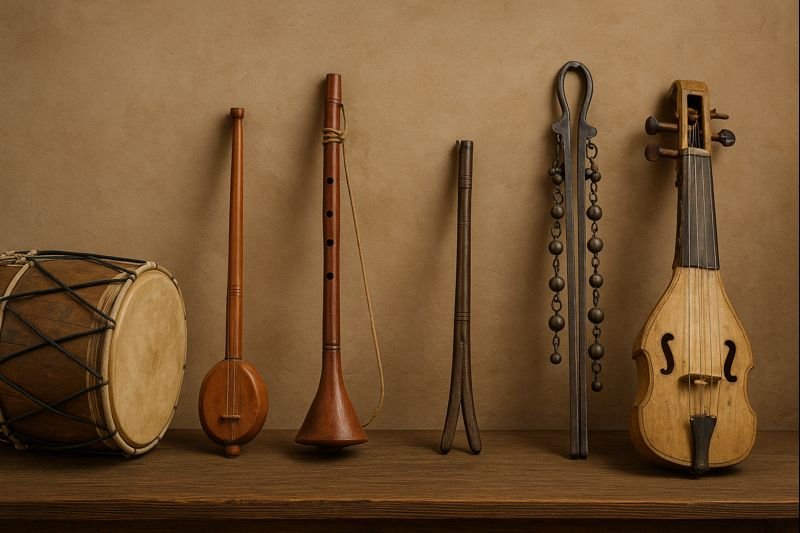
Punjab’s music does not live only in lyrics; it lives in wood, skin, metal, and breath. Each instrument carries a personality of its own, shaped by the land and the lives of the people who played it. Long before amplification and recording, these instruments were the voices that filled courtyards, fields, and battle grounds. They did not accompany the story – they told it.
- Dhol:
The dhol is the heartbeat of Punjab. Its deep, resonant beats do more than mark rhythm; they command the body to move. When a dhol begins, feet respond instinctively, joy becomes physical. Played at harvests, weddings, victories, and festivals, the dhol announces collective celebration. Its sound carries across open fields, calling people together, reminding them that joy is meant to be shared. In its thunder is confidence, pride, and an uncontainable love for life. - Tumbi:
In contrast, the tumbi is playful, sharp, and mischievous. A single-string instrument, it seems impossibly simple, yet its bright, twanging sound cuts through everything. The tumbi laughs, teases, and flirts. It belongs to the storyteller who wants to provoke, to the singer who wants to wink at the audience. In modern times, it became the unmistakable signature of Punjabi pop, but its soul remains rooted in folk tradition – bold, fearless, and unapologetically alive. - Algoza:
The algoza is made of two flutes played together, often by a single musician. One pipe carries the melody, the other the drone or harmony, creating a conversation between two voices that breathe as one. Traditionally played by shepherds and travelers, the algoza feels intimate and meditative. Its sound is open and wandering, like long afternoons spent watching clouds drift. Many describe it as two lovers speaking without words – gentle, responsive, inseparable. - Chimta:
Originally a humble household tool used to lift bread from fire, the chimta found a second life as an instrument of rhythm and celebration. Struck together, often with small jingling rings attached, it adds sparkle and energy to folk performances. The chimta embodies a core truth of Punjabi folklore: anything can become music if touched with joy. What once served survival now serves celebration; utility transformed into expression. - Sarangi:
Then there is the sarangi; perhaps the most emotionally expressive of them all. Used by dhadis and qissa-khwans, the sarangi does not simply accompany the voice; it mirrors it. Its strings can cry, plead, sigh, and tremble. In epic ballads like Heer, the sarangi becomes a second narrator, carrying sorrow where words fall short. Its sound lingers long after the song ends, heavy with memory and feeling.
Together, these instruments translate emotion into vibration. Even without understanding the language, you can feel what they mean – joy in the dhol, mischief in the tumbi, longing in the algoza, celebration in the chimta, and grief in the sarangi.
In Punjab, music doesn’t need explanation. It speaks directly to the body and the heart.
The Women Who Carried the Songs
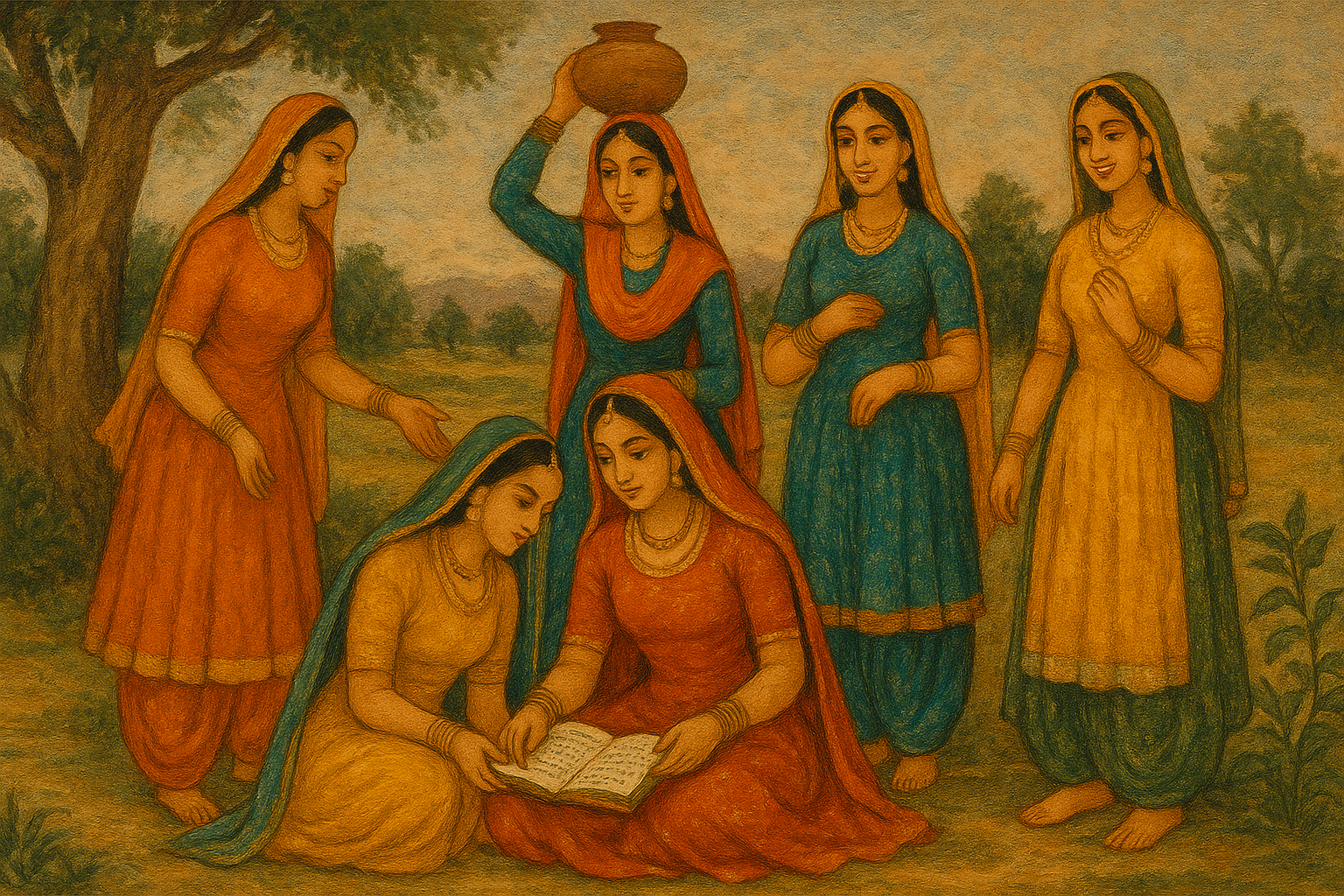
While much of Punjabi music is performed publicly by men, its deepest veins were preserved by women. In courtyards and kitchens, women’s songs – suhag, gidda, jindua, tappe – carried emotions that history rarely recorded.
They sang of longing for husbands away at war, of the pain of leaving one’s home after marriage, of motherly wisdom and unspoken rebellion.
Theirs were songs of endurance and through their repetition, folklore survived every generation’s silence.
When I hear those melodies now, I realize that women weren’t just the custodians of tradition – they were its heartbeat.
Performance as Preservation
In a land shaped by centuries of oral tradition, singing was never an accessory to storytelling – it was the archive. Long before books were common or histories written down, stories survived because they were performed. The qissa and the vaar were not meant to be read silently or consumed alone; they were meant to be voiced aloud, to gather people beneath one sky, to be shared in breath and sound.
A performance transformed space. A village square, a shrine courtyard, or the edge of a field became a temporary sanctuary of memory. People didn’t just arrive to listen; they came to participate, to nod, to sigh, to murmur recognition. Children sat cross-legged at the front, elders leaned on walking sticks, and the story unfolded in real time, shaped by the mood of the crowd and the cadence of the night.
The singer was never merely an entertainer. They were a teacher carrying moral instruction, a historian safeguarding collective memory, and a philosopher posing questions about love, justice, and faith. Through pauses and inflection, through repetition and improvisation, they guided listeners toward reflection as much as emotion. Every performance was an act of interpretation and therefore renewal.
In this way, performance became preservation. Each retelling allowed stories to adapt without being lost, to bend without breaking. The core remained, even as the edges softened or sharpened with each generation. Memory here was not static; it was alive, responsive, communal.
That is why Punjabi folk performances continue to draw people together today at village melas, at Sufi shrines, and across the diaspora in places like Canada and the UK. The settings may have changed, the accents may sound different, and microphones may replace lanterns, but the impulse remains unchanged: to gather, to listen, to feel, and to remember together.
When a Heer is sung in Toronto or a vaar performed in Birmingham, it is not nostalgia at work; it is continuity. It is a reaffirmation that these stories still matter, that identity survives through voice, and that as long as someone sings, the past remains present.
From the Fields to the World Stage
What began as a folk rhythm rooted in the soil has grown into a global identity. Bhangra, once danced in open fields to celebrate a successful harvest, now fills stadiums and university halls from Vancouver to Birmingham. Its high kicks and pounding beats travel easily across borders, but they never lose their origin – a people giving thanks for survival, for labor completed, for another season endured.
Beneath the colorful stage lights, the amplified sound systems, and the endless remixes, the pulse remains unchanged. Bhangra is still about collective joy – the release of exhaustion through movement, the affirmation that work has meaning, and the refusal to let hardship silence celebration. What the world sees as performance was once, and still is, a form of gratitude.
Even contemporary Punjabi artists carry this inheritance forward. Singers like Surinder Kaur, whose voice defined an era of folk expression, Gurdas Maan, who bridged village storytelling with modern sensibility, and Harbhajan Mann, who brought folk emotion to a cinematic generation, all trace their creative roots to these traditions. Their music may sound modern, but its emotional grammar remains ancient. Love is still tender, longing still aches, laughter still disarms, and loss still teaches.
The instruments may have microphones now, and the stages may be larger, but the stories are still sung in the same key – hope.
Why the Songs Still Matter
Because sound remembers what words forget.
Even when stories blur and details fade, melodies linger in the body. They settle into muscle memory, into breath and heartbeat. Long after the language shifts or the context is lost, the tune remains an emotional archive carried forward without needing translation.
When I hear the dhol echo across a festival ground, something ancient stirs – not nostalgia, but recognition. The response is instinctive, almost physical. Before thought catches up, the foot taps, the spine straightens, the chest opens. It feels less like remembering something learned and more like recalling something known. As if the land itself is speaking, gently but firmly: you come from rhythm, not silence.
These songs teach us that art was never a luxury in Punjab. It was necessity. Music was how people carried history when books were scarce, humor when life was hard, and heartbreak when words were too heavy to hold alone. It was how joy survived famine, how grief found release, how identity endured upheaval.
In that sense, every folk song is an act of resilience. A way of saying: we are still here, we still sing, and as long as the rhythm continues, so do we.
Closing Reflection
Music is how Punjab remembers itself.
Through melody, laughter, and lament, it keeps its stories alive – not in museums, but in mouths and hands and hearts.
Every folk song is a kind of defiance – against forgetting, against silence, against despair.
And when the dhol beats, when the voices rise in unison, you can almost hear the five rivers flowing again – carrying stories of the past into the open arms of the present.
Because here, in this land, folklore does not end with the telling.
It ends in a song – and every song is a promise that the story will live again tomorrow.
Links to the essays in the series:
- Echoes of the Five Rivers: A Journey Through Punjabi Folklore
- Echoes of the Five Rivers, Part 1: The Soul of Punjab and Its Stories
- Echoes of the Five Rivers, Part 2: Themes, Motifs & the Soul of Punjabi Storytelling
- Echoes of the Five Rivers, Part 3: Folk Beliefs, Rituals & the Living Spirit of Punjab
- Echoes of the Five Rivers, Part 4: Folk Music, Songs & the Voice of the Land
- Echoes of the Five Rivers, Part 5: The Qissas – Love, Rebellion, and the Eternal River
- Echoes of the Five Rivers, Part 6: Saints, Seekers & the Soul of Punjab
- Echoes of the Five Rivers, Part 7: Legends of Valor, Justice & the Everyday Hero
- Echoes of the Five Rivers, Part 8: Folklore & Modernity – The Stories That Refuse to Die
- Echoes of the Five Rivers, Part 9: Reflections, Continuity & the River That Remembers
👁️ 1122 views