

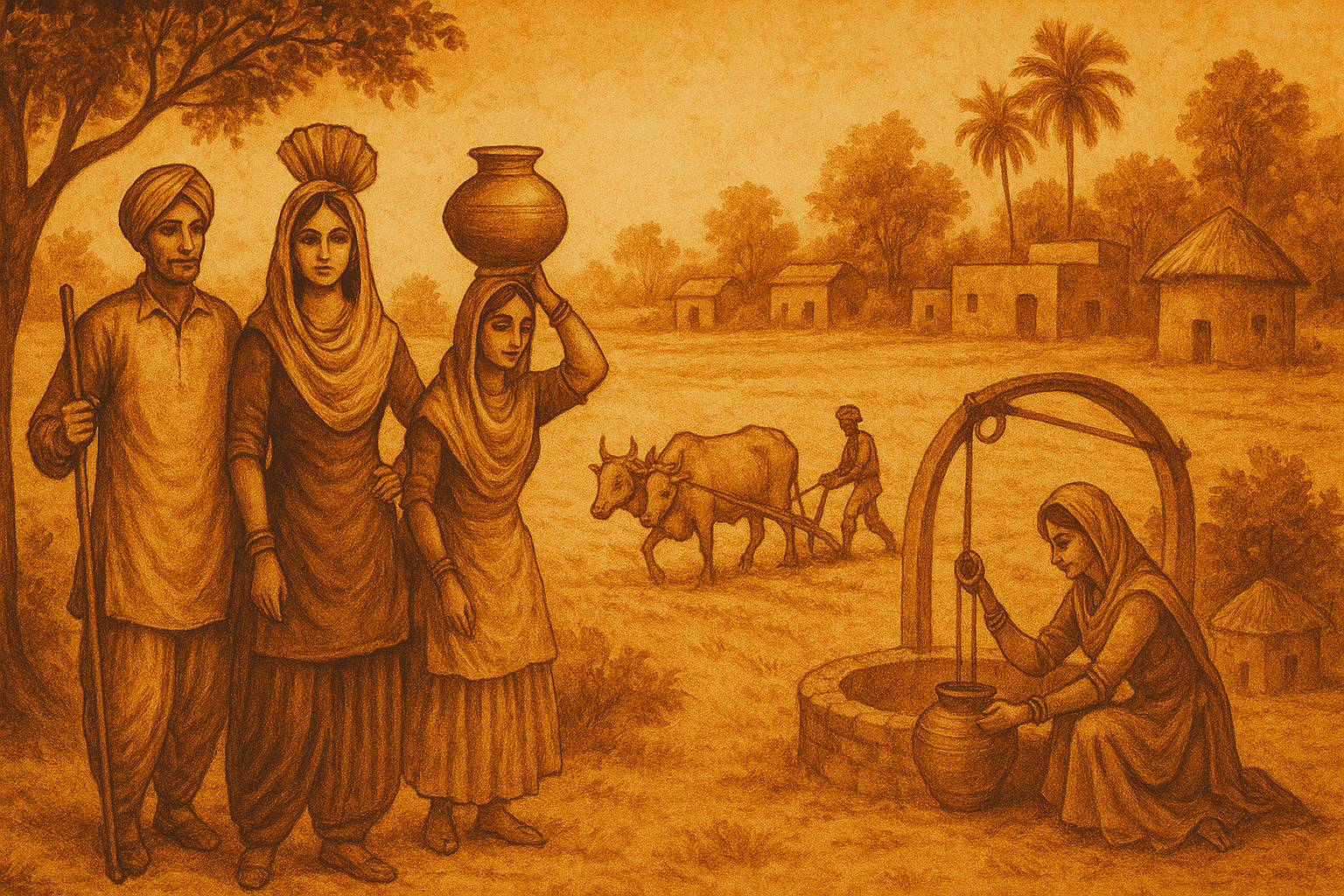
Every folklore tradition hides a heartbeat – a rhythm that carries the collective dreams, fears, and wisdom of its people.
In Punjab, that heartbeat is unmistakable: earthy, vibrant, and full of longing.
If Part 1 of this series was about where the stories live, this one is about what they carry inside them.
The Story Beneath the Story
When I was younger, I used to think Heer Ranjha was simply a tragic love story – two lovers separated by society and fate. It took years, and many re-tellings, to realize that the story was never only about love. It was about rebellion, spirituality, and the eternal human search for freedom. Heer’s defiance against her family and Ranjha’s renunciation of the world are as much acts of devotion as they are of love.
That is the essence of Punjabi storytelling – every tale wears many faces. A fable about a talking sparrow might secretly be about wit over power. A song about a ploughman may hide a prayer for rain. Folklore has always been Punjab’s way of saying profound things in simple words.
Love and Defiance
Love is the central pulse of Punjabi folklore, but not the quiet, obedient kind. It is fierce, impatient, and often doomed – because true love here is an act of resistance.
Heer and Ranjha, Sohni and Mahiwal, Mirza and Sahiban – they all choose love over law. In doing so, they challenge authority, caste, and social custom. Their stories endure not because they end tragically, but because they dignify defiance.
Perhaps that’s why these tales are still told: they remind us that love, in Punjab’s imagination, is not just emotion – it’s courage.
Sacrifice and Honor
If love is the emotion of these stories, honor (izzat) is their backbone. From the smallest proverb to the longest qissa, you’ll find the constant tension between personal desire and family reputation. Sahiban’s hesitation before drawing her bow against her brothers, or Sohni’s fatal leap into the river to meet her lover, both emerge from this conflict between duty and heart.
These moments of sacrifice – where a character chooses love, truth, or honor even at great cost – are what make Punjabi tales morally resonant. The lesson is rarely about winning. It’s about staying true, even when the world burns.
Nature as Witness
Few regions in the world have loved their landscape as passionately as Punjab has.
The land is not background – it is character. Rivers weep and conspire. Winds carry secrets. The fields themselves seem to whisper songs of yearning.
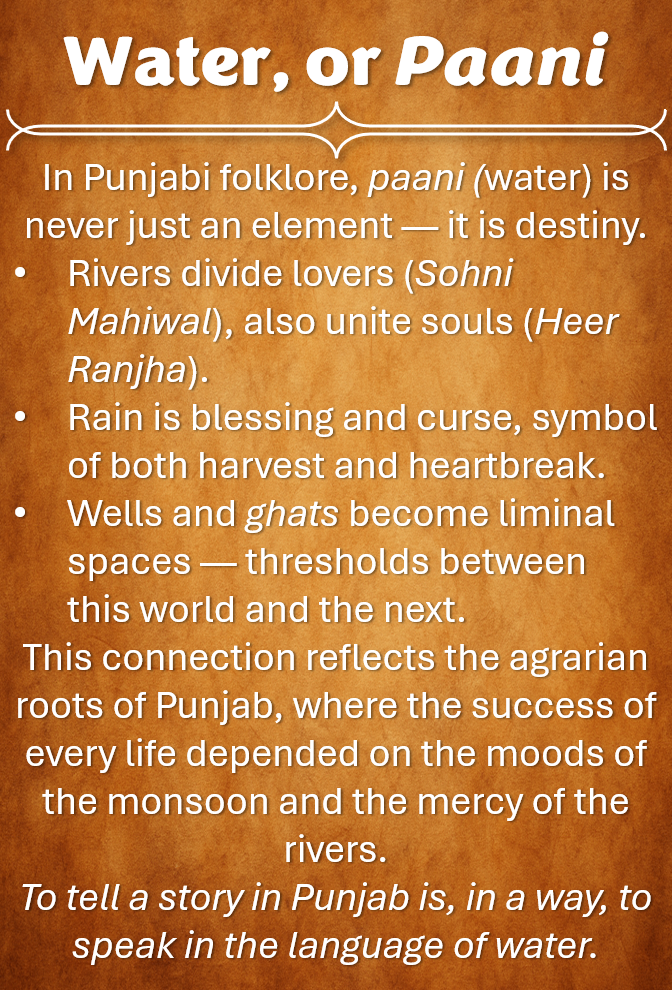
The five rivers – Ravi, Beas, Chenab, Sutlej, Jhelum – appear again and again as living forces in stories. They separate lovers, test pilgrims, and deliver justice. The river in Sohni Mahiwal is both her path to love and her final grave. In Heer Ranjha, the Chenab becomes a silent witness to destiny.
It is almost as if nature, in Punjabi lore, holds memory longer than humans do – carrying echoes of every song sung upon its banks.
Tricksters and Wit
Not all folklore is solemn. Punjabis have an irrepressible love for humor – sharp, earthy, and quick. The clever farmer who fools a greedy landlord, the witty woman who outsmarts her husband, the crow who steals from the lion – these stories form a counterbalance to the grand tragedies.
They remind us that wisdom doesn’t always wear a scholar’s robe. Sometimes it comes from the village fool, the servant, or the child who asks an inconvenient question.
Through laughter, these tales celebrate the intelligence of the underdog – a recurring motif in Punjab’s moral universe.
Fate and Faith
At the heart of many Punjabi stories lies a paradox: humans struggle against destiny, yet surrender to divine will.
The region’s folklore absorbed centuries of Sufi and Bhakti influence, blending spiritual resignation with personal agency. Love becomes prayer; separation becomes a test of devotion.
Ranjha’s journey to become a jogi (ascetic) is not an escape – it’s an awakening. His flute, once a symbol of passion, becomes a call to the divine. Heer’s love becomes a metaphor for the soul’s yearning for union with God.
In this sense, Punjabi folklore turns the personal into the cosmic. Each heartbreak is also a hint of enlightenment.
Women as Moral Compass
One of the most striking features of Punjabi folklore is its portrayal of women – not as passive victims, but as emotional and moral anchors.
Heer, Sohni, and Sahiban are remembered not only for their beauty but for their strength and will. Even in smaller village tales, it is often the grandmother, mother, or sister who restores balance to chaos.
There’s an unspoken reverence in these stories: that women carry wisdom the world often ignores. Through them, the storytellers reveal their deepest understanding – that compassion and courage, not power, hold societies together.
The Rhythm of the People
Punjabi tales are inseparable from sound. You don’t just read them; you hear them.
The cadence of a boli, the repetition in a tappa, or the chorus of a harvest song gives each story its pulse.
These rhythms mirror the life of the people – the sowing of seeds, the turning of seasons, the rise and fall of hope.
Even the moral lessons arrive in rhyme, making them easy to remember and impossible to forget. It’s how oral wisdom has survived across centuries of illiteracy and upheaval – through melody.
Why These Themes Endure
Because they are us.
Every Punjabi has lived some version of these stories – love that defied reason, loss that demanded dignity, laughter that softened hardship, faith that survived doubt.
Folklore has lasted not because it was written down, but because it was lived again and again.
A mother still hums Jugni while working in the kitchen. A farmer still quotes an old proverb about patience. A wedding singer still teases the groom with ancient verses.
Each act, however small, is a quiet continuation of a thousand-year conversation.
Closing Reflection
In the end, the themes of Punjabi folklore are not ancient – they are eternal.
They ask questions that still haunt us:
What is worth defying for? What is the price of dignity? Where does love end and faith begin?
Perhaps that’s why these stories still find us, no matter how far we travel.
Because beneath all our modern noise, we are still people of stories – carrying the same hunger for meaning that our ancestors once sang to the stars.
And when we listen closely enough, we can still hear them – the echoes of the five rivers, whispering that every heart, no matter how far it wanders, longs to return to the tale it was born into.
Links to the essays in the series:
- Echoes of the Five Rivers: A Journey Through Punjabi Folklore
- Echoes of the Five Rivers, Part 1: The Soul of Punjab and Its Stories
- Echoes of the Five Rivers, Part 2: Themes, Motifs & the Soul of Punjabi Storytelling
- Echoes of the Five Rivers, Part 3: Folk Beliefs, Rituals & the Living Spirit of Punjab
- Echoes of the Five Rivers, Part 4: Folk Music, Songs & the Voice of the Land
- Echoes of the Five Rivers, Part 5: The Qissas – Love, Rebellion, and the Eternal River
- Echoes of the Five Rivers, Part 6: Saints, Seekers & the Soul of Punjab
- Echoes of the Five Rivers, Part 7: Legends of Valor, Justice & the Everyday Hero
- Echoes of the Five Rivers, Part 8: Folklore & Modernity – The Stories That Refuse to Die
- Echoes of the Five Rivers, Part 9: Reflections, Continuity & the River That Remembers
👁️ 1092 views
1 Comment on “Echoes of the Five Rivers, Part 2: Themes, Motifs & the Soul of Punjabi Storytelling”
Deep. Like those rivers.